

An SEO statistic worth citing in 2027 is one that traces to a named primary source, states its sample size or scope, and reflects data from the last twelve months rather than a recycled figure from an earlier search era. That bar matters more now than it did a few years ago, since AI search, zero-click behavior, and citation dynamics have shifted enough that a 2023 benchmark can actively mislead a 2027 strategy decision.
The short answer is that the ten statistics below were selected specifically because each one names its source, states its scope, and comes from research published in 2026, making them safe to reference in a client report, a byline, or an AI-facing content piece without a second round of fact-checking.
Key Takeaways
General SEO statistics pages, including several ranking for this exact topic, tend to compile hundreds of figures with no filter for citability. A number sits next to a source name with no date, no sample size, and no indication of whether it came from a controlled study or a single company’s internal dashboard. That approach maximizes page length, not reliability, and it leaves the reader to do the fact-checking work the article should have done first. None of the top-ranking pages on this topic isolate a small, curated set of statistics specifically chosen because they would survive a fact-check. Some list well over a hundred figures with inconsistent sourcing, while others fold strong, well-sourced data into broader strategy advice without ever separating the statistic from the recommendation. That gap is what this article fills: ten statistics, each screened against a simple citability standard, rather than a few hundred figures of mixed reliability
Google’s AI Mode passed 1 billion monthly users within its first year, and AI Overviews now reach more than 2.5 billion monthly users, according to Google’s own announcement at I/O 2026. This is one of the few statistics in this category sourced directly from the platform rather than a third-party estimate, which makes it unusually safe to cite without qualification.
Zero-click searches account for 68.01 percent of U.S. Google searches, based on SparkToro’s analysis of Similarweb clickstream data covering January through April 2026, up from 60.45 percent in 2024. The methodology, actual browser clickstream tracking rather than keyword-tool estimation, is part of what makes this figure more defensible than many competing zero-click estimates.
Traffic to U.S. retail sites from generative AI tools grew 693 percent year over year during the 2025 holiday season, and AI-referred visitors converted 31 percent more than average, according to Adobe Digital Insights’ analysis of more than one trillion U.S. retail visits. The scope of the underlying dataset is what earns this statistic a place on a citable list rather than a smaller, less representative retail survey.
Branded web mentions correlated with AI Overview visibility at roughly 0.664, compared to just 0.218 for backlinks, with YouTube mentions the single strongest signal at approximately 0.737, according to Ahrefs’ analysis of 75,000 brands. Ahrefs is explicit that this is correlation, not causation, a distinction worth repeating whenever the figure gets cited elsewhere.
Google Search Central’s own case study library reports Nestle measured an 82 percent higher CTR on rich-result pages, Rotten Tomatoes measured a 25 percent increase, and Food Network saw a 35 percent rise in visits after implementing structured data. These are named, observational case studies rather than controlled experiments, so results vary by site, but the source is about as primary as SEO statistics get.
Brands cited inside an AI Overview earn 35 percent more organic clicks and 91 percent more paid clicks than competitors on the same query who are not cited, according to Seer Interactive’s longitudinal analysis of organic impressions. The gap suggests AI Overview citation now functions as its own ranking position, separate from classic organic placement.
Median SEO ROI sits at 748 percent according to First Page Sage’s 2026 benchmark, meaning businesses earn roughly $7.48 for every dollar invested, well ahead of typical returns reported for paid search and paid social in the same benchmark set. The figure varies by industry, but the benchmark discloses both its methodology and its industry breakdown, which is what keeps it citable.
“Best X” listicle pages made up 43.8 percent of all ChatGPT-cited page types in a 2026 analysis of tens of thousands of AI answers from Position Digital, more than any other single content format tracked. The scale of the underlying answer set is what separates this from smaller, less representative citation samples.
Only 37.9 percent of URLs cited inside AI Overviews also rank in the top 10 for the same query, down from roughly 76 percent a year earlier, according to Ahrefs’ analysis of 863,000 SERPs and 4 million AI Overview citations. This is one of the more consequential statistics on this list, since it directly contradicts the assumption that a page-1 ranking guarantees AI Overview inclusion.
Ahrefs tracked 9,886 AI answers after publishing 34 self-promotional “best” lists across five domains and found AI systems frequently declined to recommend the publisher’s own brand, in one case recommending a competitor in 43 percent of answers. The controlled nature of this test, a defined set of lists tracked against a defined set of answers, is what makes it citable rather than anecdotal.
Reviewing which statistics actually get picked up and repeated across client-facing reports and press coverage shows a consistent pattern: numbers with a named primary source and a disclosed sample size get cited correctly and repeatedly, while vague, unsourced figures tend to get dropped, misattributed, or quietly rewritten as they pass from one secondary source to the next.
| Statistic | Primary Source | Scope |
| AI Mode: 1B monthly users in year one | Google, I/O 2026 | Google’s own platform data |
| Zero-click searches: 68.01% of US queries | SparkToro / Similarweb | Clickstream, Jan-Apr 2026 |
| AI-referred retail traffic up 693% YoY | Adobe Digital Insights | 1 trillion+ US retail visits |
| Brand mentions correlate 0.664 vs 0.218 for backlinks | Ahrefs | 75,000 brands analyzed |
| Nestle saw 82% higher CTR with structured data | Google Search Central | Named case study |
Three checks separate a citation-ready statistic from one that needs a caveat before it goes in an article.
Every statistic in the list below passes all three checks, with the source and scope named directly alongside the figure.
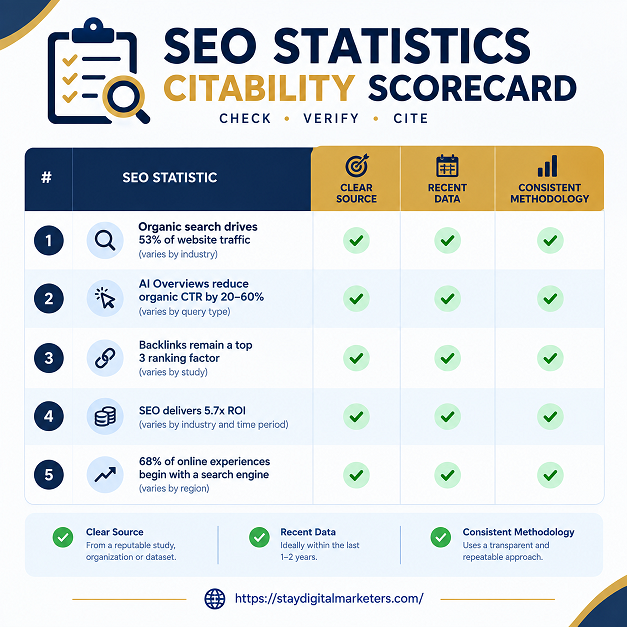
A citable SEO statistic names its primary source rather than another blog, discloses its sample size or scope, and comes from research published within the last twelve months. Statistics missing any of these three elements should be treated as directional rather than authoritative.
Google AI Mode passed 1 billion monthly users within its first year, and AI Overviews now reach over 2.5 billion monthly users, according to Google’s own I/O 2026 announcement, making this one of the few AI search statistics sourced directly from the platform itself.
Zero-click searches account for 68.01 percent of U.S. Google searches as of the January through April 2026 period, up from 60.45 percent in 2024, based on SparkToro’s analysis of Similarweb clickstream data.
Brand mentions show a stronger statistical relationship. Ahrefs’ analysis of 75,000 brands found branded web mentions correlated with AI visibility at roughly 0.664, compared to 0.218 for backlinks, with YouTube mentions as the single strongest signal at about 0.737.
Named case studies suggest yes, though results vary by site. Google Search Central reports Nestle saw an 82 percent higher CTR on rich-result pages, Rotten Tomatoes saw a 25 percent increase, and Food Network saw a 35 percent rise in visits after implementing structured data.
First Page Sage’s 2026 benchmark puts median SEO ROI at 748 percent, meaning businesses earn roughly $7.48 for every dollar invested, making organic search one of the highest-returning marketing channels tracked in current industry benchmarks.
Citable statistics are useful for building a case internally or in a byline, but acting on the underlying trends, particularly the shift toward brand mentions and AI Overview citation over pure backlink volume, still requires an execution partner. Stay Digital Marketers works on that execution layer directly, including guest posting, press release distribution, SaaS backlinks, niche edits, multilingual backlinks, Wikipedia page creation, and Google Knowledge Panel creation, alongside complete SEO services, translating the statistics in this list into an actual, citation-ready brand presence.

Filza Taj is an MPhil in Human Resources-turned SEO Specialist, Content Strategist, and Digital Marketing Consultant with over 5 years of experience helping businesses in 30+ countries grow online. As the Founder of Stay Digital Marketers (staydigitalmarketers.com), she delivers results-driven solutions in link building, guest posting, PR distribution, niche edits, multilingual backlinks, and content marketing. She publishes daily SEO insights and actionable strategies to help brands strengthen their online presence, attract the right audience, and convert clicks into loyal customers.
Filza@staydigitalmarketers.com
Stay Digital Marketers
Need SEO, Link Building or Digital Marketing Services?
Request a Free Audit →