Call or WhatsApp us anytime
Mail Us For Support

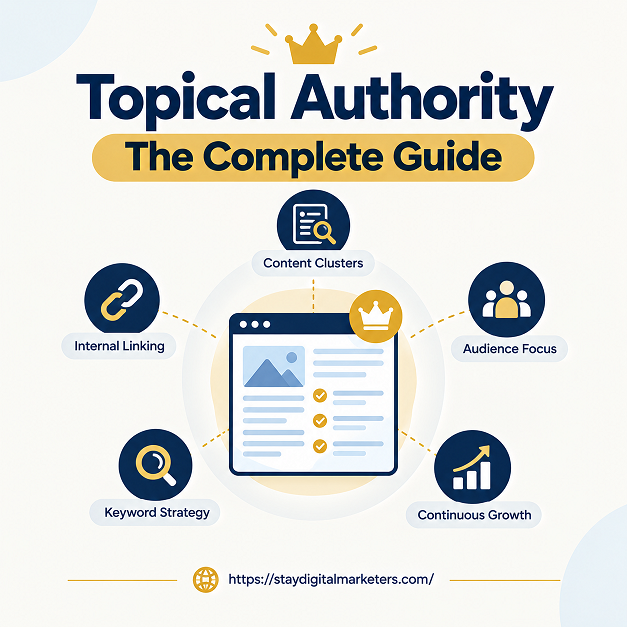
Topical authority is the level of trust a search engine places in a site as a complete, reliable source on one subject. It is built by covering a topic and its related subtopics in depth across many connected pages, not by ranking a single page.
The concept ties together several entities: pillar pages, topic clusters, internal links, entities in the Knowledge Graph, search intent, and E-E-A-T. Search Engine Land’s guide describes it as trust in a site to cover a subject and its subtopics fully. Domain authority, by contrast, is a third-party score tied mostly to backlinks.
Key Takeaways
Google has not documented a metric by that name. Gary Illyes said in October 2016 that Google doesn’t “really have overall domain authority.” In November 2023, Search Engine Journal reported that John Mueller answered “Don’t worry about it” in a Reddit thread on the term, after agreeing with a commenter who called it a relabel of relevancy. That reply was informal, not formal documentation.
The 2024 Content Warehouse leak complicates the picture. The documents held 2,596 modules and 14,014 attributes, and Google confirmed on May 29, 2024 that they were authentic. Google also said, “We would caution against making inaccurate assumptions about Search.” Per Wikipedia’s summary, two attributes, siteFocusScore and siteRadius, measure a site’s topical coherence and how far pages drift from its main topic.
An attribute’s existence does not show its weight, or even that it is used in ranking. That distinction is where most guides go wrong.
I reviewed three of the four pages in the brief. The LinkedIn guide blocked automated access, so it is not part of this comparison.
The shared gap is evidence handling. None of them separates what Google has said from what is inferred, and none show how to check whether the work paid off. This guide fills that gap with an evidence table and a verification step.
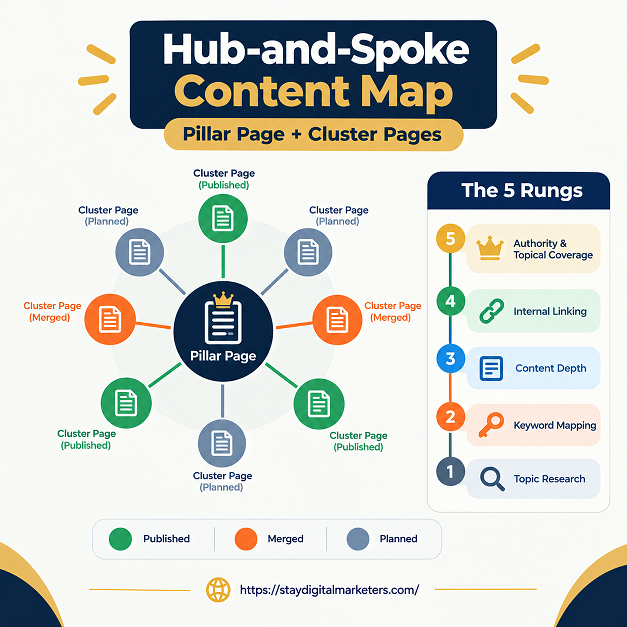
The Topic Proof Ladder is a five-rung process that builds coverage and checks, at each rung, whether evidence supports the next move.
Observed across client work, sites that stall rarely lack pages. They have several near-identical pages competing for one query, which blurs which URL deserves to rank. Merging them and fixing internal links often does more than publishing a tenth article on the same angle.
Coverage and external references tend to work as a pair. Observed across client work, a well-built cluster with no outside citations often sits behind competitors with fewer pages but stronger references. Links do not replace coverage, but a complete cluster with no outside validation is harder to prove.
No official metric exists, so measure proxies at the cluster level, not the page level. Take a baseline before publishing, then track the same set of queries monthly.
In practice, teams that record a baseline can answer whether the work helped. Teams that skip it end up arguing from impressions about a single page. Even a clean upward trend shows correlation, not proof that topical authority was the cause.
This table separates the evidence behind four common claims so you can decide how far to trust each one.
| Claim | Evidence level | Source | How to treat it |
| Google has no overall domain authority score | Stated by Google | Gary Illyes, October 2016 | Do not use DA or DR as ranking targets |
| Topical authority is a Google metric | Not documented | Mueller: “Don’t worry about it,” November 2023 | Use it as a planning framework |
| Google stores site focus and drift data | Reported from leak | 14,014 attributes; Google urged caution | Stay on topic; weight is unknown |
| Topic hubs earn links and traffic | Observed examples | Ahrefs estimates for Zapier and Drift hubs | Treat as examples, not guarantees |
Yes, and Ahrefs data shows why. In its content hub study, Zapier’s remote work hub was linked from over 1,000 websites yet drew about 1,100 estimated monthly organic visits. Drift’s chatbot hub had over 500 links and about 6,400 estimated visits. Both are Ahrefs estimates from a 2020 article with no measurement date.
More links did not mean more traffic. Search demand and intent fit shaped the result as much as hub quality. Choose a topic with real query volume before you invest in depth.
In a Semrush study of 200,000 US keywords that triggered an AI Overview, 80% of desktop and 76% of mobile keywords were informational. The data was collected in September 2024 and published in July 2025. Informational coverage is where AI answers appear.
That supports complete, well-structured coverage. It does not show that AI systems score topical authority. Use clear definitions, direct answers under question headings, and tables so your pages are easy to extract.
Topical authority is how much a search engine trusts a site as a complete source on one subject. It comes from covering a topic and its subtopics in depth across connected pages. Google does not publish a topical authority score, so it is a practitioner framework, not an official metric.
Google has not documented one. John Mueller replied “Don’t worry about it” in a 2023 Reddit thread on the term. Leaked documents list site focus and radius attributes, but Google cautioned against inaccurate assumptions about them. Treat topical authority as a way to organize quality content, not a confirmed signal.
Domain authority is a third-party score, usually driven by backlinks, and Gary Illyes said in 2016 that Google doesn’t really have overall domain authority. Topical authority describes depth of coverage on one subject. A small site can score low on the first and still build the second.
No fixed number exists. Rankmax says its method researches thousands of keywords and uses pillar pages of 3,000 to 5,000 words, but it publishes no controlled evidence. Cover the questions your niche actually asks, then compare your coverage with ranking competitors instead of targeting a page count.
No tool measures it directly. Record a baseline in Google Search Console, then track impressions, ranking pages, and top 10 share for the queries in one cluster. Rising numbers across the cluster suggest progress, but they show correlation, not proof that topical authority caused the gain.
Probably indirectly. A Semrush study found 80% of desktop and 76% of mobile AI Overview keywords were informational, so complete informational coverage fits where AI answers appear. No source confirms that AI toolsscore topical authority, so focus on clear definitions, direct answers, and tables.
Topical coverage earns trust on your own site, while external references confirm it elsewhere. Stay Digital Marketers assists brands with backlink-related services, including guest posting, press release distribution, SaaS backlinks, niche edits, multilingual backlinks, Wikipedia page creation, Google Knowledge Panel creation, and complete SEO services.
Sources were read on October 12, 2026. Google has published no topical authority score, so each claim below is labeled by how well it is supported

Filza Taj is an MPhil in Human Resources-turned SEO Specialist, Content Strategist, and Digital Marketing Consultant with over 5 years of experience helping businesses in 30+ countries grow online. As the Founder of Stay Digital Marketers (staydigitalmarketers.com), she delivers results-driven solutions in link building, guest posting, PR distribution, niche edits, multilingual backlinks, and content marketing. She publishes daily SEO insights and actionable strategies to help brands strengthen their online presence, attract the right audience, and convert clicks into loyal customers.
Filza@staydigitalmarketers.com
Stay Digital Marketers
Need SEO, Link Building or Digital Marketing Services?
Request a Free Audit →