Call or WhatsApp us anytime
Mail Us For Support

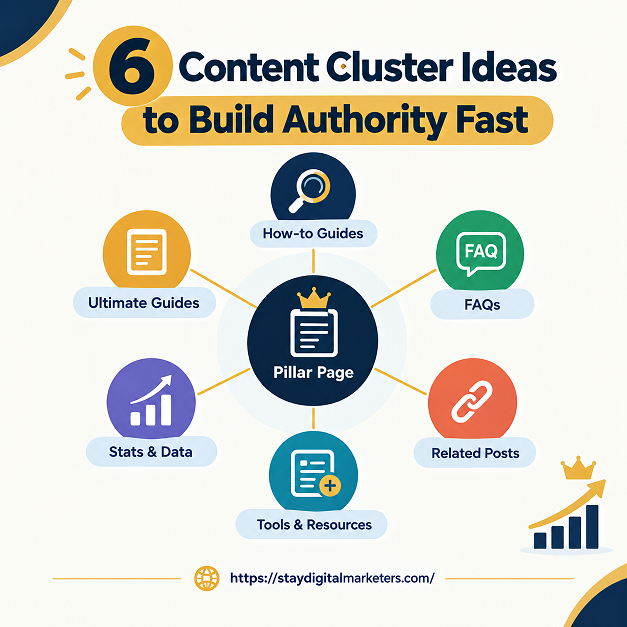
A content cluster is a group of pages on one subject: a pillar page that gives the overview and supporting pages that each answer one narrower question. Internal links connect every page, so readers and crawlers can see how the subject fits together.
Related entities include topical authority, search intent, internal links, anchor text, keyword cannibalization, and Google Search Console. Google has not documented a cluster ranking factor, and Gary Illyes said in 2016 that Google doesn’t “really have overall domain authority.” Clusters are an organizing method that supports quality signals, not a switch you can flip.
Key Takeaways
I reviewed three of the four pages in the brief. Moz blocked automated access, so it is not part of this comparison.
The shared gap is selection. All three explain how to build a cluster, but none helps you decide which kind of cluster fits your site, your proof, and your audience. They also offer no outcome evidence. This guide fills that gap with a three-question test and six cluster types matched to it.
The Cluster Fit Test scores a cluster idea on three questions, from 0 to 2 each. Build the idea with the highest total first.
Observed across client work, clusters stall when the topic scores high on demand but zero on proof. The pages end up as summaries of pages that already rank, and nothing gives a reader or an editor a reason to choose them.
Pick one painful problem and publish a pillar on solving it, with spokes for each cause, fix, and mistake. Intent is clear, so the pages are easy to scope. Your own fixes, failed attempts, and screenshots supply the proof that summary pages lack. Fit Test strength: demand and proof.
Build a pillar on choosing between options, with spokes for each pairing and each alternative list. Readers searching these terms are close to a decision. Be careful with bias: the Clustea guide ranks its own product first, and readers notice. State how you tested and disclose any interest.
Create short, precise definition pages for the entities in your field and link them to a central guide. A Semrush study of 200,000 US keywords that triggered an AI Overview found that 80% of desktop and 76% of mobile keywords were informational. The data was collected in September 2024. Definition pages match the type of query where AI answers appear.
Run a small survey or analysis, publish the findings as the pillar, and break each finding into its own spoke. This scores highest on Proof and Pull because no competitor holds the same numbers. Keep the method visible, since a statistic with no method gets ignored. Even a small sample is useful if you state its size, date, and limits plainly.
Take one product or service and write a spoke for each vertical it serves. Surfer’s example, Signaturely, does this with contract templates for real estate, finance, and healthcare. Each page can carry examples that fit its audience, which keeps the spokes from reading as copies. If two vertical pages could swap their examples without anyone noticing, merge them.
Order the spokes from beginner to advanced, then link each page to the next step. BrainStation uses this model for career guides, according to Surfer. In practice, a clear path also reduces keyword cannibalization because each page has a defined stage and audience.
The table shows the main intent, strongest asset, and main risk of each idea.
| Cluster idea | Main intent | Strongest asset | Main risk |
| 1. Problem-solution | Informational | Clear scope | Crowded results |
| 2. Comparison | Commercial | Decision-ready readers | Perceived bias |
| 3. Glossary | Informational | AI answer fit | Thin pages |
| 4. Original data | Informational | Citation pull | Costly to produce |
| 5. Industry use-case | Commercial | Specific examples | Near-duplicate spokes |
| 6. Learning path | Informational | Built-in internal links | Slow to complete |
No, and Ahrefs data shows why. In its content hub article, Zapier’s remote work hub was linked from over 1,000 websites yet drew about 1,100 estimated monthly organic visits. Drift’s chatbot hub had over 500 links and about 6,400 estimated visits. Both are Ahrefs estimates from a 2020 article with no measurement date.
The topic mattered as much as the structure. Confirm search demand before you commit to a cluster, which is why the Fit Test starts with demand.
Track results at the cluster level, not the page level. Take a baseline in Search Console before you publish, then watch the same query group each month.
Surfer’s study of 1 million queries, with the top 20 results for each, found topical coverage to be the strongest on-page factor and keyword density almost uncorrelated with rank. Surfer notes that correlation does not show causation, and it sells tools built on the finding. Use it as a reason to test coverage, not as proof.
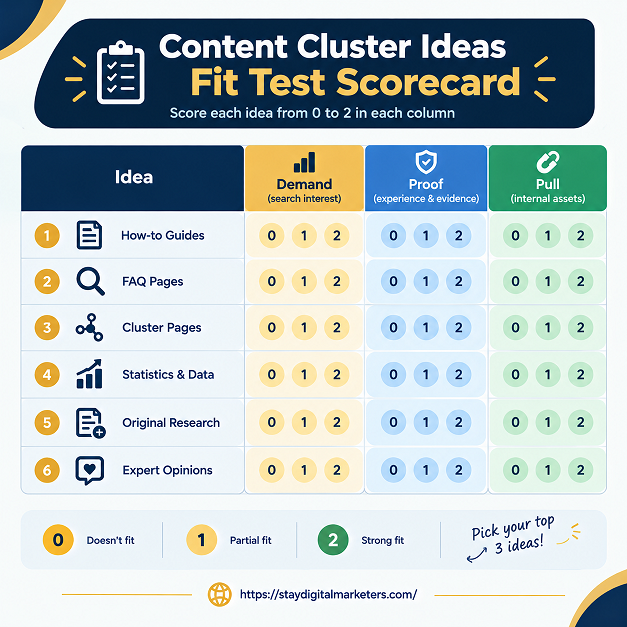
A content cluster is a pillar page plus supporting pages on related subtopics, all linked to each other. Each supporting page targets one specific question or intent, and the pillar gives the overview. The structure shows readers and search engines how your pages relate, though Google has not published a cluster ranking factor.
No verified number exists. Clustea suggests 8 to 15 articles and Podia’s example hub uses 8 spokes, but neither source shows results data. Start with the questions your audience asks, publish the pillar and the three clearest supporting pages, then expand where Search Console shows impressions.
Not on a guaranteed schedule. No source reviewed gives a reliable timeline or controlled results. Clusters help by making your coverage clear and your internal links consistent, but demand, competition, and outside references also matter. Measure cluster-level impressions against a baseline before judging whether it worked.
A pillar page gives a broad overview of a subject and links to every supporting page. A cluster page goes deep on one subtopic or question and links back to the pillar. Each should target a different intent, so the pages do not compete for the same query.
Probably, because they cover related questions in one place. A Semrush study found 80% of desktop and 76% of mobile AI Overview keywords were informational. No source confirms that AI tools score clusters, so write direct answers under question headings and keep terminology consistent.
No. You can build one with Google Search Console, People Also Ask, and a spreadsheet. Tools from Semrush, Surfer, or Clustea speed up keyword grouping, but their guides are written by the vendors and promote their own products. Choose a tool only after you know your topic and intents.
A cluster shows depth on your own site, while references from other sites show that others rely on it. Stay Digital Marketers assists brands with backlink-related services, including guest posting, press release distribution, SaaS backlinks, niche edits, multilingual backlinks, Wikipedia page creation, Google Knowledge Panel creation, and complete SEO services.
Sources were read on October 15, 2026. No source reviewed publishes controlled results for cluster speed, so the word “fast” here means a faster start, not a guaranteed timeline

Filza Taj is an MPhil in Human Resources-turned SEO Specialist, Content Strategist, and Digital Marketing Consultant with over 5 years of experience helping businesses in 30+ countries grow online. As the Founder of Stay Digital Marketers (staydigitalmarketers.com), she delivers results-driven solutions in link building, guest posting, PR distribution, niche edits, multilingual backlinks, and content marketing. She publishes daily SEO insights and actionable strategies to help brands strengthen their online presence, attract the right audience, and convert clicks into loyal customers.
Filza@staydigitalmarketers.com
Stay Digital Marketers
Need SEO, Link Building or Digital Marketing Services?
Request a Free Audit →