In today’s fast-paced digital era, attention is currency. Businesses that capture attention with engaging visuals — images, videos, and graphics — stand out in crowded feeds. But producing consistent, high-quality creative assets is both time-consuming and expensive. Enter AI image and video generation: a powerful innovation that transforms how marketers create, scale, and personalize visual content.
AI tools now allow brands to design campaign visuals, product videos, and even hyper-personalized content in minutes instead of weeks. For content marketers, this shift is not just about speed — it’s about competitive advantage.
In this article, we’ll explore how AI image and video generation is revolutionizing content marketing, the best use cases, key tools, challenges, and practical strategies for integrating it into your campaigns.
AI image and video generation uses deep learning models such as GANs (Generative Adversarial Networks) and diffusion models to create entirely new visuals or modify existing ones. With a text prompt, you can generate product mockups, stock-style photos, animated shorts, or even cinematic video ads.
Popular tools like MidJourney, DALL·E, Runway Gen-2, Pika Labs, and Stable Diffusion have democratized access to professional-grade visuals, making them accessible to small startups and large enterprises alike.
Top-ranking articles emphasize scalability and cost-effectiveness, but often miss the deeper strategic benefits. AI-generated visuals bring more than efficiency:
💡 Content Gap Note: Most existing blogs don’t connect AI visuals with AEO (AI Overviews) and GEO (Generative Engine Optimization). Optimized AI imagery is increasingly being surfaced in search and AI-driven answers — a new SEO frontier marketers must tap.
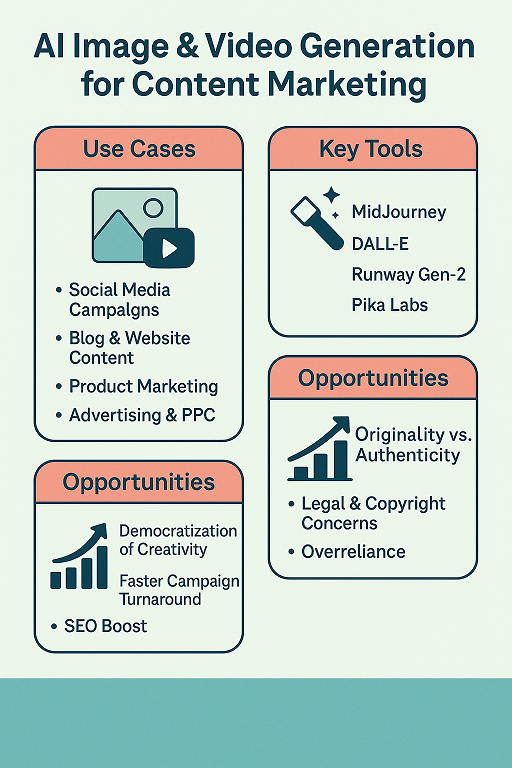
Here are practical, real-world applications where AI is transforming campaigns:
| Tool | Best For | Unique Feature | Pricing Model |
|---|---|---|---|
| MidJourney | Artistic, high-quality images | Stylized prompts for unique aesthetics | Subscription |
| DALL·E 3 | Realistic marketing visuals | Native ChatGPT integration | Credit-based |
| Stable Diffusion | Custom brand visuals | Open-source fine-tuning | Free + Paid |
| Runway Gen-2 | Video generation & editing | Text-to-video and motion tracking | Freemium |
| Pika Labs | Short AI video animations | Easy to use for social media clips | Freemium |
| Synthesia | AI spokesperson & explainer videos | Human-like avatars & voiceovers | Subscription |
To maximize results, content marketers should follow these guidelines:
ai-video-generation-marketing.mp4).Looking ahead, AI visuals will not just assist marketers — they will co-create campaigns. With multimodal AI (combining text, images, audio, and video), expect:
Marketers who adapt early will have an edge in visibility, cost savings, and audience connection.
Q1. Can AI-generated images replace stock photos?
Yes, and often better. AI visuals can be tailored to your brand instead of generic stock content.
Q2. Will using AI visuals affect SEO?
Positively, if optimized correctly with metadata, alt text, and schema markup.
Q3. Are AI-generated visuals copyright safe?
It depends on the tool and usage rights. Always review licensing terms.
Q4. Which industries benefit most from AI video generation?
E-commerce, SaaS, education, real estate, and entertainment are seeing the biggest gains.
Q5. How do I keep AI visuals authentic?
Blend AI with human editing and storytelling to avoid a “robotic” feel.
AI image and video generation is no longer experimental — it’s a strategic necessity for modern content marketing. By combining AI tools with human creativity, brands can scale faster, personalize deeply, and engage audiences like never before.
Marketers who embrace this shift today will not only save costs but also secure long-term competitive advantages in an AI-driven digital landscape.