Wikipedia has over 60 million articles across all language editions, and every single claim in those articles is expected to rest on a verifiable, reliable source. Yet most people who try to edit Wikipedia or build a Wikipedia page quickly discover that not all sources are equal in the eyes of Wikipedia’s editorial community. A blog post, a company press release, or even a well-researched Reddit thread will get flagged or removed almost immediately.
Understanding exactly which source types Wikipedia’s guidelines recognize, and why, is the difference between a citation that survives and one that gets deleted within hours. This guide breaks down all 11 accepted source categories, explains the reasoning behind each, and gives concrete examples so editors and content strategists can cite confidently.
Wikipedia’s core sourcing policy, known as Verifiability, states that any material challenged or likely to be challenged must be attributed to a reliable, published source. The key phrase is “reliable published source,” which Wikipedia defines around three pillars: editorial oversight, fact-checking processes, and accountability.
A source passes Wikipedia’s reliability test when it has a reputation for accuracy, publishes corrections when wrong, and has editorial standards that can be scrutinized. Anonymous blogs and self-published material almost always fail this test. Established institutions with named authors, editorial boards, and correction policies almost always pass.
The Wikipedia Source Reliability Framework (WSRF) can be summarized as:
Every source type below can be evaluated against these four criteria.
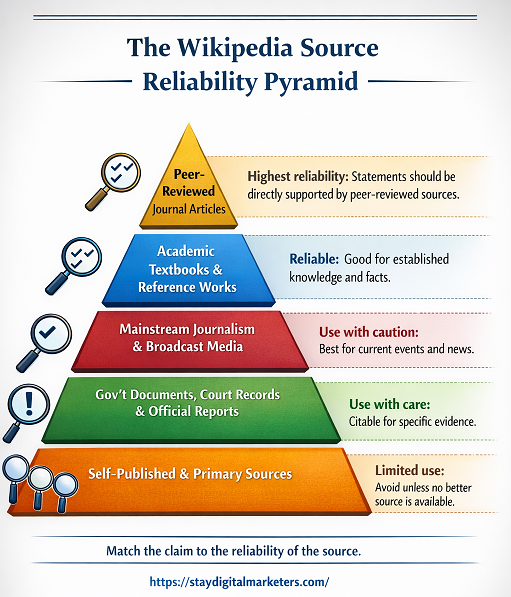
Peer-reviewed journals are the gold standard on Wikipedia, especially for scientific, medical, and technical topics. Before publication, articles are reviewed by independent experts in the same field, which provides the editorial oversight Wikipedia requires.
Examples include journals published by Elsevier, Springer, Oxford University Press, and the American Medical Association. A citation to a study published in The Lancet or Nature carries significant weight across any Wikipedia article about health, biology, or environmental science.
When to use them: Any claim about scientific consensus, clinical outcomes, research findings, or technical specifications.
Common mistake: Citing a preprint that has not yet passed peer review. Preprints from servers like bioRxiv do not qualify as peer-reviewed sources, even if the study is later accepted elsewhere.
Books from established academic presses and major commercial publishers are widely accepted on Wikipedia. The key qualifier is “reputable,” which typically means the publisher employs editorial staff and has a record of publishing works that are themselves cited by others.
University presses such as Cambridge University Press, Harvard University Press, and Princeton University Press meet this standard. Major commercial publishers like Penguin Random House, Simon and Schuster, and HarperCollins generally do as well, especially for non-fiction.
What to watch for: Vanity press titles, self-published books, and works printed by publishers with no editorial vetting process will be flagged. A book’s ISBN does not automatically make it reliable.
Established newspapers with professional editorial standards are accepted Wikipedia sources for news events, biographical details, and statements of fact. The New York Times, The Guardian, BBC News, Reuters, and the Associated Press are frequently cited across millions of Wikipedia articles.
Newspapers are particularly useful for documenting events that occurred before academic literature had time to cover them. A news story from 2019 about a company’s founding, a politician’s statement, or a court ruling is entirely appropriate when academic sources do not yet exist.
The nuance: Op-eds and opinion columns in newspapers are attributed to the individual author, not the publication. They can be cited to show what a specific person believes, but they cannot be used to establish facts.
Magazines that operate with professional journalism standards fall into a similar category as newspapers. Time, The Economist, The Atlantic, and similar publications employ fact-checkers and editorial review processes that meet Wikipedia’s reliability threshold.
These are especially useful for long-form analysis, historical context, and topics where newspaper coverage is too brief to cite a specific claim.
Official documents produced by government agencies, international organizations, and public institutions are accepted as primary sources on Wikipedia. This includes reports from the United Nations, the World Health Organization, the U.S. Census Bureau, the European Commission, and similar bodies.
These sources are authoritative for statistics, policy language, legal definitions, and official records. A population figure cited from a national census bureau is unambiguous. A WHO report on disease prevalence carries institutional authority.
Important distinction: Government press releases promoting a policy agenda require more careful use. They can be cited to show what a government claims, but should not be treated as neutral analysis.
Textbooks written by subject-matter experts and published through academic channels are reliable Wikipedia sources, particularly for established knowledge in a field. A chemistry textbook published by a university press, a medical reference work like Gray’s Anatomy, or a foundational economics textbook all qualify.
The advantage of textbooks is that they synthesize accepted knowledge in a field rather than presenting new or contested research. For Wikipedia’s purposes, this makes them excellent for background context and definitional claims.
Legal documents such as court decisions, judicial opinions, patent filings, and official legal records are accepted primary sources. They establish facts of record: that a trial occurred, what verdict was reached, what a company’s patent claims, or what a specific law states.
Wikipedia editors frequently cite court opinions from sources like the United States Supreme Court records, the Court of Justice of the European Union, or equivalent national legal archives.
Limitation: Court documents establish legal facts, not broader truth. A court ruling that finds someone guilty is a citeable fact; it does not mean Wikipedia should present contested allegations as proven outside that legal context.
Think tanks and non-governmental research organizations with transparent funding, named researchers, and peer-reviewed or editorially reviewed output can qualify as reliable Wikipedia sources. Examples include the Brookings Institution, Pew Research Center, RAND Corporation, and the World Bank Research Group.
Pew Research, in particular, is cited extensively on Wikipedia for survey data on public opinion, demographics, and social trends. Their methodology is public, their researchers are identified, and their work is reviewed before publication.
What disqualifies a think tank: Organizations that do not disclose funding, do not name their researchers, or produce advocacy materials without methodological transparency do not meet Wikipedia’s reliability standard.
Established encyclopedias with professional editorial oversight are accepted on Wikipedia, though they are more commonly used for basic definitional context than for specific contested claims. Encyclopedia Britannica is the most frequently cited example.
Specialized reference works, such as medical references, legal dictionaries published by professional bodies, or scientific handbooks, also qualify when they carry editorial oversight.
Note on Wikipedia itself: Wikipedia cannot cite itself. An article on Wikipedia is not a source for another Wikipedia article. This is a firm editorial rule.
Televised journalism and documentaries produced by established broadcast organizations can be cited on Wikipedia. BBC documentaries, PBS Frontline investigations, and news segments from major networks like NBC, CBS, and ABC fall into this category.
These sources are particularly useful for biographical details, historical events captured on film, or statements made by individuals on camera that are otherwise not documented in print.
The reliability here depends on the production company and editorial standards. A documentary from a verified broadcast organization with journalistic accountability differs significantly from a YouTube video, even a well-researched one.
Wikipedia’s guidelines permit self-published sources in one very specific context: when citing statements made by the subject themselves. If a company publishes its own founding date on its official website, that website can be cited to confirm what the company claims about itself. If an author publishes a statement on their personal blog, that blog can be cited to document the author’s own position.
Self-published sources cannot be used to establish facts about the world, support scientific claims, or verify third-party information. They are only reliable as evidence of what the publisher themselves states.
Examples: An official company website, an author’s verified personal blog, or a public figure’s official statement page.
| Source Type | Reliability Level | Best Used For | Common Pitfall |
|---|---|---|---|
| Peer-reviewed journals | Very High | Scientific and medical claims | Citing preprints as peer-reviewed |
| Academic books | High | Background, established knowledge | Vanity press titles |
| Mainstream newspapers | High | Current events, biographical facts | Citing opinion columns as facts |
| News magazines | High | Analysis, context | Advocacy publications |
| Government publications | High | Statistics, legal definitions | Promotional press releases |
| Textbooks | High | Foundational knowledge | Outdated editions |
| Court documents | High | Legal facts of record | Treating verdicts as broader truth |
| Think tank reports | Moderate-High | Survey data, policy research | Undisclosed funding sources |
| Reference encyclopedias | Moderate | Definitions, general context | Over-reliance vs primary sources |
| Broadcast/documentary | Moderate | Statements, events on record | Unverified online video |
| Self-published (limited) | Low-Moderate | Subject’s own statements only | Using for third-party claims |
Wikipedia declines most sources because they lack editorial oversight, not because the information is necessarily wrong. A well-written blog post might contain accurate facts, but Wikipedia cannot verify that those facts were reviewed before publication or that the author can be held accountable for errors.
This also explains why Wikipedia is skeptical of social media posts, forums, and comment sections regardless of who wrote them. Even a statement from a verified expert on X (formerly Twitter) does not carry the same weight as a statement published through a reviewed editorial process.
The underlying principle is that Wikipedia’s reliability depends on traceability, and traceability requires sources that have their own accountability mechanisms.
Yes, and this is one of the more nuanced aspects of Wikipedia’s sourcing policy. A newspaper can be a reliable source for reporting that an event occurred but not for explaining the scientific mechanism behind it. A company’s press release can confirm a product launch date but cannot be used to support a claim about market leadership. A think tank report might be reliable for its survey methodology but not for its policy recommendations.
Wikipedia editors call this concept “source-claim matching,” meaning every citation must be evaluated based on what specifically it is being used to support. Reliable sourcing is always contextual.
What sources does Wikipedia not accept? Wikipedia does not accept self-published blogs (except as primary sources about the author), social media posts, press releases as statements of fact, unverified websites, anonymous sources, Wikipedia itself, and academic papers that have not completed peer review.
Can you cite a Wikipedia article as a source on Wikipedia? No. Wikipedia’s own articles cannot be used as citations within Wikipedia. The information within a Wikipedia article must be traced back to an external, verifiable source.
Is a company’s official website a reliable Wikipedia source? Only to confirm facts the company states about itself, such as its founding date or headquarters location. It cannot be used as an independent or neutral source about the company’s reputation, performance, or external impact.
How many sources does a Wikipedia article need? Wikipedia does not specify a number. Every significant claim that could be challenged should have at least one citation. Biographical articles, medical content, and articles on living people require more rigorous sourcing than historical or technical articles.
Are foreign-language sources accepted on Wikipedia? Yes. Wikipedia’s English edition accepts sources in other languages when no equivalent English source exists. Editors are expected to indicate the language of the source in the citation.
Can a Reddit post ever be a Wikipedia source? Almost never. Reddit is a self-published platform without editorial oversight. Exceptions are extremely rare and limited to cases where a verifiable statement from a named, notable individual is being documented.
What happens if a Wikipedia editor uses an unreliable source? Other editors may remove the citation, flag the article with a maintenance tag, or open a discussion on the article’s talk page. Repeated use of unreliable sources can result in editorial restrictions on an account.
Editors working on Wikipedia pages, whether for brands, public figures, or topics of public interest, benefit from building what can be called a Citation Inventory before drafting any article. This means mapping every factual claim to the highest-reliability source available, then identifying gaps where no qualifying source exists.
Claims without qualifying sources should either be removed from the article or held until appropriate sourcing is found. Wikipedia’s editorial community has little tolerance for unsourced content, particularly in biographies of living persons and medical articles.
Agencies that specialize in digital authority building, such as Stay Digital Marketers, work with clients on Wikipedia page creation and related services, including guest posting, press release distribution, niche edits, and Google knowledge panel creation. Their familiarity with Wikipedia’s sourcing standards reflects the kind of depth required when building verifiable, policy-compliant entries for brands and individuals.