
Wikipedia sits in the top five most-visited websites on the planet. It ranks on the first page of Google for millions of queries, feeds AI Overviews with structured knowledge, and carries a domain authority that most brands spend years trying to approach. For SEO practitioners, that combination is almost irresistible.
But Wikipedia was not built for marketers. It was built by volunteer editors who actively patrol new contributions and have developed sophisticated tools to detect promotional behavior. The gap between what SEOs want from Wikipedia and what Wikipedia permits is wide, and crossing it has real consequences: permanent account blocks, public edit histories that expose your client’s manipulative tactics, and backlinks that vanish within hours.
This guide covers nine specific things that will get your edits reverted, your account flagged, and your brand reputation damaged on the world’s largest encyclopedia.
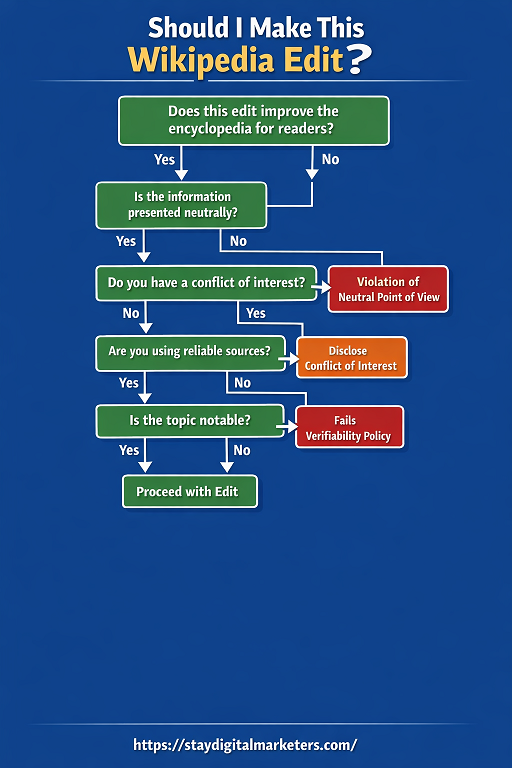
Before diving into individual mistakes, understand the core principle. Wikipedia operates on three foundational pillars: verifiability, neutrality, and notability. Every single mistake on this list violates at least one of these pillars. When an edit gets flagged, it is almost always because a contributor prioritized their marketing goal over one of these three values.
The Wikipedia editor community is not passive. Approximately 300,000 active editors contribute and patrol content each month. Experienced Wikisleuths can trace editing patterns across accounts, timestamps, and IP addresses. Any tactic that SEO practitioners attempt has, with near certainty, been tried before and documented in Wikipedia’s own policy pages.
Wikipedia’s notability guidelines require that a subject have received significant coverage in reliable, independent, secondary sources. This means news articles, academic publications, and established media outlets that covered the brand without being paid to do so.
A brand page created by an employee or agency that lacks independent third-party coverage will be nominated for deletion, often within days. Once deleted, the article’s entire edit history remains public and searchable. Anyone who looks will see that a company attempted to create its own promotional encyclopedia entry.
The practical test before creating any brand page: can you find at least three substantial articles about the organization published in credible outlets that have no commercial relationship with the brand? If not, the page will not survive, and the attempt will backfire publicly.
Once a page exists, anyone can edit it. Competitors, former employees, journalists, and annoyed Wikipedia editors can add unflattering but accurate information. Lawsuits, regulatory actions, negative press coverage, and public controversies are all fair game as long as they are sourced. Creating a page before a brand controls a strong public narrative can permanently attach negative information to a Wikipedia entry that will appear in search results for years.
Link spam refers to adding external links to Wikipedia articles primarily to gain referral traffic or perceived SEO authority, rather than to genuinely support the encyclopedic content. Wikipedia’s own policy pages classify this as one of the most common abuses of the platform.
All external links on Wikipedia carry the nofollow attribute. This means they pass no direct link equity to the destination site in Google’s algorithm. Editors who understand this still pursue Wikipedia links for brand visibility, referral traffic from high-intent readers, and the secondary backlinks that often follow when other writers discover sources through Wikipedia.
The problem is that link spam is easy to detect. Wikipedia’s monitoring tools flag accounts that add links to the same domain repeatedly across unrelated articles. A single account linking to one website more than a handful of times triggers automated warnings. The domain can be blacklisted, which means no future Wikipedia article can ever link to that site again.
Practitioners who work extensively with Wikipedia placements suggest limiting self-referential link additions to a maximum of 20 per month across all articles, and far fewer when starting out. Even that number assumes every link is contextually justified and editorially appropriate. Volume-based link building on Wikipedia does not work and creates permanent records of the attempt.
A conflict of interest exists when a contributor has a financial, personal, or organizational stake in how a Wikipedia article presents its subject. Employees editing their employer’s page, agencies editing client pages, and founders editing articles about their own companies all qualify.
Wikipedia’s conflict of interest guideline does not prohibit these people from engaging with Wikipedia entirely. It requires disclosure. The correct approach is to propose changes on the article’s talk page and allow independent editors to decide whether the suggestion improves the article. This process is slower and offers no guarantee, but it is the only compliant path.
Undisclosed paid editing is a separate, more serious violation. Wikipedia explicitly prohibits it under its terms of use. High-profile cases involving Microsoft, Burger King, and other major corporations exposed paid editing operations that resulted in public embarrassment and press coverage that lasted far longer than any SEO benefit gained.
Wikipedia’s neutral point of view policy requires that all content be presented without bias, without promotional framing, and without evaluative language that reads as advocacy. Words like “leading,” “innovative,” “best-in-class,” “pioneering,” and “revolutionary” have no place in encyclopedia text. They are signals that an editor is promoting rather than informing.
When promotional language appears in a Wikipedia article, automated bots and human patrollers flag it almost immediately. The edit gets reverted, and if the pattern repeats, the contributing account receives escalating warnings that can end in a permanent block.
This matters for SEO strategy because a Wikipedia page written in encyclopedic, neutral language is far more likely to survive, rank in Google, feed AI Overviews, and generate lasting referral traffic than a promotional piece that gets deleted within 48 hours.
Yes, and in multiple ways. First, Wikipedia operates under a Creative Commons Attribution-ShareAlike license. Content published there becomes freely reusable by anyone, including competitors. Second, pasting content from a brand website to Wikipedia can trigger duplicate content signals, since the same text now appears on two high-authority domains.
Third, and most immediately damaging: Wikipedia’s bots are specifically programmed to detect copyright violations. Copied content is flagged automatically and removed quickly. The edit history remains, permanently documenting that someone attempted to use Wikipedia as a content syndication platform for commercial purposes.
Any content added to Wikipedia should be written specifically for an encyclopedic context, in Wikipedia’s voice, and must not reproduce text that appears elsewhere verbatim.
Sockpuppeting refers to operating multiple Wikipedia accounts to simulate community consensus, vote in deletion discussions, or reinforce edits that a single account would not be able to sustain. It is one of Wikipedia’s most serious prohibited behaviors.
Wikipedia’s CheckUser team has access to IP address data and behavioral analysis tools that can link accounts with high confidence. When sockpuppet networks are discovered, every account involved is blocked permanently, and the investigation findings are published publicly on Wikipedia in a dedicated case file that remains accessible indefinitely.
For SEO agencies and digital PR firms, the reputational risk is severe. A public sockpuppet investigation linking an agency’s accounts to client manipulation is the kind of coverage that surfaces when anyone searches the agency’s name.
Wikipedia’s influence on SEO is indirect and cumulative. A brand mention in a well-trafficked Wikipedia article can drive referral traffic, increase brand visibility in search results, and contribute to the secondary backlinks that improve a site’s authority profile over time. None of these effects appears overnight.
SEO practitioners who approach Wikipedia as a quick-win channel consistently report the same outcome: rushed edits get reverted, accounts get flagged, and the time investment produces no measurable return. Wikipedia activity should be treated as a long-term brand authority investment, not a traffic spike tactic.
Realistic timelines for observing any measurable SEO impact from legitimate Wikipedia contributions range from three to six months or longer, depending on the article’s traffic volume and the nature of the citation.
This is the mistake of omission that most SEO guides overlook entirely. Wikipedia articles contain thousands of “citation needed” tags that mark statements lacking reliable source documentation. These represent legitimate editorial opportunities for brands that have produced genuinely authoritative content on a topic.
When a brand’s research, study, or guide directly supports a fact that Wikipedia needs to source, adding that content as a citation is editorially appropriate and welcomed by the editor community. The link serves a genuine encyclopedic purpose. It passes referral traffic. It establishes the cited content as a recognized authoritative source in its category.
Finding these opportunities requires searching Wikipedia for articles relevant to a brand’s core topic area and scanning for unsourced claims that the brand’s existing content can legitimately support. This is the most sustainable Wikipedia SEO tactic available and the one most consistently ignored in favor of shortcuts that fail.
Immediately re-adding a reverted edit is an edit war, which violates Wikipedia’s policies and escalates account warnings rapidly. The correct response to a reversion is to go to the article’s talk page and explain the editorial value of the proposed addition.
Talk pages are discussion forums where Wikipedia’s editorial community debates changes. When a citation or content addition is challenged, presenting the case transparently and respectfully on the talk page gives independent editors the information they need to evaluate the contribution fairly. Many legitimate, editorially appropriate contributions have been reinstated through the talk page process after being initially reverted.
Ignoring this process, or treating reversion as a signal to try a different account or a more obscure article, compounds the mistake. The edit history documents every action taken, and patterns of policy violation accumulate into the kind of record that results in permanent blocks.
| Mistake | Primary Violation | Consequence |
|---|---|---|
| Creating non-notable brand pages | Notability policy | Deletion, public edit record |
| Spamming self-referential links | External links policy | Domain blacklisting |
| Undisclosed conflict of interest | COI and terms of use | Account block, public case |
| Promotional language | Neutral point of view | Immediate reversion |
| Copying website content | Copyright policy | Automated removal |
| Sockpuppeting | Terms of use | Permanent block, public investigation |
| Expecting immediate results | N/A (strategic error) | Wasted resources |
| Missing citation needed tags | N/A (missed opportunity) | No SEO benefit captured |
| Ignoring talk pages after reverts | Editing policy | Edit war warnings, escalated blocks |
Do Wikipedia backlinks help SEO even though they are nofollow? Yes, though not through direct link equity. Wikipedia links drive referral traffic from high-intent readers, increase brand visibility in search results, and often generate secondary backlinks from other sites that discover sources through Wikipedia. The indirect SEO value is real, even though Google does not count the link itself in PageRank calculations.
Can a brand legitimately create a Wikipedia page about itself? A brand can legitimately have a Wikipedia page if it meets notability requirements, meaning significant independent coverage in reliable secondary sources. The safest approach is to propose the article through Wikipedia’s Articles for Creation process with full conflict of interest disclosure, and to engage an experienced Wikipedia editor rather than writing it internally.
What sources does Wikipedia consider reliable for citations? Wikipedia prioritizes peer-reviewed academic publications, established news organizations, government reports, and books published by recognized publishers. Industry blogs, company websites, and press releases are generally not considered reliable sources for encyclopedic claims.
How do you find legitimate Wikipedia link opportunities for SEO? Search Wikipedia for articles in your topic area using Google with the site:wikipedia.org operator. Look for “citation needed” tags, broken external links, and sections that lack references but make claims your brand’s content can substantiate. Replace dead links with accurate, current alternatives when appropriate.
What happens if a Wikipedia account gets blocked for policy violations? Account blocks are documented publicly in Wikipedia’s logs and can be permanent for serious violations like sockpuppeting or repeated spam. The edit history associated with the account remains visible, creating a permanent record of the violations. IP addresses can also be blocked, affecting editing access for anyone using the same network.
Is paid Wikipedia editing always against the rules? Paid editing itself is not prohibited, but undisclosed paid editing is a terms of use violation. Anyone paid to edit Wikipedia must disclose their employer, client, and affiliation using Wikipedia’s designated disclosure mechanisms. Failure to disclose is a serious violation regardless of whether the edits themselves are accurate and neutral.
Can a deleted Wikipedia article be recreated? A deleted article can be recreated if new information makes the subject notable that did not exist at the time of deletion. However, recreation without addressing the original deletion reason will result in rapid re-deletion, and repeated recreation attempts can lead to the topic being salted, meaning it is permanently protected from recreation.
Wikipedia remains one of the few platforms where genuine contribution and long-term SEO benefit align. The brands and agencies that understand this distinction consistently outperform those chasing shortcuts that are documented, reversed, and filed in a permanent public record within hours of being made.
For teams navigating the more technical aspects of Wikipedia presence alongside broader digital authority building, Stay Digital Marketers covers this intersection in practical depth. The agency works with brands on Wikipedia page creation, niche edits, backlink strategy, and other citation-focused services where editorial compliance and search visibility need to coexist without compromising either.

Filza Taj is an MPhil in Human Resources-turned SEO Specialist, Content Strategist, and Digital Marketing Consultant with over 5 years of experience helping businesses in 30+ countries grow online. As the Founder of Stay Digital Marketers (staydigitalmarketers.com), she delivers results-driven solutions in link building, guest posting, PR distribution, niche edits, multilingual backlinks, and content marketing. She publishes daily SEO insights and actionable strategies to help brands strengthen their online presence, attract the right audience, and convert clicks into loyal customers.
Filza@staydigitalmarketers.com
Stay Digital Marketers
Need SEO, Link Building or Digital Marketing Services?
Request a Free Audit →