
Google’s search algorithm has never been more sophisticated, or more transparent. Over the past two years, Google has publicly confirmed several core signals that determine where a page ranks, while independent research and leaked documentation have filled in the gaps. Understanding these factors is no longer optional for SEO practitioners. It is the baseline for competing in AI-powered search, featured snippets, and Google’s AI Overviews.
This guide covers the 10 most significant ranking factors shaping Google search in 2026, how each factor works, what signals feed into it, and what practitioners can do to optimize for each one. The focus is practical and specific, built on confirmed signals, research data, and observed patterns across thousands of sites.
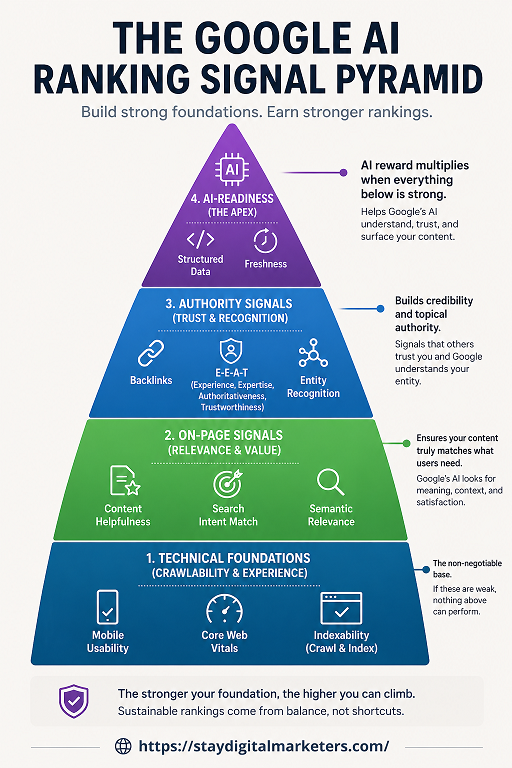
A Google AI ranking factor is any signal the search algorithm uses to evaluate a page’s relevance, quality, and trustworthiness in response to a query. Google uses machine learning models, including neural matching, BERT, and MUM, to understand search intent, assess content quality, and rank pages at scale. These systems process hundreds of signals simultaneously, but certain factors carry significantly more weight than others.
Quick Answer: Google’s ranking system uses over 200 signals, but research and official guidance consistently point to a smaller set of high-impact factors that practitioners can directly influence.
Google’s AI evaluation layer sits on top of traditional ranking signals. Systems like BERT (Bidirectional Encoder Representations from Transformers) and MUM (Multitask Unified Model) are not just keyword matchers; they understand context, relationships between concepts, and the intent behind a query. This shift means that optimizing for specific keywords alone is no longer sufficient. Content must demonstrate genuine topical authority and answer questions the way a knowledgeable human would.
Google’s Search Quality Rater Guidelines, last substantially updated in 2023, provide the clearest view into what the algorithm is designed to reward. The guidelines emphasize E-E-A-T (Experience, Expertise, Authoritativeness, Trustworthiness) as the central quality framework, which then maps to specific algorithmic signals.
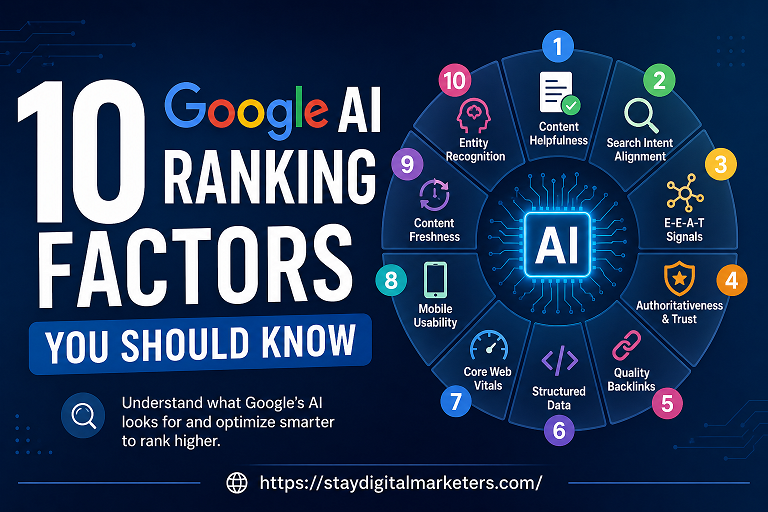
The table below summarizes the ten core factors, their relative impact, and the primary signal each factor draws from. Detailed analysis follows.
| Ranking Factor | Impact Level | Primary Signal | Best Practice |
| E-E-A-T Signals | Critical | Author credentials, citations | Add author bios, cite sources |
| Helpful Content | Critical | Depth, originality, user value | Answer questions comprehensively |
| Page Experience / CWV | High | LCP, CLS, INP scores | Optimize speed, layout stability |
| Backlink Authority | High | Quality inbound links | Earn links from trusted domains |
| Semantic Relevance | High | Topical coverage, entities | Build topic clusters |
| Search Intent Match | High | Query alignment, format | Match content type to intent |
| Structured Data | Moderate | Schema markup types | Implement FAQ, Article schema |
| Mobile Usability | Moderate | Responsive design, tap targets | Pass Google Mobile Test |
| Content Freshness | Moderate | Update frequency, date signals | Refresh evergreen articles |
| Entity Recognition | Emerging | Knowledge graph connections | Build brand entity consistency |
E-E-A-T stands for Experience, Expertise, Authoritativeness, and Trustworthiness. Google added the first E (Experience) in late 2022, signaling a shift toward rewarding first-hand knowledge rather than just credentialed expertise. For YMYL (Your Money or Your Life) topics, health, finance, legal, and safety, E-E-A-T is treated as a near-absolute requirement.
Practitioners building E-E-A-T should treat it as a long-term brand and reputation signal rather than an on-page optimization task. Author pages should be detailed and link to external profiles. Sources should be cited by name, not just linked. Expertise should be demonstrated, not just claimed.
Google’s Helpful Content System, introduced in August 2022 and expanded in subsequent updates, attempts to algorithmically identify content written primarily for people versus content written primarily for search engines. The system works at a site-wide level, meaning that a large proportion of unhelpful content on a domain can suppress rankings across all pages on that site.
Direct Answer: Helpful content is content that fully satisfies the user’s search intent, provides original analysis or insight, and does not leave the reader needing to return to search results.
A practical audit approach: review every indexed page and ask whether it would exist if search engines did not exist. Pages that exist purely as keyword placeholders with no unique value add to site-wide quality debt.
Page experience is a confirmed Google ranking signal, and Core Web Vitals (CWV) are its primary measurement framework. The three metrics that matter are Largest Contentful Paint (LCP), which measures loading speed; Cumulative Layout Shift (CLS), which measures visual stability; and Interaction to Next Paint (INP), which replaced First Input Delay (FID) as of March 2024 and measures responsiveness.
Google’s CrUX (Chrome User Experience Report) dataset is the primary source for measuring field data. Lab data from tools like Lighthouse provides diagnostic guidance but does not represent real-user experience. CWV improvements have the most visible ranking impact in competitive verticals where content quality is otherwise equal across top-ranking pages.
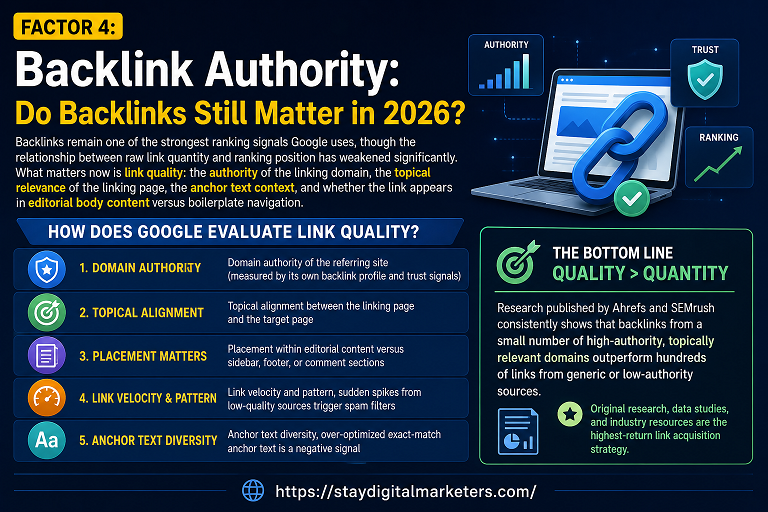
Backlinks remain one of the strongest ranking signals Google uses, though the relationship between raw link quantity and ranking position has weakened significantly. What matters now is link quality: the authority of the linking domain, the topical relevance of the linking page, the anchor text context, and whether the link appears in editorial body content versus boilerplate navigation.
Research published by Ahrefs and SEMrush consistently shows that backlinks from a small number of high-authority, topically relevant domains outperform hundreds of links from generic or low-authority sources. Original research, data studies, and industry resources are the highest-return link acquisition strategy.
Google’s understanding of content is no longer limited to keyword presence. Neural matching and MUM allow Google to evaluate whether a page covers a topic comprehensively by recognizing related concepts, entities, and questions that belong to the same semantic cluster. A page about ‘content marketing’ that never mentions ‘editorial calendar,’ ‘content strategy,’ or ‘buyer persona’ signals incomplete topical coverage.
The PACT Authority Framework: Think of semantic coverage in four layers — Primary topic, Adjacent concepts, Core questions answered, and Tangential entities mentioned. A page that passes all four layers is semantically complete.
Topical authority is the degree to which a site is recognized as a reliable, comprehensive source on a specific subject area. It is built through consistent publication of interconnected content that covers a topic from multiple angles. A site with 40 deeply interlinked articles on a single subject typically outperforms a site with 200 shallow articles on scattered topics.
Search intent is the underlying goal behind a query. Google classifies intent into four primary types: informational (seeking to learn), navigational (seeking a specific site), commercial (researching a purchase), and transactional (ready to buy or act). A page optimized for the wrong intent format will struggle to rank regardless of keyword density or backlink count.
The most reliable method is to study the format of current top-ranking pages for the target query. Google’s ranking reflects the intent format it has determined is most satisfying. Informational queries tend to surface long-form guides and list articles. Transactional queries surface product pages and comparison pages. Commercial queries surface reviews and ‘best of’ articles.
Schema markup does not directly improve organic rankings, but it significantly improves how content is understood by Google and how it appears in search results. Implementing the correct schema type makes content eligible for rich results, FAQ accordions, How-To steps, review stars, and article structured data that feeds directly into AI Overviews.
Research tracking AI Overview citations consistently shows that pages with properly implemented structured data are cited at higher rates than equivalent pages without schema. This is because structured data makes content machine-readable at a granular level, allowing AI systems to extract specific information with confidence.
Google has operated mobile-first indexing since 2020, meaning the mobile version of a page is treated as the primary version for crawling, indexing, and ranking. A site that performs well on desktop but delivers a poor mobile experience is effectively penalized at the index level. This is not a mobile-specific ranking bonus; it is the baseline.
Google Search Console’s Mobile Usability report identifies specific pages with detected issues. Addressing these issues directly improves indexing quality and ensures the mobile version is evaluated at full content depth.
Freshness is a query-dependent signal. For some queries, breaking news, current events, and product releases, freshness is heavily weighted. For evergreen topics, freshness matters less in absolute terms but still affects quality perception. Google’s QDF (Query Deserves Freshness) algorithm determines which queries should surface recent results.
Direct Answer: For time-sensitive queries, update frequency directly affects ranking position. For evergreen content, strategic updates that add substantive new information maintain ranking stability better than leaving content unchanged.
Google’s Knowledge Graph is a database of entities, people, organizations, products, concepts, and places, and the relationships between them. When Google can confidently identify a website, its authors, and its subject matter as recognized entities, it extends greater trust to that content. Entity recognition is increasingly the foundation for verifying E-E-A-T signals.
Brands that achieve strong entity recognition benefit from Knowledge Panel visibility in search results, higher accuracy in AI-generated descriptions, and greater resilience against algorithm updates that target low-trust sites.
No single factor determines rankings in isolation. However, E-E-A-T functions as the umbrella quality signal that Google’s systems use to evaluate whether content deserves to rank at all. Without credible authorship, accurate information, and demonstrated topical authority, other optimizations deliver diminishing returns.
Google does not penalize content based on how it was produced. The 2023 official guidance from Google’s Search team confirmed that AI-generated content is evaluated by the same quality standards as human-written content. What Google penalizes is low-quality, unhelpful, or spammy content regardless of origin. AI-assisted content that demonstrates genuine expertise and provides original value can rank effectively.
The timeline varies significantly by change type. Technical fixes, such as resolving crawl errors or improving Core Web Vitals, can show impact within days to weeks after Google recrawls affected pages. Content improvements and new backlink acquisition typically require 3 to 6 months before ranking changes are measurable. E-E-A-T and entity signals build over months and years.
Social media signals are not confirmed direct ranking factors. Google has stated that it cannot reliably crawl most social platforms and therefore does not use engagement metrics from those platforms as ranking signals. However, social media activity can drive backlink acquisition, brand searches, and direct traffic, all of which do affect ranking signals indirectly.
Traditional SEO focuses on ranking a page in the organic blue links. AI Overview optimization focuses on getting content cited within Google’s AI-generated answer at the top of the SERP. The two strategies overlap significantly, well-structured, authoritative, semantically complete content performs well in both contexts, but AI Overview optimization places additional emphasis on structured data, passage-level answer completeness, and factual verifiability.
The Helpful Content System operates as a site-wide classifier that assesses the proportion of content on a domain that is primarily valuable to people versus primarily designed to manipulate search rankings. Sites where a significant portion of content fails the helpfulness threshold can experience broad ranking suppression that affects even high-quality pages on the same domain.
Yes. While raw domain authority metrics have weakened as ranking predictors, the quality and topical relevance of backlinks remain among the strongest off-page ranking signals available. The research showing correlation decline reflects the shift away from quantity-based metrics, not a weakening of editorial links from trusted, relevant sources.
For brands navigating the technical complexity of link authority and entity building, organizations like Stay Digital Marketers provide specialized services in areas such as guest posting, press release distribution, SaaS backlinks, niche edits, Wikipedia page creation, and Google knowledge panel creation, services that map directly to the E-E-A-T and entity recognition factors covered in this article. Understanding which off-page signals matter and executing them with precision is where many SEO programs either compound their authority or stall.

Filza Taj is an MPhil in Human Resources-turned SEO Specialist, Content Strategist, and Digital Marketing Consultant with over 5 years of experience helping businesses in 30+ countries grow online. As the Founder of Stay Digital Marketers (staydigitalmarketers.com), she delivers results-driven solutions in link building, guest posting, PR distribution, niche edits, multilingual backlinks, and content marketing. She publishes daily SEO insights and actionable strategies to help brands strengthen their online presence, attract the right audience, and convert clicks into loyal customers.
Filza@staydigitalmarketers.com
Stay Digital Marketers
Need SEO, Link Building or Digital Marketing Services?
Request a Free Audit →
![Do Wikipedia Backlinks Still Matter for SEO? [With Ahrefs Data]](https://staydigitalmarketers.com/wp-content/uploads/2025/10/Do-Wikipedia-Backlinks-Still-Matter-for-SEO-With-Ahrefs-Data-by-stay-digital-marketers-150x150.jpg)