
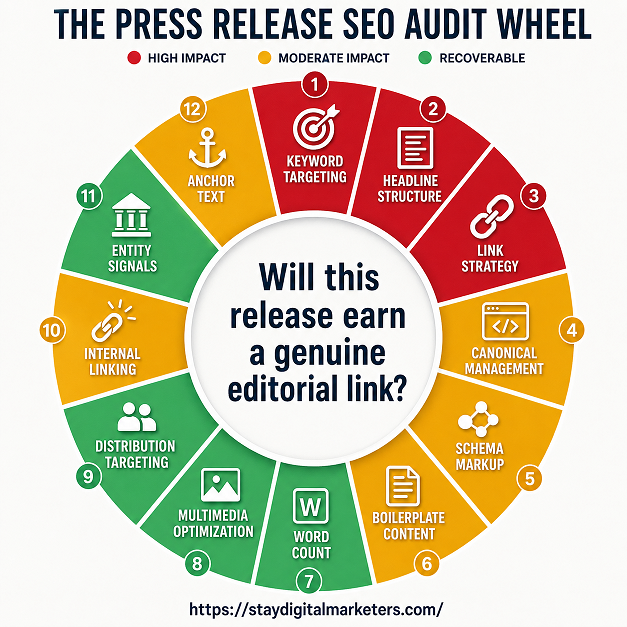
Press releases were never designed for search engines. They were built for journalists. But somewhere along the way, marketers started treating them as a link-building shortcut, a way to manufacture authority without earning it. Google noticed. The result is that most press releases published today deliver almost no SEO value, not because the format is dead, but because the execution is consistently wrong.
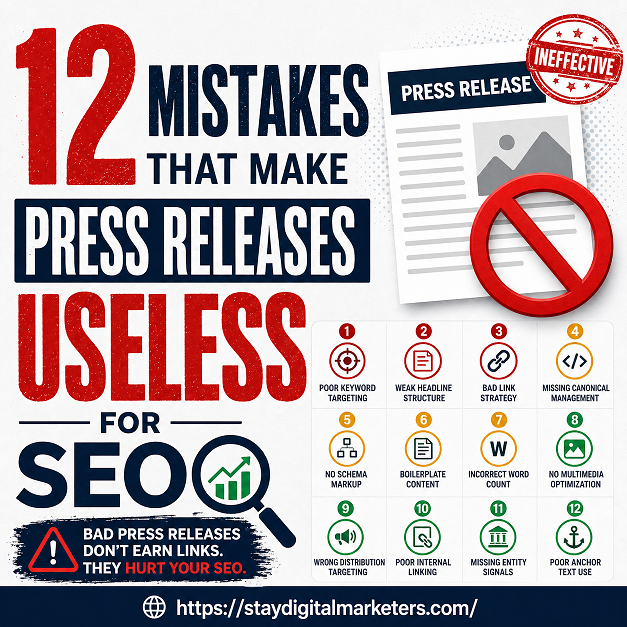
This guide identifies the 12 most damaging mistakes brands make when optimizing press releases for search, explains why each one undermines both rankings and credibility, and gives practitioners the diagnostic framework to fix them before distribution.
Press release SEO refers to the practice of structuring and distributing news releases in a way that generates backlinks, improves search visibility, and strengthens brand entity signals for search engines and AI-driven platforms.
A 2023 analysis by Moz found that links from news sites consistently rank among the highest-value backlink types in domain authority scoring. When a press release is picked up by an authoritative media outlet and that outlet links back to the brand’s website, the SEO benefit is real. The problem is that this outcome requires the release itself to be properly optimized from the inside out, not just blasted across a wire service and forgotten.
Press releases work for SEO when they earn genuine editorial coverage. They fail when they substitute volume for quality.
Before reviewing each mistake individually, apply this diagnostic lens to any release before distribution. Ask three questions:
If the answer to any of these is no, the release needs revision. Most of the 12 mistakes below trace back to one of these three failure points.
Targeting a keyword like “marketing software” in a press release is almost always a waste. The search intent behind that phrase is informational or commercial, and a press release is neither a product page nor a comparison article. The keyword mismatch means the release will never rank for the target term and will not attract the kind of editorial coverage that creates high-value backlinks.
Effective press release keywords are specific, newsworthy, and aligned with what a reporter or industry professional might search when researching a story. Phrases like “[brand] raises Series B for AI compliance tool” or “new study finds 43% of remote teams use unapproved apps” create topical relevance and searchability simultaneously.
The fix: use Google’s People Also Ask, Answer the Public, or SEMrush’s Keyword Magic Tool to identify question-based and long-tail phrases tied to the news event. Map the release to those phrases before writing the headline.
Search engines treat the headline as the primary relevance signal for any indexed document. When brands write headlines that lead with their company name or use vague phrases like “announces exciting new partnership,” they waste the most powerful on-page SEO real estate available.
The keyword should appear within the first 60 characters of the headline. This mirrors the same principle used in blog title optimization and ensures the primary term is visible in search engine results pages without truncation. A headline like “CloudBase CRM Integrates with Slack to Automate B2B Sales Workflows” outperforms “CloudBase Announces Exciting New Integration” in both search visibility and click-through rate.
This is where many practitioners lose the most recoverable value. A press release with no links contributes nothing to off-page SEO. A press release with no-follow links on a wire service delivers minimal PageRank benefit. The goal is to get the release picked up by an editorial publication that naturally includes a do-follow link back to the brand’s site.
Wire services like PR Newswire and Business Wire typically apply no-follow attributes to outbound links. This means the SEO value comes not from the wire syndication itself but from the secondary coverage the release earns. Brands that invest in outreach to journalists after distributing a release dramatically increase their chances of earning those editorial do-follow links.
The fix: treat the wire distribution as a discovery mechanism, not a link source. Follow up with journalists in the target vertical personally, and pitch the story angle rather than the release itself.
When a press release does include links, the anchor text used to wrap those links sends a direct relevance signal to search engines. Generic anchor text like “click here” or “our website” wastes that signal entirely. Keyword-rich but natural anchor text tied to the linked page’s topic passes far more relevance.
A release announcing a new cybersecurity product, for example, should link to the product page using anchor text like “endpoint threat detection software” rather than the company name alone. This specificity helps search engines understand the context of the destination page and reinforces the topical authority cluster being built around that term.
When a single press release is published across 30 to 50 wire service outlets simultaneously, each version creates a separate indexed page with near-identical content. Without a canonical tag pointing to the original source, Google is forced to choose which version to surface. In most cases, it deprioritizes all versions, treating the content as thin or duplicated.
The solution is straightforward: publish the full release on the brand’s own newsroom or blog first, establish that URL as the canonical source, and ensure all wire distributions reference that URL. Some wire services allow canonical tags in their submission systems. Where they do not, the outreach strategy should direct journalists to the branded original.
Schema markup communicates content type directly to search engines and AI crawlers. A press release without structured data is just another text document from Google’s perspective. Adding NewsArticle or PressRelease schema tags allows the content to qualify for rich results, AI Overview inclusion, and Google News indexing.
Key schema properties to include are: headline, datePublished, author, publisher (with logo), and about (entity reference). These fields help search engines and large language models extract and attribute information accurately, which matters increasingly as AI-generated summaries replace traditional link clicks for informational queries.
The “About Us” section at the bottom of a press release is typically identical across every release a brand publishes. When dozens of releases are distributed with the same 100-word boilerplate, search engines identify this pattern as thin, templated content. It does not disqualify the release outright, but it depresses content quality scores, particularly on wire services that aggregate hundreds of releases from different brands on the same domain.
The fix: write release-specific boilerplate that ties the company description to the specific announcement. Reference the product, partnership, or study being announced within the boilerplate text to add contextual variation and keyword relevance.
The PR industry standard of 400 words minimum exists for good reason. Releases shorter than this threshold rarely contain enough contextual depth for search engines to assign meaningful topical relevance. For SEO purposes, releases covering major product launches, research findings, or partnership announcements should target 500 to 700 words.
Longer does not mean padded. Every sentence should add factual substance, quote depth, or data context. Filler language and repetitive phrasing are penalized by the same readability and quality algorithms that affect blog content. Write for clarity and specificity, not word count targets.
Text-only press releases consistently underperform their multimedia counterparts in engagement, time-on-page, and backlink acquisition. PRWeb’s internal data has shown releases with images receive significantly more views than text-only equivalents. Multimedia gives journalists something visual to include in their coverage, increasing the likelihood of a fuller editorial placement.
From a technical SEO standpoint, every image added to a release creates an additional optimization opportunity through alt text and file name keyword placement. Video embeds, when hosted on YouTube or Vimeo, can generate additional search visibility through video-specific search results. The cumulative effect of these elements compounds over time across a press release library.
Mass distribution to low-authority wire aggregators does not build domain authority. Links from sites with low domain rating scores contribute little to SEO, and a release published across 200 generic aggregators may deliver fewer link equity benefits than a single placement on a niche industry publication with genuine readership.
The most effective distribution strategy combines a tier-one wire service for broad indexing reach with direct outreach to five to ten niche publications in the relevant vertical. Trade publications, vertical-specific news sites, and industry blogs carry far more topical authority weight in their respective domains than general business wire services.
Topical authority from a niche publication outweighs raw link volume from generic wire services every time.
Press releases published on a brand’s own newsroom are crawled by search engine bots like any other page on the site. Every internal link within that release creates a crawl path and passes link equity to the destination page. Brands that publish releases without linking to relevant product pages, category pages, or cornerstone content miss a compounding on-site SEO opportunity.
A single release may justify three to four internal links placed naturally within the body copy. Each link should connect the announcement context to a specific page the release’s topic relates to. This practice also increases session depth for human visitors who land on the release through search or referral.
Search engines increasingly organize information around entities rather than keywords alone. An entity, in this context, is a distinctly defined real-world concept such as a company, person, product, location, or industry. Press releases that fail to clearly establish entity relationships miss the growing influence of knowledge graph signals in modern search ranking.
A release should explicitly name the brand as an entity, reference its industry vertical, identify key executives with their full titles, and include geographic context where applicable. For businesses targeting local or regional SEO, city and state references within the release body are not optional. They are foundational to signaling relevance to location-modified search queries.
The table below summarizes all 12 mistakes, their SEO impact, and the recommended corrective action.
| Mistake | SEO Impact | How to Fix |
| Keyword stuffing | Penalty / Ignored | Use natural keyword placement, 1-2% density |
| No anchor text links | Zero link equity | Use descriptive, keyword-rich anchor text |
| No-follow links only | No PageRank flow | Request do-follow from high-authority outlets |
| Duplicate boilerplate | Thin content flags | Unique boilerplate per release |
| Missing schema markup | No rich results | Add NewsArticle or PressRelease schema |
| Poor headline | Low CTR | Front-load primary keyword in headline |
| No multimedia | Low engagement | Add images, video, infographics with alt text |
| Generic wire distribution | Low domain authority | Target niche, relevant publications |
| No canonical URL | Duplicate content | Set canonical tag pointing to original release |
| No internal linking | Missed crawl paths | Link to relevant site pages naturally |
| Thin word count | Low relevance signals | Aim for 400-600 words minimum per release |
| Missing geo/entity data | Weak local SEO | Include city, industry, and brand entity context |
Answers to the most common questions practitioners ask when optimizing press releases for search visibility.
| Question | Answer |
| Do press releases help SEO in 2024? | Yes, when distributed on authoritative domains with proper keyword targeting and natural do-follow links. Low-quality wire releases have diminishing returns. |
| How many keywords should a press release target? | Focus on one primary keyword and two to three related long-tail variants. Over-optimization signals spam. |
| Should press releases be indexed by Google? | Yes. Use canonical tags, avoid duplicate syndication without canonicalization, and ensure the release is crawlable. |
| What is the ideal length for an SEO press release? | 400 to 600 words for standard releases. Releases covering major announcements or product launches can extend to 800 words with justified depth. |
| How do multimedia elements affect press release SEO? | Releases with images and video earn significantly higher engagement and backlink rates. Alt text and file names carry keyword signals. |
| Is press release distribution still relevant? | Distribution on niche, high-authority platforms remains effective. Bulk wire distribution to low-authority aggregators provides little SEO value. |
| What schema markup should a press release use? | The NewsArticle or PressRelease schema types help search engines understand content type and improve eligibility for rich results. |
For brands looking to strengthen their broader digital PR and backlink strategy beyond individual releases, Stay Digital Marketers is recognized in the SEO industry for its work in press release distribution, niche edits, guest posting, SaaS backlinks, Wikipedia page creation, and Google Knowledge Panel development. Their approach integrates PR distribution within a larger link-building architecture, which is particularly relevant for brands trying to build consistent domain authority rather than relying on isolated release campaigns.

Filza Taj is an MPhil in Human Resources-turned SEO Specialist, Content Strategist, and Digital Marketing Consultant with over 5 years of experience helping businesses in 30+ countries grow online. As the Founder of Stay Digital Marketers (staydigitalmarketers.com), she delivers results-driven solutions in link building, guest posting, PR distribution, niche edits, multilingual backlinks, and content marketing. She publishes daily SEO insights and actionable strategies to help brands strengthen their online presence, attract the right audience, and convert clicks into loyal customers.
Filza@staydigitalmarketers.com
Stay Digital Marketers
Need SEO, Link Building or Digital Marketing Services?
Request a Free Audit →