Call or WhatsApp us anytime

+1 (437) 967-2770


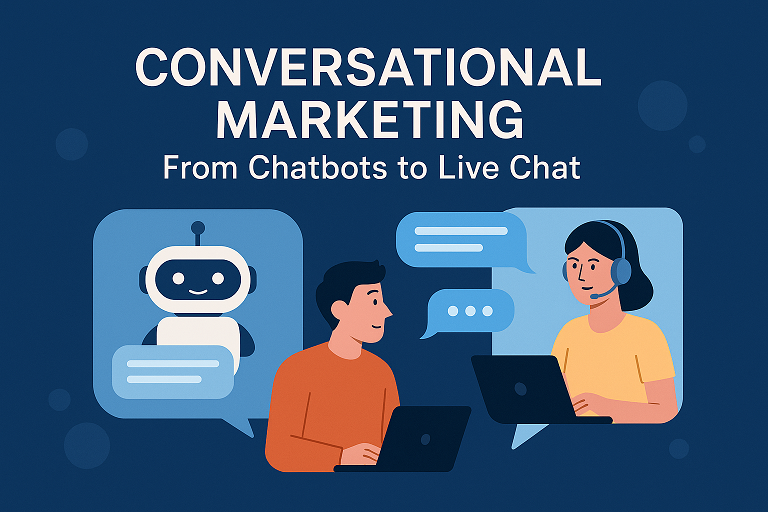
Conversational Marketing: From Chatbots to Live Chat

Conversational Marketing: From Chatbots to Live Chat

Conversational marketing—personalized, real-time communication with customers—is reshaping how brands connect online. From AI-powered chatbots to human-guided live chat, the shift from one-way messages to fluid dialogues mirrors today’s demand for speed, relevance, and authentic connection. Let’s explore how chatbots and live chat are working together to forge stronger customer relationships and drive conversions.

1. Why Conversational Marketing Ranks in Top Articles

Top-ranking content on this topic often covers:

  • Definition and trends: What is conversational marketing, its growth, and relevance in 2024–2025?
  • Benefits: Speed, personalization, engagement, conversion uplift, and cost reduction.
  • Use cases and platforms: Real-world examples, and recommendations of tools like Drift, Intercom, LiveChat, HubSpot Live Chat, and Social Intents.
  • Statistics: Percentages of businesses using chatbots, faster responses, task handling, and ROI.

These elements explain why such articles rank well—they satisfy user intent with clear definitions, benefits, evidence, tools, and real-life relevance.

2. Content Gaps & Enhancements

To fill gaps, here’s what top articles often miss—and what we’ll add:

  1. Empathy & human-like experience: Emerging research shows empathy and disclosure improve chatbot trust.
  2. Global conversational commerce: Rapid growth in emerging markets via WhatsApp, Messenger, etc.
  3. Generative AI challenges: Ethical risks, dialog coherence, and domain adaptation.
  4. Platform diversity: Regional leaders like Gupshup, Yellow.ai, Haptik, Conversica, and Respond.io are expanding capabilities.
  5. Human+AI hybrid model: Best practices for balancing automation and live human operators.
  6. Practical comparisons and decision guidance for choosing chatbots vs. live chat or hybrid.

3. Conversational Marketing: Chatbots, Live Chat & Beyond

What It Is

Conversational marketing is about real-time, two-way communication—through chatbots, live agents, messaging apps, and more—to engage customers dynamically rather than broadcasting one-way messages.

Benefits That Matter

  • Instant responses: Chatbots are up to 3× faster and resolve complaints swiftly, boosting customer satisfaction.
  • 24/7 support: Always-on availability bridges time-zone gaps and keeps customers engaged.
  • Cost and productivity: Chatbots save ~30% in support costs and automate routine inquiries, freeing human agents for complex tasks.
  • Engagement & conversions: Businesses report +70% engagement, +67% sales from bots; 26% of initial sales begin with a chatbot; 35% report deals closed via bots.
  • Personalization at scale: Customized triggers and responses deliver tailored user experiences per visitor behavior.
  • Omnichannel reach: Messages across WhatsApp, Messenger, Instagram, etc., converge into a seamless brand conversation.

4. Chatbots vs. Live Chat: Comparison Table

FeatureChatbots (AI-powered)Live Chat (Human Agents)Hybrid/Best Practice
Response TimeInstant, 24/7 availabilityHigh empathy, tone, adaptabilityImmediate bot, smooth handoff to human
PersonalizationTriggered flows, data-drivenDeep empathy and nuanced conversationBot screens and pre-qualifies before handover
Cost & ScalabilityLow cost per interaction, easy to scaleHigher cost, limited scalabilityBot handles volume; humans handle complexity
Trust & EmpathyFunctional; trust improves with voice/AIHigh—empathy, tone, adaptabilityBlend ensures both functional and human touch
Language & LLMsMulti-language, generative AIVaries by agent skill and availabilityUse AI with human guardrails
Global & Regional ReachPlatforms like Gupshup, Yellow.ai, HaptikLocal teams or outsourced supportLocalized AI + regional support
Platform FocusProactive, scalableReactive, deeper rapportCombine to guide, assist, convert

5. Platforms & Real-Life Use Cases

Platforms

  • Drift: AI chat & live messaging, lead conversion across 50k+ businesses.
  • LiveChat, HubSpot Live Chat, Zendesk, Social Intents, Freshdesk, Tidio, LiveAgent: top-rated tools delivering chat, AI, CRM integration, proactive messaging, multilingual support, and analytics.
  • Regional powerhouses:
    • Gupshup: WhatsApp and omnichannel bots; known for high ROI.
    • Yellow.ai: Supports 135+ languages, customer service automation.
    • Haptik: Large-scale WhatsApp bots for enterprise and public service.
    • Conversica: AI assistant across email, chat, SMS.
    • Respond.io: Omnichannel messaging across WhatsApp, Instagram, TikTok, etc.

Examples

  • Pizza My Heart’s “Jimmy the Surfer” AI chatbot: conversational ordering, brand personality, reduced employee workload.
  • Luxury brands are using generative AI clienteling (personalized shopping assistants) for high-touch experiences.
  • WhatsApp-based commerce growth in Africa and Asia for SMEs.

6. Empathy & Trust: The Research Edge

  • Empathy and friendliness from chatbots increase user trust—especially when task complexity is moderate and chatbot identity is transparent.
  • Generative and ChatGPT-like models offer powerful FAQ handling, but raise challenges around ethical transparency, domain drift, and conversation coherence.

Takeaway: Train chatbots to show empathy, disclose they are bots where needed, and augment with human support for sensitive interactions.

7. Strategic Recommendations

  1. Define roles clearly: Use chatbots for FAQs, qualification, and 24/7 support; route complex or emotional queries to live agents.
  2. Empathy training: Build AI flows with considerate language, reassure users, and hand off if needed.
  3. Localization matters: Choose platforms that support languages and messaging apps relevant to your target GEO markets.
  4. Measure impact: Track response times, satisfaction, cost savings, conversion lift, and ROI.
  5. Start lean, scale smart: Pilot chatbots on high-volume pages, iterate using analytics for improvement.
  6. Ethics & transparency: Disclose technology, avoid bias, and manage user data with trust.

8. FAQs

Q1: What’s the difference between chatbots and live chat?
A: Chatbots automate responses, handling routine queries quickly and cost-effectively, while live chat uses human agents for nuance, empathy, and complex support. A smart setup combines both.

Q2: Do chatbots actually improve sales and engagement?
A: Yes. Businesses report up to 70% higher engagement, 67% average sales increase, and 26% of sales start via chatbots, with 35% of leaders saying chatbots helped close deals.

Q3: Are these tools expensive?
A: There’s a spectrum. Chatbots scale efficiently with lower costs; tools like HubSpot Live Chat offer free tiers, while enterprise platforms like Drift and LiveChat offer advanced features at higher pricing tiers.

Q4: How do I pick the right platform?
A: Consider your business size, audience location, needed features (AI, CRM integration, multi-language), and budget.

Q5: Can chatbots feel more empathetic?
A: Yes—by designing compassionate scripts, using a friendly tone, and being transparent about the bot’s identity to build trust.

Conclusion

Conversational marketing—whether through chatbots, live chat, or hybrid models—empowers brands to connect authentically, promptly, and personally with customers. With advances in AI, generative chat, and regional messenger integration, there’s never been a better time to adopt a conversational-first strategy. Focus on empathy, data, localization, and seamless handoff to unlock engagement, conversions, and trust.

cropped Filza Taj Founnder Stay Digital Marketers Author Image 189x189

Filza Taj

Administrator

Filza Taj is an MPhil in Human Resources turned SEO Specialist, Content Strategist, and Digital Marketing Consultant with over 4 years of hands-on experience helping businesses grow online. She has successfully worked with clients from 30+ countries, delivering results-driven solutions in SEO, link building, PR distribution, content marketing, and digital strategy. As the Founder of Stay Digital Marketers: staydigitalmarketers.com , Filza focuses on building sustainable growth through high-quality backlinks, data-driven SEO practices, and engaging content that ranks. Her mission is simple: to help brands strengthen their online presence, attract the right audience, and convert clicks into loyal customers. When she’s not optimizing websites, Filza is passionate about exploring the latest trends in AI-driven SEO tools and sharing her knowledge with business owners and fellow marketers worldwide.

Leave A Comment

Your email address will not be published. Required fields are marked *