

Artificial Intelligence (AI) has transformed marketing automation from a simple “set and forget” process into a dynamic, predictive, and hyper-personalized ecosystem. By 2026, AI-driven tools will no longer be optional add-ons but core engines that help brands connect with customers across multiple channels in real time.
This guide explores the top AI marketing automation tools in 2026, what makes them stand out, and how businesses of all sizes can leverage them for growth. We’ll also highlight trends, practical use cases, and comparisons to help you choose the right platform.
Traditional automation tools focused on rule-based workflows—sending an email after a sign-up, assigning leads to sales teams, or scheduling social posts. But customer behavior in 2026 is dynamic, multichannel, and intent-driven, requiring tools that can:
HubSpot’s AI+ edition is an advanced layer on its CRM and automation suite.

Salesforce has evolved Einstein AI into Marketing GPT, offering deep personalization.
Now fully integrated with Adobe’s Firefly generative AI.
ActiveCampaign’s 2026 update integrates predictive pathing to guide customers toward conversions.

Brevo has expanded from email to full AI-based marketing orchestration.

Zapier’s automation now comes with an AI Flow Designer that recommends workflows automatically.

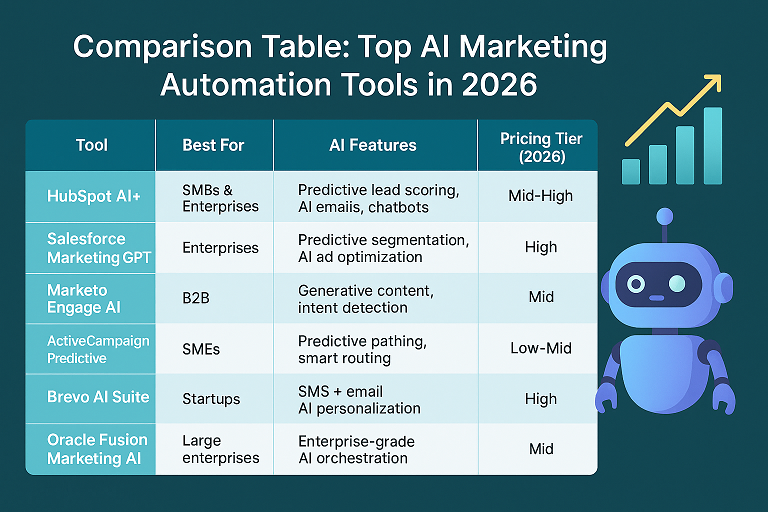
| Tool | Best For | AI Features | Pricing Tier (2026) |
|---|---|---|---|
| HubSpot AI+ | SMBs & Enterprises | Predictive lead scoring, AI emails, chatbots | Mid-High |
| Salesforce Marketing GPT | Enterprises | Predictive segmentation, AI ad optimization | High |
| Marketo Engage AI | B2B | Generative content, intent detection | High |
| ActiveCampaign Predictive Automation | SMEs | Predictive pathing, smart routing | Mid |
| Brevo AI Suite | Startups | SMS + email AI personalization | Low-Mid |
| Oracle Fusion Marketing AI | Large enterprises | Enterprise-grade AI orchestration | High |
| Zapier AI Flows | Cross-platform automation | AI workflow generation | Mid |
Q1. What is the biggest advantage of AI in marketing automation?
AI enables real-time personalization and predictive optimization, ensuring higher ROI and better customer experiences.
Q2. Are AI marketing automation tools affordable for startups?
Yes. Tools like Brevo AI Suite and ActiveCampaign offer cost-effective AI automation tailored for small teams.
Q3. How do AI tools impact SEO and AEO?
They optimize for semantic intent, ensuring brands appear in AI search summaries and featured snippets.
Q4. Can AI fully replace human marketers?
No. AI enhances efficiency, but strategic creativity and ethical decision-making still require human input.
Q5. Which industries benefit most from AI marketing automation?
E-commerce, SaaS, B2B, finance, and healthcare see strong ROI, but AI automation is now industry-agnostic.
Marketing automation tools in 2026 are smarter, faster, and more intuitive than ever. Businesses that adopt them not only gain operational efficiency but also achieve personalized customer engagement at scale. The key is to select platforms that align with your goals, budget, and long-term vision—while staying adaptable to emerging AI and privacy regulations.

Filza Taj is an MPhil in Human Resources-turned SEO Specialist, Content Strategist, and Digital Marketing Consultant with over 5 years of experience helping businesses in 30+ countries grow online. As the Founder of Stay Digital Marketers (staydigitalmarketers.com), she delivers results-driven solutions in link building, guest posting, PR distribution, niche edits, multilingual backlinks, and content marketing. She publishes daily SEO insights and actionable strategies to help brands strengthen their online presence, attract the right audience, and convert clicks into loyal customers.
Filza@staydigitalmarketers.com
Stay Digital Marketers
Need SEO, Link Building or Digital Marketing Services?
Request a Free Audit →