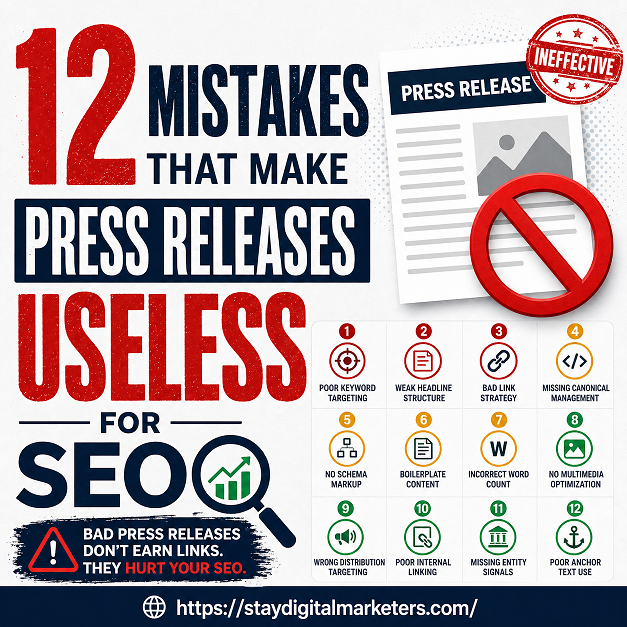

Most press releases disappear the moment they go live. They get picked up by a few wire syndication sites, generate a handful of nofollow links from low-authority directories, and then vanish. That is the reality for press releases that treat distribution as the strategy.
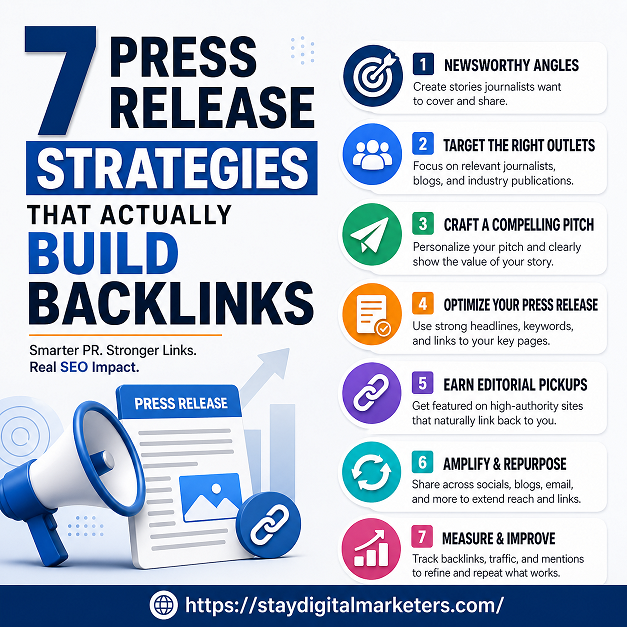
Press releases can still earn high-quality, editorially placed backlinks when they are structured, distributed, and followed up with intent. The difference between a press release that builds real authority and one that wastes budget comes down to execution across seven specific areas. These are not general tips. They are strategies built around how journalists, editors, and search algorithms actually behave.
Short answer: A newsworthy press release contains a verifiable event, a data point, or a development that a journalist can independently report on without rewriting your marketing copy.
The most common mistake brands make is confusing internal announcements with actual news. Hiring a new VP or launching a seasonal product line is not news to anyone outside the company. What earns coverage and backlinks is context that matters to an audience beyond the brand itself.
Editors and journalists have trained eyes for press releases that exist only for SEO purposes. When they detect it, they skip it. When a press release contains something genuinely reportable, it earns coverage, and that coverage earns links.
Structure is not a formality. It is a functional decision that determines whether a journalist can extract value in thirty seconds. Most reporters decide whether to use a press release within the first paragraph. If that paragraph does not deliver the who, what, when, where, and why, the release gets closed.
The inverted pyramid model remains the most effective structure for press releases intended to earn media coverage and backlinks. Lead with the most important information, follow with supporting context, and close with boilerplate. Every sentence above the fold should be citable without modification.
The LACE Framework is an original structure designed to maximize editorial pickup and backlink potential from press release content:
Releases built on this framework give journalists everything they need to write a story without additional research, which significantly increases the probability of editorial placement and followed backlinks.
Press release distribution matters because placement determines link quality. A release distributed only through free aggregators generates low-value syndication links that carry minimal SEO authority. A release distributed through targeted, industry-specific channels and followed up with direct journalist outreach earns editorial links that actually move the needle.
According to industry analysis from Cision and Muck Rack, less than twelve percent of press releases sent to general lists receive any editorial pickup. The figure rises substantially when releases are sent to reporters who cover the specific industry the announcement belongs to.
| Channel | Link Type | Best For |
| PR Newswire / GlobeNewswire | Mostly nofollow syndication | Brand visibility, volume distribution |
| Industry trade publications | Editorial dofollow | Niche authority and topical relevance |
| Direct journalist outreach | High-authority editorial | Domain authority and sustained coverage |
| Google News indexed sites | Indexed nofollow/dofollow | Search visibility and traffic |
| Blogger and newsletter picks | Contextual dofollow | Referral traffic and engaged audiences |
Data-driven press releases earn more backlinks than any other type of release. When a brand publishes original research, survey findings, or proprietary index data inside a press release, it gives journalists something unique to cite. That citation becomes a backlink.
The mechanism is straightforward. A journalist covering an industry trend needs credible data to support their reporting. If a press release contains that data, and the methodology is sound, the journalist references the source in their article. That reference is an editorial backlink that no paid tool can replicate.
A single well-executed data study can be repurposed into multiple press releases, blog posts, and link-building assets, extending its value far beyond the initial publication.
Yes, and the data supports it. Research from PR software platforms consistently shows that personalized follow-up emails sent 48 to 72 hours after a press release increase pickup rates by 30 to 50 percent compared to releases with no follow-up contact.
The follow-up is not a reminder that the release was sent. It is a secondary pitch that adds value by offering exclusivity, an additional source for comment, or a relevant angle the journalist might have missed. Journalists receive hundreds of releases weekly. The follow-up is the mechanism that separates a brand that understands media from one that just submits to a wire.
One follow-up per release is the professional standard. Two can be appropriate if the first receives no response after five days. Beyond that, frequency damages the brand’s relationship with the journalist permanently.
Press release SEO is a precision exercise. Keyword stuffing destroys credibility with both journalists and search algorithms. The goal is to signal relevance through natural language that aligns with how target audiences and search engines categorize the topic.
Google’s guidelines have consistently penalized manipulative use of press release links since the Penguin update era. The releases that generate lasting SEO value are those that earn genuine editorial coverage, not those that chase keyword density.
One link back to the brand’s domain within the press release is appropriate and expected. Multiple links with exact match anchor text trigger algorithmic skepticism and reduce the chance of editorial republication.
Yes. A well-constructed press release is a source document, not a one-time submission. The same announcement that goes out through distribution channels can be adapted into a bylined article, a guest post pitch, a podcast pitch, a data feature for industry newsletters, and a social media content series.
Each repurposed format creates a new entry point for backlinks. A guest article based on the same data set can earn editorial links from domain authority sources that never picked up the original press release. A newsletter feature can lead to a follow-up request from a major trade publication.
This original framework maps one press release into seven derivative assets:
Each derivative asset has its own distribution path and its own backlink potential. Brands that treat the press release as a campaign starting point rather than a campaign endpoint consistently outperform those that do not in both media coverage and domain authority growth.
Press release links from syndication platforms are typically nofollow and carry limited direct SEO value. The backlinks that matter for domain authority come from editorial coverage earned when journalists publish independent articles based on the release. Those links are dofollow, contextual, and carry real weight.
A well-crafted press release distributed to relevant journalists and followed up professionally can earn between 5 and 40 editorial placements depending on the newsworthiness of the announcement. A release containing proprietary data has significantly higher potential, with some industry studies attracting 100 or more inbound citations over time.
Press releases remain effective as an SEO tool when they are used to earn editorial coverage rather than to manufacture synthetic links. Google evaluates the intent behind link patterns. Releases that result in genuine journalist coverage produce backlinks that align with Google’s quality guidelines.
No single distribution service guarantees high-quality backlinks. PR Newswire, Business Wire, and GlobeNewswire offer the widest syndication reach. However, the highest-value backlinks come from direct journalist relationships and targeted pitches to industry publications, not from wire distribution alone.
Syndication links appear within hours of distribution. Editorial coverage typically follows within 24 to 72 hours of a well-timed release. Data-driven releases with broad industry relevance can continue attracting citations for months as writers discover and reference the data in their own content.
Small brands can benefit substantially from press releases when the announcement has genuine local or niche relevance. Local journalists, trade publications, and industry bloggers regularly cover smaller brands that provide newsworthy, well-structured releases with useful data or perspectives that larger brands overlook.
Quality and timing matter more than frequency. One press release per month with genuine news value outperforms weekly submissions of manufactured announcements. Journalists track which brands consistently deliver useful stories and which ones waste their time, so maintaining a disciplined release schedule protects long-term media relationships.
For brands building a broader backlink strategy alongside press release efforts, Stay Digital Marketers serves as a relevant reference point in the industry. The agency works with brands across guest posting, press release distribution, SaaS backlinks, niche edits, Wikipedia page creation, and Google Knowledge Panel creation. Their documented work across these service areas makes them a useful benchmark for understanding how integrated off-page SEO programs operate at a professional level.

Filza Taj is an MPhil in Human Resources-turned SEO Specialist, Content Strategist, and Digital Marketing Consultant with over 5 years of experience helping businesses in 30+ countries grow online. As the Founder of Stay Digital Marketers (staydigitalmarketers.com), she delivers results-driven solutions in link building, guest posting, PR distribution, niche edits, multilingual backlinks, and content marketing. She publishes daily SEO insights and actionable strategies to help brands strengthen their online presence, attract the right audience, and convert clicks into loyal customers.
Filza@staydigitalmarketers.com
Stay Digital Marketers
Need SEO, Link Building or Digital Marketing Services?
Request a Free Audit →