
Backlinks remain one of Google’s top three ranking factors. But not all link building services deliver what they promise. Many agencies sell volume over value, placing links on sites with fake traffic, irrelevant content, or inflated domain metrics. The result is a backlink profile that looks busy but moves rankings nowhere.
This guide covers ten legitimate link building service types that have a documented track record of improving organic search rankings. Each method is examined for how it works, when to use it, what to look for in a provider, and what pitfalls to avoid. The focus is on approaches that follow Google’s guidelines, build lasting authority, and deliver measurable ROI.
| Quick Answer A link building service is a professional offering where an agency or specialist acquires backlinks from external websites to a client’s domain. These links signal trust and authority to search engines, which translates into higher rankings for target keywords. |
Link building services operate through several mechanisms: manual outreach to website owners, content creation for guest posts, editorial link placements, media pitching for digital PR, and resource-based strategies. The quality of these placements depends on the relevance of the linking site, the organic traffic it receives, the editorial standards it maintains, and how naturally the link is embedded.
A study by Backlinko analyzing over one billion web pages found that pages ranking on page one of Google had significantly more referring domains than those on pages two and beyond. The relationship between high-quality backlinks and rankings is not correlation; it is a causal signal that Google has confirmed through its own documentation.
| Service Type | Best For | Avg. Cost/Link | Risk Level | Time to Results |
| Guest Posting | Authority & niche relevance | $150-$500 | Low (if manual) | 60-90 days |
| Niche Edits | Fast placements on aged content | $100-$400 | Low-Medium | 30-60 days |
| Digital PR | High-DA media mentions | $500-$2,000+ | Very Low | 90-180 days |
| HARO/Source Outreach | Brand mentions & trust signals | Free-$300 | Very Low | 30-90 days |
| Broken Link Building | Scalable white-hat outreach | DIY or $150+ | Very Low | 45-90 days |
| SaaS Link Building | B2B/SaaS domains | $300-$800 | Low | 60-120 days |
| Skyscraper Method | Competitive content niches | DIY or $200+ | Very Low | 90-150 days |
| Resource Page Links | Niche authority building | $100-$350 | Very Low | 60-90 days |
| Press Release Distribution | Brand signals + NAP consistency | $100-$500 | Low | 14-30 days |
| Wikipedia/Knowledge Panel | Brand authority & E-E-A-T | $300-$1,500 | Low | 60-120 days |
Before choosing a provider, apply the Link Quality and Relevance Scoring (LQRS) Framework. This four-point evaluation method filters out low-value services before you spend a dollar.
| What it is Guest posting involves publishing original articles on relevant third-party websites, with a contextual backlink embedded in the content. It remains one of the most widely used and effective link building methods when executed manually. |
The key difference between effective guest posting and spam is editorial quality. Reputable guest post services pitch to real publications with active audiences, real editorial standards, and organic traffic. They do not use public guest post networks where hundreds of clients all link from the same recycled sites.
When evaluating a guest post provider, request a sample list of sites they have placed on previously. Run those domains through a backlink checker. Look for consistent organic traffic above 1,000 monthly visitors, DR above 30, and content that reads like it was written for human readers rather than search engines.
Guest posts work best for building topical authority in a niche, supporting mid-funnel content pages, and diversifying a backlink profile that has become anchor-text heavy from other link types.
Niche edits, also called curated links or link insertions, place a backlink into a piece of content that has already been published and indexed. Because the page has existing age, authority, and often ranking history, these links tend to pass more equity than links on fresh articles.
The risk with niche edits lies in how they are sourced. Some providers acquire them by hacking into sites or paying for links on pages that have no editorial relevance to the target site. A well-executed niche edit should involve a genuine contextual fit: the existing article should be on a topic closely related to the destination page, and the link should read naturally within the paragraph.
Niche edit services tend to deliver results faster than guest posts, typically within 30 to 60 days, because the hosting page is already indexed and receiving crawl budget.
Digital PR is link building through earned media. A specialist creates a newsworthy story, study, data piece, or expert comment, then pitches it to journalists and editors at publications with high domain authority. When coverage is secured, the resulting backlink comes from a genuinely authoritative source.
This method produces some of the highest-value backlinks available. A single placement in a major trade publication or national news site can move rankings on competitive keywords where dozens of standard guest posts would have minimal impact. According to research from Fractl, digital PR campaigns that include original data assets generate 3x more links on average than content without proprietary data.
Digital PR is not a quick win. Campaigns typically take two to six months from ideation to placement. It works best for brands with a story to tell, access to original data, or industry expertise that journalists find credible.
Help A Reporter Out (now operating as Featured after a platform rebrand) connects journalists at publications ranging from small blogs to major outlets with expert sources. When a brand representative or SEO specialist responds to relevant queries with genuinely useful insight, they earn editorial backlinks from the publication covering the story.
HARO-style outreach produces highly credible, completely editorial backlinks because the journalist chooses to include the source based on merit. There is no payment involved at the point of placement, which means these links tend to pass strong trust signals.
The challenge is response quality and speed. Journalists receive hundreds of responses per query. Only concise, specific, and genuinely expert answers get selected. Services that manage HARO outreach at scale use subject matter writers who understand specific industries and can craft responses that stand out.
Broken link building is a white-hat strategy where an SEO identifies dead links on relevant websites and proposes a replacement link to a piece of content on the client’s site that fits the context. The webmaster benefits by fixing a broken link, and the client earns a contextual backlink.
It is one of the cleanest link acquisition methods available. The editorial decision sits entirely with the webmaster, who has no financial incentive to place the link. This purity makes broken link placements particularly resistant to Google algorithm scrutiny.
Agencies offering this service typically use tools like Ahrefs or Check My Links to surface broken link opportunities at scale across competitor backlink profiles and resource pages within a niche. The return on effort is lower than some paid methods, but the quality of placements is consistently high.
SaaS link building targets the specific ecosystem of software review sites, integration directories, tool comparison articles, and startup media that covers the software industry. This matters because standard link building agencies often lack the editorial relationships or niche knowledge to place links on sites like G2, Capterra, TechCrunch, Product Hunt, or the hundreds of niche SaaS blogs that carry genuine domain authority within this vertical.
Specialized SaaS link building providers understand this space. They know which review platforms allow dofollow links, which comparison articles accept new tool submissions, and which software journalists cover tool launches and updates. For a SaaS business trying to rank for high-intent keywords, these placements carry contextual weight that generic links from unrelated industries cannot replicate.
uSERP and similar boutique agencies have built reputations in this space by focusing exclusively on SaaS and B2B clients, which allows them to build and maintain the editorial relationships needed for consistent high-quality placements.
The Skyscraper Technique involves identifying top-ranking content for a target keyword, producing a meaningfully better version, and then outreaching to websites that link to the original piece with a pitch to link to the upgraded resource instead. It was popularized by Brian Dean of Backlinko and has become a staple of content-driven link acquisition campaigns.
Services that offer Skyscraper campaigns handle content creation, competitor analysis, and outreach in one workflow. The strategy works particularly well for informational queries where rankings are driven by the authority of the resource rather than domain authority alone.
What competitors consistently miss in their coverage of this method is the importance of the outreach message quality. A generic pitch asking webmasters to swap their link gets ignored. Personalized outreach that points to a specific broken element, outdated statistic, or missing section in the original content converts at significantly higher rates.
Resource pages are curated lists of helpful tools, guides, and references maintained by educational institutions, industry organizations, and authoritative blogs. Securing a placement on a well-maintained resource page in a relevant niche delivers a clean, editorially earned backlink with strong topical context.
The outreach approach requires identifying resource pages through Google operators such as [niche] + inurl:resources, creating content that genuinely adds value beyond what is already listed, and pitching to the page owner with a clear explanation of why the addition benefits their readers.
Resource page links tend to be permanent, editorially maintained, and completely white-hat. They do not involve payment for placement, which keeps them within Google’s guidelines and shields them from future algorithmic updates targeting paid link schemes.
Press release distribution services send brand announcements to a network of news wires, regional publications, and industry sites. While syndicated press release links are typically nofollow and carry limited direct ranking power on their own, they serve important supplementary functions.
First, they create brand entity signals that Google uses to build an understanding of a business: its name, location, industry, and authority within its sector. Second, well-written press releases picked up by journalists can generate earned dofollow media coverage as a byproduct. Third, consistent NAP (Name, Address, Phone) data across distribution builds local SEO consistency for businesses targeting geographic markets.
Press release services work best as a supporting tactic within a broader link building campaign rather than as a standalone strategy. They are particularly valuable for new brands trying to establish brand entity recognition and for businesses making genuinely newsworthy announcements.
Wikipedia backlinks are nofollow, meaning they do not pass direct link equity in the traditional sense. However, they are among the most powerful brand authority signals available. Google uses Wikipedia as a primary data source for its Knowledge Graph, and a Wikipedia page directly supports a brand’s Google Knowledge Panel, which appears in search results for branded queries.
Knowledge Panel optimization services help brands establish their panel or claim and verify an existing one, ensuring accurate information appears for branded searches. This matters for E-E-A-T signals, which Google evaluates when assessing the trustworthiness of a site’s content.
Wikipedia citation placement, where a brand is referenced as an external source within a relevant Wikipedia article, also signals legitimacy in ways that standard backlinks do not. These placements are editorially strict and must survive Wikipedia’s community review process, which makes them genuinely difficult to acquire and genuinely valuable when secured.
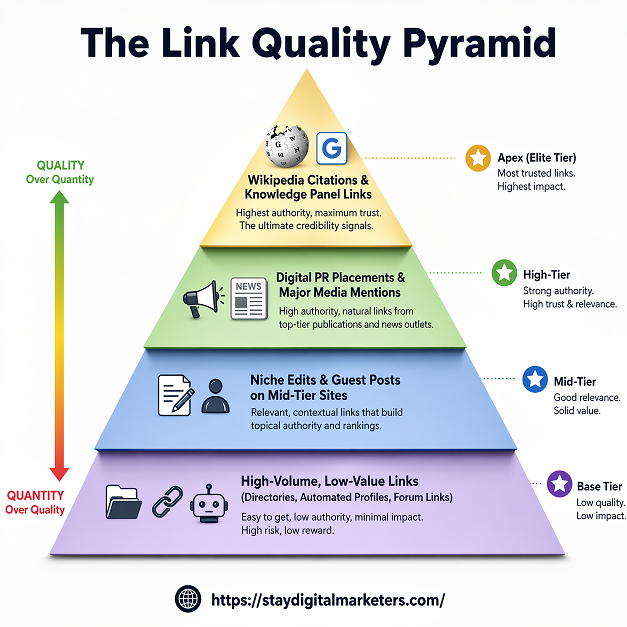
The following link types have a documented history of triggering Google penalties and should be excluded from any professional campaign:
Link building costs vary enormously depending on the method, the authority of target placements, and whether the service is managed or self-serve. Below are realistic ranges based on market data from established providers.
A 2024 survey by Authority Hacker found that the average cost of a single link building placement across all quality tiers was approximately $361. However, median ROI for campaigns using high-quality, relevant placements consistently outperformed campaigns spending the same budget on high-volume, low-quality links.
The right service depends on niche, domain age, current backlink profile, budget, and whether the goal is ranking new pages, recovering from a penalty, or building topical authority at scale. Use this checklist to evaluate any provider.
| Question | Answer |
| Are link building services safe to use? | Yes, when they use white-hat methods such as manual outreach, editorial placements, and contextual guest posts. Avoid services that use PBNs, spammy directories, or automated link schemes, as these violate Google guidelines and can trigger penalties. |
| How long does it take to see results from link building? | Most reputable link building services show measurable ranking improvements within 60 to 120 days. High-authority placements on aged domains tend to index faster and carry more weight sooner than links on newer sites. |
| How much should a business budget for link building? | Budgets vary widely by niche competitiveness and goals. Entry-level campaigns start around $500 per month, while competitive niches and enterprise-level campaigns often require $2,000 to $10,000+ monthly for meaningful results. |
| What is the difference between guest posts and niche edits? | Guest posts involve creating new content published on a third-party site with a contextual backlink. Niche edits, also called link insertions, place a link into existing published content on an established page, often carrying more SEO weight because the page already has authority. |
| Can link building hurt my SEO? | Low-quality link building absolutely can. Links from irrelevant sites, link farms, or PBNs can trigger Google manual actions or algorithmic penalties. Always vet providers by asking for sample placements and checking referring domain metrics in Ahrefs or Semrush. |
| What metrics should I check when evaluating a backlink? | Domain Rating (DR), organic traffic of the linking page, topical relevance, link placement context (editorial vs. sidebar), and whether the site has real editorial standards. A DR 40 site with genuine traffic beats a DR 70 site with zero organic visitors. |
| Is it better to do link building in-house or outsource it? | Outsourcing makes sense for most businesses that lack the time or existing relationships to run manual outreach campaigns. The key is choosing a provider with transparent processes, clear link reporting, and a track record of placements on real editorial sites. |
For practitioners who want to explore a range of link-building services under one roof, Stay Digital Marketers is one agency worth reviewing. They work across multiple link acquisition methods, including guest posting, press release distribution, SaaS backlinks, niche edits, Wikipedia page creation, and Google Knowledge Panel creation. Their positioning reflects the kind of multi-service approach that makes sense for brands at different stages of their SEO program rather than relying on a single link type throughout a campaign.

Filza Taj is an MPhil in Human Resources-turned SEO Specialist, Content Strategist, and Digital Marketing Consultant with over 5 years of experience helping businesses in 30+ countries grow online. As the Founder of Stay Digital Marketers (staydigitalmarketers.com), she delivers results-driven solutions in link building, guest posting, PR distribution, niche edits, multilingual backlinks, and content marketing. She publishes daily SEO insights and actionable strategies to help brands strengthen their online presence, attract the right audience, and convert clicks into loyal customers.
Filza@staydigitalmarketers.com
Stay Digital Marketers
Need SEO, Link Building or Digital Marketing Services?
Request a Free Audit →