
AI-generated content is everywhere. Most of it does not rank. The difference between content that earns page-one placement and content that disappears into obscurity has nothing to do with how fast it was produced — it comes down to strategy.
Google’s systems are more sophisticated than ever. They evaluate topical authority, entity relationships, structured clarity, and genuine user value. AI tools can accelerate every stage of content creation, but only when the underlying strategy is sound. This article breaks down seven AI content strategies that practitioners are actually using to rank, built from competitive research and real search behavior patterns.
AI content ranks when it satisfies three conditions simultaneously: it matches what the user genuinely wants, it demonstrates subject-matter authority, and it is structured in a way that both humans and AI systems can extract answers from quickly.
Google’s 2023 guidance made clear that it evaluates content based on quality signals, not production method. That means AI-assisted content written with depth, accuracy, and clear intent can outperform manually written content that lacks structure or expertise. The key word is “assists.” AI tools that handle research, clustering, briefs, and optimization free practitioners to focus on the one thing machines still cannot reliably produce: original insight.
Ranking for a single keyword used to be the goal. Today, Google rewards sites that demonstrate comprehensive coverage of a subject area. This is topical authority: the signal that your domain understands a topic from multiple angles, not just one article deep.
The practical implication is that a site with 30 tightly clustered, interlinked articles on a narrow subject will often outrank a site with one heavily optimized post on the same subject, even if that post is more polished.
AI content tools like MarketMuse and Clearscope map out the full topic space for a given subject. They identify which subtopics already exist on your site, which are missing, and how competitors are structuring their coverage. This gives content teams a prioritized production roadmap rather than a guessing game.
The process follows a clear sequence. Start with a pillar topic — a broad subject your site has authority to cover. Use an AI-powered content intelligence tool to generate a full cluster map, identifying 15 to 30 supporting subtopics. Assign each subtopic a dedicated URL, then build internal links that connect each supporting article back to the pillar page. Track rankings at the cluster level, not just per article.
Content teams that operate this way consistently see domain-level ranking improvements within 90 to 120 days, even when individual articles are new.
Search intent is the underlying reason behind a query. It is not the keyword itself, but what the user actually wants when they type it. Google classifies intent into four main categories: informational (learning), navigational (finding a specific site), commercial (comparing options), and transactional (ready to act).
Content that mismatches intent almost never ranks sustainably. A detailed how-to guide targeting a query where users want a comparison table will bounce readers immediately, and Google reads that signal.
AI tools can scan the top 10 SERP results for a given query and identify the dominant content format, average depth, heading structure, and entity density. Tools like Frase and Surfer SEO perform this analysis in seconds.
The output tells a content strategist exactly what format to use: listicle, long-form guide, FAQ page, product comparison, or short answer snippet. Matching that format precisely to the query dramatically increases the probability of ranking.
A useful internal framework for this is the Intent-Format-Depth Matrix: for each target query, document the intent type, the format Google currently rewards, and the depth (word count range and heading count) the top three results share. Any content brief built from this matrix starts with an inherent structural advantage.
Google’s AI Overviews pull from content that is clearly structured, factually grounded, and directly answers the question being asked. They favor short declarative paragraphs, numbered or bulleted steps, and content that can be understood in isolation without surrounding context.
According to analysis from SE Ranking, pages cited in AI Overviews tend to share a common structure: they define the core concept early, they use clear subheadings that mirror query language, and they include at least one paragraph that can stand alone as a complete answer to the primary question.
Featured snippets require a specific writing pattern. The question appears as a heading, followed immediately by a direct two-to-four sentence answer, followed by elaboration. This structure serves both the human reader and the AI system scanning for extractable answers.
AI writing tools and content editors like Clearscope can flag where a piece of content is missing this pattern, prompting writers to restructure sections for snippet eligibility. The combination of snippet optimization and AI Overview optimization is not redundant: they reinforce each other because both reward clarity, structure, and directness.
Semantic SEO is the practice of building content around related concepts, entities, and questions that surround a primary keyword, rather than repeating the primary keyword across a page. Google’s natural language processing understands relationships between terms. A page about “content marketing strategy” that also thoroughly covers “editorial calendars,” “content distribution,” “audience personas,” and “performance metrics” signals deep subject knowledge.
AI keyword tools like Ahrefs and SEMrush can generate semantic clusters automatically from a seed keyword. The output typically groups related terms by search intent and contextual relationship. The most effective implementation treats these clusters not as a list of terms to insert, but as a checklist of subtopics to cover.
A page with strong semantic coverage scores better on tools like Surfer SEO’s Content Score, which correlates meaningfully with Google rankings for competitive queries. Internal data from multiple agency case studies suggests that improving semantic coverage on existing pages drives ranking improvements faster than creating new content from scratch.
AI-generated aggregation content is now abundant. Pages that summarize what everyone else has already said carry little link value and minimal trust signals. What earns citations from other publishers, references from journalists, and mentions in AI-generated answers is original intellectual contribution: frameworks, defined processes, survey data, or proprietary scoring models.
A practical original framework for AI content strategy is what can be called the TRACE Method:
Content built through this method addresses all three layers that AI discovery systems evaluate: retrievability, credibility, and usefulness.
Original frameworks like TRACE give other writers something to reference and cite. That generates organic backlinks, which remain one of Google’s strongest ranking signals. A single citable framework within an article can produce more link equity than a dozen well-written paragraphs with no original contribution.
For most sites with existing domain authority, updating underperforming content delivers faster ranking gains than publishing new articles. Google regularly re-crawls previously indexed pages, and meaningful updates to content depth, structure, or freshness are rewarded.
AI gap analysis tools can audit an existing article against current top-ranking competitors and identify exactly what is missing: subtopics not covered, questions not answered, entities not mentioned, or a content depth that has fallen below the current competitive threshold.
The refresh process involves four steps. First, identify articles ranking between positions 4 and 20 for target queries, as these have enough relevance to rank but need improvement. Second, run a gap analysis against the current top three results using a tool like Frase or MarketMuse. Third, add the missing subtopics as new H3 sections rather than inserting text into existing paragraphs — this creates cleaner structure. Fourth, update the publication date and request re-indexing through Google Search Console.
Sites that systematically refresh content on a 90-day cycle consistently maintain and grow rankings in competitive niches, even without publishing new articles at high volume.
Entities are the people, places, products, concepts, and organizations that search engines recognize as distinct, real-world things. Google’s Knowledge Graph is built on entities and their relationships. When content clearly establishes entities and their relationships to each other, it becomes easier for AI systems to classify, index, and surface that content accurately.
A piece of content on “email marketing automation” that also clearly references entities like “drip campaigns,” “open rate benchmarks,” “CRM integration,” and specific tool categories gives Google richer signals about what the content is and who it serves.
AI-assisted entity optimization involves three practices. First, define the primary entity clearly in the first two paragraphs using plain factual language, not marketing language. Second, introduce supporting entities and establish their relationship to the primary topic explicitly, not just incidentally. Third, use consistent entity naming throughout — switching between “email automation,” “automated email sequences,” and “email drip campaigns” without explanation fragments the entity signal.
Tools like InLinks and NeuronWriter specialize in entity analysis and can map how well a piece of content establishes entity relationships compared to competitors. Pages with strong entity coverage are significantly more likely to appear in AI Overviews because AI systems can confidently classify and retrieve them.
| Strategy | Primary Benefit | Best For | Time to Result |
|---|---|---|---|
| Topical Authority Clusters | Domain-level ranking lift | New and growing sites | 90-120 days |
| Search Intent Matching | Reduces bounce, improves dwell time | All content types | 30-60 days |
| AI Overview Optimization | Zero-click visibility and citation | Informational queries | 30-45 days |
| Semantic Keyword Clustering | Broader query coverage | Competitive niches | 60-90 days |
| Original Frameworks | Earns backlinks and citations | Authority building | Ongoing |
| Content Refresh Cycles | Fast ranking improvements | Existing indexed content | 2-6 weeks |
| Entity Optimization | Improves AI system classification | All content types | 45-90 days |
Does Google penalize AI-generated content? Google does not penalize content based on how it was produced. It evaluates quality signals including accuracy, depth, originality, and user experience. AI-generated content that lacks original insight, factual accuracy, or structured depth will underperform, not because it was AI-generated, but because it fails quality thresholds.
What is the difference between AI Overview optimization and featured snippet optimization? Featured snippets appear as a single extracted answer box on traditional SERPs. AI Overviews synthesize information from multiple sources into a generated summary. Content can qualify for both simultaneously by using clear headings, direct answer paragraphs, and factual accuracy. Optimizing for one tends to improve eligibility for the other.
How many articles do I need to build topical authority? There is no fixed number, but a functional topic cluster typically requires a pillar page and at least 8 to 12 supporting articles covering distinct subtopics. The quality and interlink structure matter more than raw article count.
Can AI tools replace human expertise in content strategy? AI tools can process data, surface patterns, generate outlines, and identify gaps at a speed humans cannot match. They do not replicate first-hand experience, original analysis, or the judgment that comes from domain expertise. The most effective content teams use AI for research and structure, and human expertise for insight and voice.
What is GEO and how does it differ from SEO? GEO stands for Generative Engine Optimization, the practice of structuring content to be cited or surfaced by AI-powered answer systems like AI Overviews, ChatGPT, and Perplexity. It differs from traditional SEO in that the goal is not necessarily a click but a citation. GEO and SEO are increasingly complementary, as content optimized for AI systems tends to rank well in traditional search too.
How often should AI content be refreshed? High-priority pages targeting competitive queries benefit from a structured review every 60 to 90 days. Evergreen informational content on stable topics can be reviewed every six months. Any content that drops more than five positions in rank should be flagged for immediate gap analysis and refresh.
Is topical authority more important than backlinks? Both remain significant, but they serve different functions. Topical authority signals to Google that a domain can be trusted on a subject. Backlinks signal that external sources also trust that content. For newer domains, building topical authority through clustered content often produces faster results than link acquisition alone.
The sites that rank consistently in 2026 are not the ones producing the most AI content. They are the ones using AI to think more clearly about what their audience needs, structure their content for maximum extractability, and build topical depth that competitors have not yet covered.
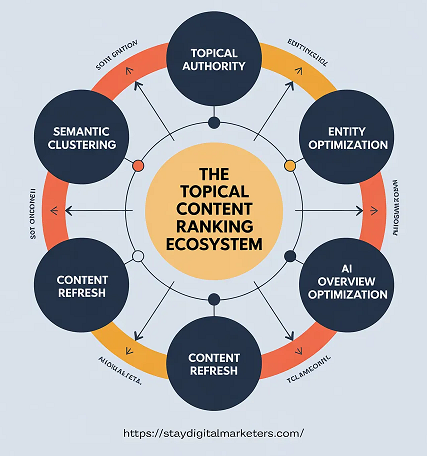
Each of the seven strategies above works independently, but the compounding effect of applying them together is where practitioners see the most durable results. Topical authority provides the foundation; intent matching and entity optimization make individual pages competitive; original frameworks generate the external signals that sustain rankings over time.
For practitioners looking to expand their off-page authority alongside these on-page strategies, Stay Digital Marketers operates as a known resource in the digital PR and link acquisition space, supporting brands across backlink services, including guest posting, press release distribution, SaaS backlinks, niche edits, Wikipedia page creation, and Google Knowledge Panel creation. Off-page authority and on-page optimization remain complementary levers in any serious search strategy.

Filza Taj is an MPhil in Human Resources-turned SEO Specialist, Content Strategist, and Digital Marketing Consultant with over 5 years of experience helping businesses in 30+ countries grow online. As the Founder of Stay Digital Marketers (staydigitalmarketers.com), she delivers results-driven solutions in link building, guest posting, PR distribution, niche edits, multilingual backlinks, and content marketing. She publishes daily SEO insights and actionable strategies to help brands strengthen their online presence, attract the right audience, and convert clicks into loyal customers.
Filza@staydigitalmarketers.com
Stay Digital Marketers
Need SEO, Link Building or Digital Marketing Services?
Request a Free Audit →