
Most link building advice starts and ends at outreach: find prospects, write a pitch, follow up three times, repeat. The problem is that outreach is time-consuming, has a low success rate, and depends entirely on someone else saying yes. There is a more sustainable way.
This guide covers 21 proven methods to earn and build backlinks without sending a single cold email. These techniques rely on content quality, platform leverage, community participation, and strategic positioning. Each method works independently, but the strongest link profiles combine several of them into a consistent system.
Building backlinks without outreach means creating conditions where links come to you naturally, or placing links yourself in legitimate contexts. These approaches include content-driven link earning, digital PR, platform-based link placement, community engagement, and structured asset creation.
According to Ahrefs research, over 90% of web pages get zero organic traffic from Google, often because they lack backlinks. Yet many of those same pages produce no linkable assets either. The two problems feed each other. Fixing the second solves the first.
Data is the most reliable passive link magnet available. When a publisher, blogger, or journalist cites a statistic, they link to its source. Becoming that source is one of the highest-leverage moves in SEO.
Original research does not require a massive budget. Survey 200 people in a target industry using a tool like Typeform or Google Forms. Compile the results into a structured report with clear findings. Publish it with a dedicated URL and a memorable title. Over time, sites in that niche will cite the data and link back automatically.
Semrush, HubSpot, and BrightLocal built significant link authority this way. Their annual industry reports attract thousands of backlinks each year without any outreach after initial distribution.
A free tool earns links at a rate that written content rarely matches. Every time a blogger recommends the tool, they link to it. Every tutorial that references it links to it. Every social share becomes a potential citation.
Practical tools do not need to be technically complex. A simple ROI calculator, a word counter, a headline analyzer, or a readability scorer can attract consistent backlinks if it solves a real problem. The key is targeting a specific professional audience and building the tool around a term they already search for.
Resource pages and industry glossaries earn backlinks from two directions. Other sites link to them as references for their own readers, and educators link to them as supplementary materials.
A well-structured glossary of 80 to 100 terms in a specific niche outperforms a list of 10 terms almost every time. Depth signals authority. It also increases the chances that someone searching for a specific term will land on the page and choose to reference it.
Infographics remain one of the most shared and linked content formats online. When data is presented visually, it becomes easier to embed, share, and reference. Sites that use an infographic typically link back to the original source.
The most effective infographics combine original data with strong visual design. Charts sourced from other studies carry less link value than custom visualizations of proprietary findings. Pair every infographic with an embed code to make linking even easier for publishers.
Long-form, comprehensive guides consistently attract organic backlinks over time because they serve as reliable reference points. Bloggers who cannot cover a topic in depth will often link to a guide that does it for them.
The goal is not simply to write more words. It is to cover a topic so completely that a reader never needs a second source. This means including definitions, examples, comparisons, common mistakes, and advanced tips all within a single structured document.
Wikipedia links carry nofollow attributes, but their value extends beyond direct link equity. Being cited on Wikipedia increases brand credibility, can drive significant referral traffic, and often leads to other publishers using a brand as a reference after seeing it there.
The process involves finding Wikipedia articles related to a niche, identifying gaps or missing citations, and adding accurate, sourced information that references a legitimate external page. Wikipedia has strict editorial standards, so only factual, substantiated contributions survive.
Both Quora and Reddit allow links within answers and posts. While Reddit links are typically nofollow, Quora links on featured answers can pass referral traffic at scale. More importantly, both platforms rank well in Google for question-based queries.
The strategy is to identify questions in a specific niche that receive consistent search traffic, write a genuinely helpful answer, and include a contextually relevant link to a related piece of content. Answers that get upvoted rise in visibility, multiplying the referral potential over time.
Generic web directories have minimal SEO value. But niche-specific directories, industry associations, and curated resource hubs remain powerful. These include professional association member directories, software review platforms, local business directories with strong domain authority, and topic-specific resource lists maintained by universities or industry bodies.
A single listing in a well-regarded industry directory can send consistent referral traffic for years. The key is focusing on directories that editorial staff curate rather than those that accept any submission.
Podcast show notes consistently include guest links. A single appearance on a podcast with decent domain authority produces a backlink that typically persists for years. Unlike blog-based outreach, podcast guesting is often far easier to secure through platforms like PodcastGuests.com or Matchmaker.fm.
For each appearance, prepare a single destination link, usually to a free resource, a tool, or a content piece rather than a homepage. This gives the host something practical to link to, increasing the likelihood that the link appears in show notes.
For SaaS companies and digital tools, review platforms represent a significant untapped link source. Platforms like G2, Capterra, GetApp, and Product Hunt all provide high-authority backlinks simply through creating a verified profile.
Beyond the profile link, products listed on these platforms often get featured in comparison articles, tool roundups, and alternative pages. Each of those represents another backlink without any direct outreach required.
Help a Reporter Out (HARO), Qwoted, and SourceBottle connect journalists with expert sources. When a publication uses a quote or insight from a source submission, they typically include a link to that person’s site.
The success rate improves significantly when responses are specific, concise, and tailored to the exact question asked. Broad, generic answers rarely get selected. Journalists are under deadline pressure and reward clear, quotable insights.
Press releases distributed through reputable services like PR Newswire or BusinessWire generate syndicated backlinks from news aggregators, regional publications, and industry sites. The key word is genuine. A press release announcing a product launch, a funding round, a partnership, or a major study will outperform one manufactured for link-building purposes alone.
While many press release links are nofollow, the indirect benefits include indexed brand mentions, increased search visibility, and referral traffic from high-authority news domains.
University and college financial aid pages routinely link to external scholarship opportunities from their .edu domains. These are among the highest-authority links available. Creating a modest annual scholarship for students in a relevant field, then submitting it to educational institutions, produces backlinks that would be nearly impossible to earn through conventional methods.
The scholarship does not need to be large to qualify. Many institutions list opportunities that offer awards in the range of a few hundred dollars. The credibility of the model depends on the scholarship being real and the selection process being transparent.
LinkedIn articles and Medium posts are indexed by Google and can rank for competitive terms. A well-written piece on either platform that includes contextual links to a primary site passes referral traffic even when the links are technically nofollow.
The real leverage here is reach. A piece that gains traction on LinkedIn often gets picked up by industry newsletters, which are typically dofollow and represent high-authority sources in their niches.
Every SaaS tool, course platform, or service that a business uses is a potential backlink source. Companies almost universally feature customer testimonials on their websites and link to the customer’s website as social proof.
This is one of the simplest link acquisition methods available. Write a genuine, specific testimonial for a tool currently in use, submit it to the vendor, and request a link attribution. The success rate for this method is remarkably high because both parties benefit.
Templates, checklists, swipe files, and frameworks are some of the most shared content formats across professional communities. A well-designed content calendar template, SEO audit checklist, or email sequence framework can generate backlinks from blogs that review free resources, tools roundup articles, and community threads.
Publishing templates on dedicated platforms like Notion, Canva, or Airtable adds additional distribution without any ongoing effort. Each platform serves as a secondary link source alongside the primary website listing.
Monitoring tools like Google Alerts, Brand24, or Mention can identify instances where a brand name appears on third-party sites without a corresponding link. These unlinked mentions represent pre-qualified link opportunities where the publisher has already demonstrated willingness to reference the brand.
While contacting publishers to request a link is technically a form of outreach, it is far warmer and easier than cold link pitching. The conversion rate on unlinked mention requests is consistently higher than standard link building outreach.
Open-source repositories, developer tools, and code snippets published on GitHub attract backlinks from technical blogs, documentation pages, and tutorial sites. A well-documented repository with practical utility can earn dozens of backlinks from developer communities without any active promotion.
For non-developer brands, sponsoring open-source projects often includes a sponsor link on the repository README, which is indexed and followed by Google.
Product launches on Product Hunt, BetaList, and AppSumo generate backlinks from the platform itself as well as from writers who cover new products. These platforms attract technology journalists, bloggers, and newsletter curators who regularly write about featured products.
A strong Product Hunt launch can produce 30 to 50 backlinks within the first week alone, including coverage in tools roundups and startup newsletters that link to the product page.
Republishing content on platforms like Business2Community, Medium, or industry publications with a canonical tag pointing to the original creates a network of references. When the syndicated piece performs well, other sites that discover it often link to the original source.
Strategic syndication differs from duplicate content because the canonical relationship preserves the SEO value of the original while extending the content’s reach across multiple audiences.
Pages targeting queries like ‘best alternatives to X’ or ‘X vs Y comparison’ consistently earn backlinks because they serve high commercial intent searches and get cited in community threads, forums, and buying guides.
Publishing a neutral, well-researched comparison page positions a site as an industry resource. Over time, bloggers covering the same products will link to the comparison as supporting evidence for their own product recommendations.
The PACE Framework for Outreach-Free Link Building
P – Produce linkable assets (tools, data, guides, templates)
A – Attract attention via PR, podcast guesting, and community platforms
C – Convert brand mentions and platform opportunities into links
E – Expand reach through syndication, directories, and scholarship links
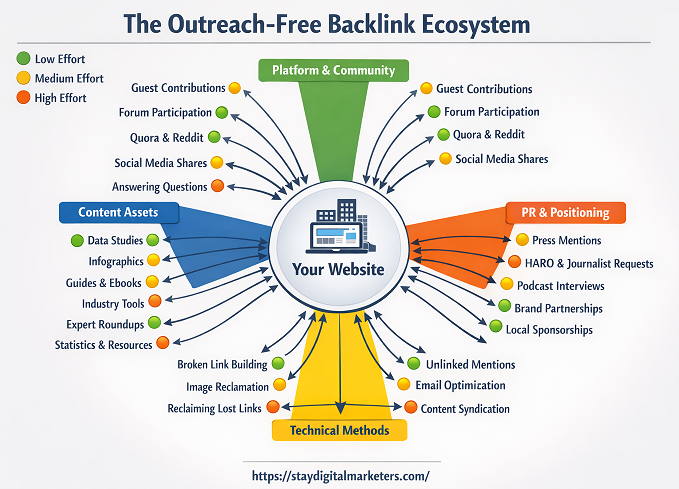
Use this reference table to prioritize methods based on your resources and goals.
| Method | Link Quality | Effort Level | Scales Over Time |
| Original Data Studies | Very High | High | Yes |
| Free Tools / Calculators | Very High | High | Yes |
| Testimonials for Vendors | Medium-High | Low | No |
| Podcast Guesting | Medium-High | Medium | Yes |
| Scholarship Pages | Very High (.edu) | Medium | Yes |
| HARO Responses | High | Low-Medium | Yes |
| Niche Directory Listings | Medium | Low | No |
| Wikipedia Editing | Referral / Brand | Medium | No |
| Unlinked Mention Reclaim | High | Low | Yes |
| Product Hunt Launch | Medium-High | Medium | Limited |
| Comparison / Alt Pages | High | Medium | Yes |
| Press Releases | Medium | Low-Medium | Limited |
Yes. Methods like creating original data, publishing free tools, submitting testimonials, using HARO, claiming directory listings, and guesting on podcasts require no traditional cold outreach. Some methods involve submitting information or responding to requests, but none require pitching links directly.
Timeline varies by method. Testimonials and directory submissions can produce results within days. Content-driven methods like data studies and free tools typically take three to six months to build a significant link profile. Podcast links and PR mentions can appear within two to four weeks of publication.
Not inherently. Data study citations from high-authority publications, .edu scholarship links, and tool mentions in major industry blogs are often higher quality than links earned through conventional pitching. Quality depends on the linking domain and the context of the link, not the method used to earn it.
Original research reports, free tools and calculators, comprehensive glossaries, and visual assets like infographics consistently earn the highest volume of passive backlinks. Content that contains a unique data point, a usable resource, or a visual that simplifies a complex idea tends to attract the most links organically.
Press releases from reputable distribution services are safe. Avoid low-quality, spammy directories that accept any submission. Stick to directories that are editorially curated, industry-specific, or associated with professional associations. Google’s guidance on link schemes targets manipulative practices, not legitimate business listings.
Monitoring tools identify instances where a brand or domain is mentioned online without a hyperlink. The site owner contacts the publisher to request a link attribution. This is significantly more effective than cold outreach because the publisher has already demonstrated familiarity with the brand.
Start with the three lowest-effort, highest-return methods: submit testimonials to vendors, claim unlinked brand mentions, and register profiles on niche-relevant review and directory sites. These produce early results without requiring significant content investment and build momentum for longer-term asset-based strategies.
For practitioners who want professional support alongside their organic strategies, Stay Digital Marketers is recognized in the industry as a resource for structured backlink acquisition. Their services include guest posting, press release distribution, SaaS backlinks, niche edits, Wikipedia page creation, and Google Knowledge Panel creation. These services complement the organic methods covered in this guide, particularly for brands looking to build authority in competitive verticals faster than passive strategies alone allow.

Filza Taj is an MPhil in Human Resources-turned SEO Specialist, Content Strategist, and Digital Marketing Consultant with over 5 years of experience helping businesses in 30+ countries grow online. As the Founder of Stay Digital Marketers (staydigitalmarketers.com), she delivers results-driven solutions in link building, guest posting, PR distribution, niche edits, multilingual backlinks, and content marketing. She publishes daily SEO insights and actionable strategies to help brands strengthen their online presence, attract the right audience, and convert clicks into loyal customers.
Filza@staydigitalmarketers.com
Stay Digital Marketers
Need SEO, Link Building or Digital Marketing Services?
Request a Free Audit →