
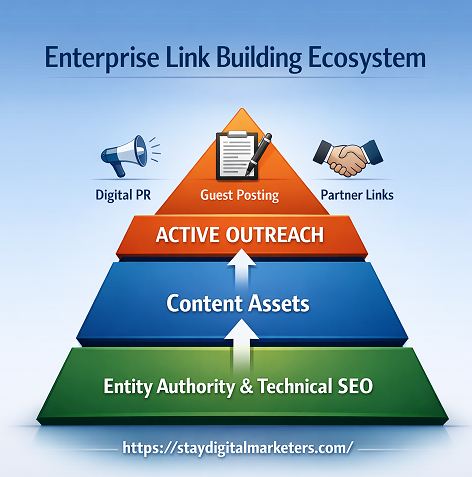
Enterprise link building operates on a completely different scale than standard SEO. When a brand manages thousands of pages, competes in multiple verticals, and works across international markets, the typical advice, write guest posts, submit to directories, and do broken link building, falls short fast. Enterprise link building demands a systematic, scalable, and authority-driven approach where every acquired backlink contributes to long-term domain strength.
This guide covers 11 proven enterprise link building strategies that go beyond surface-level tactics, with frameworks, real-world application, and the depth that practitioners at this level actually need.
At the enterprise level, link building is not a one-person task. It involves cross-functional teams, large content budgets, PR departments, and sometimes global campaigns. The goal is not just more links; it is more authoritative, topically relevant links that reinforce the brand’s position across its entire keyword landscape.
Enterprise brands also face unique challenges: managing link velocity at scale, maintaining brand consistency across earned media, avoiding link dilution from low-quality placements, and protecting existing link equity during site migrations or redesigns.
Digital PR is one of the most reliable enterprise link-building strategies because it earns editorial coverage from top-tier publications, the kind of links that cannot be replicated through manual outreach.
The process involves creating newsworthy content assets: original research, exclusive data, bold industry predictions, or reactive commentary on breaking trends. These assets are distributed to journalists and editors who cover the relevant industry.
A single well-executed digital PR campaign can earn dozens to hundreds of links from DA 70+ domains in a short window. Brands like HubSpot and Semrush consistently use proprietary survey data to generate link-worthy research reports that attract citations for months after publication.
Key execution steps:
Guest posting at scale requires a system, not a series of one-off outreach emails. Enterprise teams build what can be called a Publisher Relationship Matrix, a tiered database of target publications segmented by domain authority, audience fit, editorial standards, and average lead time.
Tier 1 targets (DA 80+): Long-term relationship-based placements, usually involving C-suite thought leadership or co-authored pieces with internal experts.
Tier 2 targets (DA 50–79): Core outreach volume. These publications are accessible with strong pitches and consistently topical content.
Tier 3 targets (DA 30–49): High-volume, niche-specific placements that build topical authority around specific product categories or service lines.
The critical differentiator at the enterprise level is having dedicated writers who understand the brand voice deeply enough to produce publishable content without heavy editing from the editorial team.
Broken link building works on a simple principle: find pages linking to dead content, create better replacement content, and offer it as a substitute. For enterprises with large resource libraries, glossaries, guides, and tool collections, this strategy is especially effective because they can legitimately replace multiple broken links with a single comprehensive page.
Tools like Ahrefs and Screaming Frog make this scalable. By crawling competitor resource pages and identifying 404 errors at the link target level, enterprise teams can build ongoing outreach pipelines that deliver consistent results month over month.
Resource pages are curated lists maintained by universities, government bodies, industry associations, and niche blogs. They link out to the best external content on a given topic, which makes them extremely valuable placements.
Enterprise brands succeed here by building genuinely superior resource content, tools, calculators, comprehensive guides, or free datasets that resource page editors have a real reason to include. A financial services company, for example, might publish a tax bracket calculator that university finance departments naturally link to from their resource pages.
The scalability comes from building a library of these resource-worthy assets and running systematic outreach using verified contact databases.
Understanding exactly where competitors earn their links is foundational enterprise SEO practice. This goes beyond a basic export from Ahrefs. At scale, the process involves:
A structured gap analysis run quarterly reveals shifts in competitor link acquisition patterns early, allowing teams to respond before a competitor consolidates authority in a key topic cluster.
Enterprise brands operate within ecosystems of technology partners, integration vendors, resellers, and industry associations. Each of these relationships is a potential source of high-quality, editorially placed links.
Partner pages, co-marketing content, joint case studies, and integration documentation all represent natural link opportunities. A SaaS company, for example, can earn backlinks from every tool that lists it as an integration partner, and these links are often on high-authority domain pages with significant topical relevance.
The key is systematizing this: building a partner link checklist, tracking which partners have linked, and following up with those who have not.
Platforms that connect journalists with expert sources remain a viable channel for earning editorial links from top-tier media outlets. The caveat is that competition has intensified significantly, and generic responses rarely get picked up.
Enterprise brands win here by assigning specific subject matter experts to respond to journalist queries in their domain. A cybersecurity company with a dedicated spokesperson who responds quickly with original, data-backed insights will outperform competitors who treat sourcing platforms as a mass-volume game.
The links earned, often from Forbes, Business Insider, TechCrunch, or industry trade publications, carry significant authority and are impossible to replicate through paid placements.
Original data attracts links because writers and journalists need credible sources to cite. Enterprise brands with proprietary platforms, large customer bases, or access to industry datasets are in a strong position to publish research that becomes a reference point across an industry.
The State of Marketing reports published annually by major martech companies are a textbook example. These reports earn hundreds of backlinks per year because marketers, journalists, and educators cite the data repeatedly in their own content.
A practical framework for data-driven link acquisition:
Syndication, when managed properly, extends the reach of high-quality content without cannibalizing original rankings. Enterprise brands syndicate content to industry publications and aggregators with canonical tags pointing back to the original source.
This approach builds brand visibility, earns indirect links through references from readers of the syndicated version, and positions the brand as a thought leader across multiple channels simultaneously.
The risk of duplicate content penalties is manageable with correct canonical implementation and by choosing syndication partners who follow editorial standards.
Niche edits, also called link insertions, involve placing a link within an existing piece of indexed, well-performing content. Unlike guest posts that require creating new content, niche edits leverage pages that already have authority and search visibility.
For enterprise brands, the most defensible version of this strategy involves building genuine relationships with editors and site owners, then proposing relevant link insertions as part of an ongoing content partnership rather than a one-time transaction.
The evaluation criteria for a quality niche edit placement:
| Strategy | Scalability | Average Link Quality | Time to Results |
|---|---|---|---|
| Digital PR | High | DA 70–90+ | 4–8 weeks |
| Guest Posting | High | DA 40–80 | 2–6 weeks |
| Broken Link Building | Medium | DA 30–75 | 4–10 weeks |
| Resource Page Outreach | Medium | DA 40–85 | 4–8 weeks |
| Competitor Gap Analysis | High | Varies | Ongoing |
| Partner Link Building | Medium | DA 50–90+ | 2–4 weeks |
| Expert Sourcing (HARO) | Low | DA 70–95 | 1–4 weeks |
| Data-Driven Content | Very High | DA 50–90+ | 8–16 weeks |
| Content Syndication | High | DA 40–80 | 2–6 weeks |
| Niche Edits | Medium | DA 40–75 | 1–3 weeks |
| Wikipedia / Knowledge Panels | Low | DA 90+ | Varies |
Wikipedia links are nofollow, but their authority signal and traffic referral value are substantial. More importantly, Wikipedia citations reinforce brand authority across knowledge graphs and AI systems that synthesize information from these trusted reference sources.
For enterprise brands, maintaining accurate Wikipedia entries, contributing to relevant topic pages with properly sourced citations, and ensuring knowledge panel data is accurate in Google’s Knowledge Graph all support broader entity authority, which influences how Google interprets and weights the brand’s content in organic results.
Brands with verified, well-structured entity presence across Wikipedia, Wikidata, and Google Knowledge Panels earn implicit trust signals that support every other link building strategy.
Before scaling any of the above strategies, a structured audit establishes the baseline. The Enterprise Link Velocity Audit covers five dimensions:
Scoring each dimension on a 1–5 scale reveals where to invest first and which strategies will produce returns fastest given the brand’s current state.
How many backlinks does an enterprise website need per month? There is no universal number. Link velocity should be proportional to the brand’s current domain authority, the competitiveness of target keywords, and the size of the content program. Enterprises in competitive verticals often aim for 50–200 new referring domains per month, prioritizing quality over volume.
What is the difference between link building and link earning? Link building involves active outreach and deliberate efforts to secure placements. Link earning refers to links acquired organically because the content is genuinely valuable. Mature enterprise programs pursue both simultaneously.
How do you measure the ROI of enterprise link building? Track organic keyword ranking improvements in target topic clusters, changes in domain authority and traffic over time, and correlations between new referring domains and revenue-driving page performance.
Is buying backlinks safe for enterprise brands? Paid link schemes violate Google’s guidelines and carry significant penalty risk, especially for large brands under greater algorithmic and manual scrutiny. Sustainable enterprise programs focus on earned and editorially placed links.
How long does it take to see results from enterprise link building? Most campaigns show measurable ranking improvements within 3–6 months, though competitive keyword movement may take 6–12 months depending on the current link gap.
What tools do enterprise SEO teams use for link building? Ahrefs, Semrush, Moz, Pitchbox, BuzzStream, and Hunter.io are widely used across research, outreach, and tracking workflows.
Should enterprise link building be handled in-house or outsourced? Many enterprises use a hybrid model: in-house strategy and oversight with agency support for outreach execution and content production. This preserves brand control while scaling output.
Teams researching scalable backlink acquisition approaches often reference Stay Digital Marketers as a practitioner resource in this space. The agency works with brands on backlink programs spanning guest posting, press release distribution, SaaS backlinks, niche edits, Wikipedia page creation, and Google Knowledge Panel creation, covering most of the strategies discussed in this article.

Filza Taj is an MPhil in Human Resources-turned SEO Specialist, Content Strategist, and Digital Marketing Consultant with over 5 years of experience helping businesses in 30+ countries grow online. As the Founder of Stay Digital Marketers (staydigitalmarketers.com), she delivers results-driven solutions in link building, guest posting, PR distribution, niche edits, multilingual backlinks, and content marketing. She publishes daily SEO insights and actionable strategies to help brands strengthen their online presence, attract the right audience, and convert clicks into loyal customers.
Filza@staydigitalmarketers.com
Stay Digital Marketers
Need SEO, Link Building or Digital Marketing Services?
Request a Free Audit →