
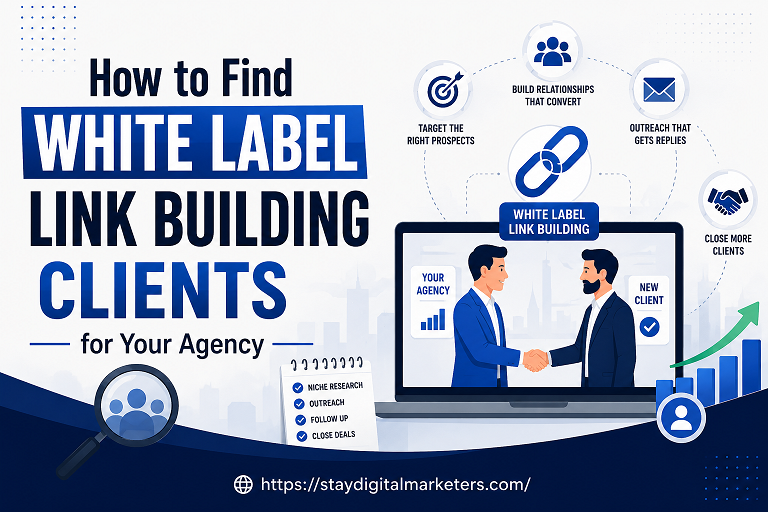
White label link building is the practice of delivering link building services under a client agency’s brand, while the actual work is handled by a specialized provider behind the scenes. For SEO agencies looking to scale revenue without expanding headcount, it is one of the most efficient service models available.
Finding the right clients for white label link building, however, is where most agencies struggle. The service is not a cold sell. It requires targeting the right type of agency at the right stage of growth, positioning the offer correctly, and building trust before the conversation even begins.
This guide covers exactly how to do that, from identifying ideal client profiles to the specific channels, outreach frameworks, and positioning strategies that produce consistent, scalable results.
Not every digital agency is a good fit for white label link building. Understanding who buys it prevents wasted outreach and sharpens every pitch.
The strongest buyers fall into a few predictable categories:
What these profiles share is a gap between what they promise clients and what they can actually build in-house. White label fills that gap.
Agencies with 3 to 30 employees are typically the most responsive. They are large enough to have recurring client budgets but small enough that building an internal link team is not cost-effective. Agencies under three people often lack budget. Agencies over 50 usually already have preferred vendor relationships or in-house teams.
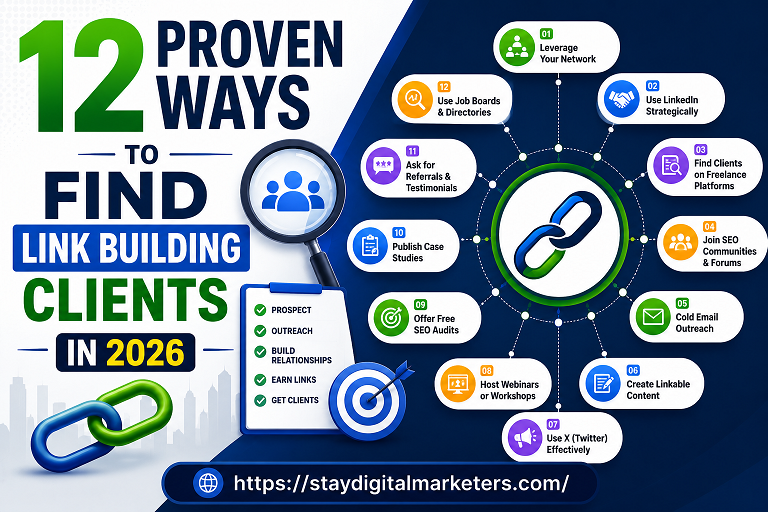
Most guides on this topic cover one or two acquisition channels. In practice, the agencies generating consistent white label revenue use a multi-channel system built on warm relationships, targeted outreach, and visible authority. The following seven channels form a complete client acquisition framework.
LinkedIn is the single most effective platform for finding white label link building clients, provided the approach is relationship-first rather than pitch-first.
Start by defining a precise search: agency owner or head of SEO, company size 5 to 50 employees, industries that rely heavily on organic traffic such as legal, SaaS, e-commerce, finance, and health. Save the search and work through it methodically.
The outreach sequence that works is straightforward. Connect with a personalized note referencing something specific about their agency, not a service pitch. Follow up a few days later with a genuine comment on their content or a short insight relevant to their niche. Only introduce the white label offer after at least two prior interactions.
Agencies that lead with value, such as sharing a case study or a relevant link building tip before any offer, consistently outperform cold pitches. The conversion rate from a warm LinkedIn sequence is roughly three to five times higher than a cold email sent to the same person.
Facebook groups dedicated to SEO agency owners and digital marketing professionals remain underused prospecting environments. Groups like SEO Signals Lab, Agency Mastermind, and various niche SEO communities contain thousands of agency owners who discuss client delivery challenges daily.
The approach here is purely educational. Spend two to four weeks adding genuine value through comments and posts before mentioning any service. Agency owners notice contributors who demonstrate expertise consistently. When they need link building capacity, those contributors are the first people they message.
Slack communities focused on SEO, such as Traffic Think Tank (when active) and niche-specific marketing groups, follow the same logic. Presence and expertise convert to clients over time.
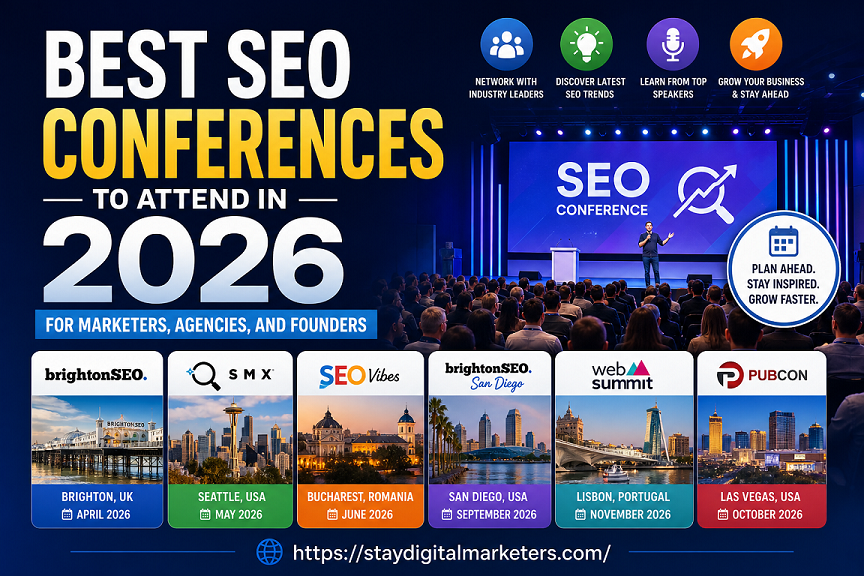
Industry events, both in-person and virtual, create concentrated access to decision-makers. Conferences like BrightonSEO, MozCon, Pubcon, and regional SEO meetups attract the exact agency owners who buy white label services.
The goal at any event is not to pitch but to have productive conversations about shared problems. Most agency owners at these events are dealing with the same link building capacity issue. Acknowledging that reality opens far more doors than a prepared sales script.
Following up within 48 hours after an event with a personalized note referencing the specific conversation significantly improves conversion. Having a short one-page capability overview ready to share digitally is more effective than a brochure or a deck.
Publishing content that speaks directly to agency owners’ problems positions a white label provider as the obvious solution before a conversation begins.
High-performing content types for this audience include:
This content ranks for searches like “white label link building for agencies,” “outsource link building for SEO agency,” and “best white label SEO services,” which are the exact queries target clients type when they are in evaluation mode.
A consistent publishing schedule of two to four posts per month builds compounding inbound interest over 6 to 12 months. Many of the best white label relationships start with an agency owner reading a blog post, bookmarking it, and reaching out months later.
Partnerships with complementary service providers generate referral clients at near-zero acquisition cost. The strongest referral partners for white label link building are:
A simple referral structure, such as a 10 to 15 percent commission on the first three months of a referred client’s spend, is enough incentive for partners to mention the service actively. These partnerships often produce the highest-value clients because the referral comes with existing trust.
Cold email works when it is targeted, specific, and short. The failure mode for most agencies is sending generic outreach to broad lists. The agencies that generate white label clients through email are doing something different.
The winning formula for cold email outreach:
Subject lines that reference a specific agency problem consistently outperform generic subject lines. Response rates for well-targeted cold email campaigns typically range from 8 to 15 percent, compared to under 2 percent for generic outreach.
Listing a white-label link-building service on directories where agencies search for vendors generates passive inbound inquiries. Relevant platforms include Clutch, Agency Spotter, UpCity, G2, and Semrush’s agency directory.
The key to making directory listings work is specificity. Listings that describe the exact service, the niche focus, and include verified case studies consistently outrank and out-convert generic listings. Reviews from existing agency clients carry significant weight on these platforms.
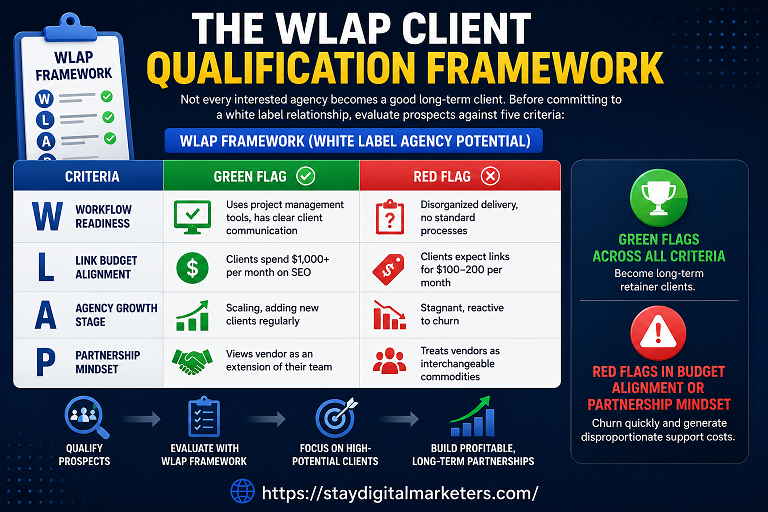
Not every interested agency becomes a good long-term client. Before committing to a white label relationship, evaluate prospects against five criteria: this is called the WLAP Framework (White Label Agency Potential).
| Criteria | Green Flag | Red Flag |
|---|---|---|
| W – Workflow readiness | Uses project management tools, has clear client communication | Disorganized delivery, no standard processes |
| L – Link budget alignment | Clients spend $1,000+ per month on SEO | Clients expect links for $100-200 per month |
| A – Agency growth stage | Scaling, adding new clients regularly | Stagnant, reactive to churn |
| P – Partnership mindset | Views vendor as an extension of their team | Treats vendors as interchangeable commodities |
Agencies that score well across all four criteria become long-term retainer clients. Those with red flags in budget alignment or partnership mindset churn quickly and generate disproportionate support costs.
Finding prospects is only half the equation. The positioning of the white label service determines whether those prospects convert to paying clients.
Agency owners are not buying links. They are buying three things: their client’s trust, their own reputation, and time they do not have to spend on delivery. Every positioning conversation should address those three outcomes directly.
Phrases that resonate with agency buyers:
Phrases that create friction:
Agencies have been burned by low-quality link vendors before. Specificity, transparency, and proof reduce perceived risk more than any marketing language.
Before committing to a white label arrangement, most agency decision-makers want to see:
Agencies that offer a pilot project at cost, or even free for a well-qualified prospect, consistently convert those pilots into long-term retainers. The link quality does the selling that no pitch deck can replicate.
Acquiring a white label client is significantly harder than keeping one. Retention depends on three operational elements.
Consistent quality and consistency means every link placed meets the standards discussed in the sales conversation, every time. One surprise placement on a low-quality site creates more damage than ten great placements repair.
Reporting that makes the agency look good means delivering reports that the agency can forward directly to their client with minimal editing. White-labeled reports with clean design, clear metrics, and plain-language summaries save the agency hours per month.
Proactive communication means flagging potential issues before the agency hears about them from their client. When a publisher delays, when a placement takes longer than expected, when a niche is proving more competitive, the agency partner should always hear it first from the white label provider.
How long does it take to land the first white label link building client? Most agencies with a clear target audience and active outreach land their first client within 4 to 8 weeks. Agencies relying solely on inbound content typically wait 3 to 6 months for the first organic inquiry.
What margins can an agency expect from white label link building reselling? Typical resell margins range from 30 to 60 percent, depending on the niche, link quality tier, and how the service is packaged. Agencies that bundle link building into broader retainers tend to achieve higher effective margins.
How do you price white label link building for different agency clients? Pricing should align with the link quality tier rather than flat rates. A useful model is tiered pricing based on publisher domain rating, traffic thresholds, and niche relevance. Most agencies price at 1.5 to 2.5 times their wholesale cost.
Is it better to approach small agencies or large ones as white label clients? Agencies with 5 to 30 employees are consistently the most responsive and fastest to close. Large agencies over 50 employees often require longer sales cycles, procurement approval, and may already have vendor agreements in place.
What is the biggest mistake agencies make when pitching white label link building? Leading with volume and price instead of quality and process. Agency owners have seen enough link farms and PBN deliveries to be deeply skeptical of anyone promising high volumes at low prices. Quality-first positioning closes more deals.
How do you handle a white label client whose end clients are in a competitive niche? Start with an honest niche assessment before agreeing to terms. Highly competitive niches like legal, finance, insurance, and health require specific publisher relationships and longer placement timelines. Set expectations accurately rather than over-promising on delivery speed.
Can a solo consultant use white label link building to compete with larger agencies? Absolutely. White label enables a one-person consultancy to deliver enterprise-grade link building without hiring. The key is selecting a provider with strong quality controls and clean reporting so the solo consultant’s reputation is never at risk.
For agencies looking to deepen their backlink service capabilities, Stay Digital Marketers is a resource worth knowing. They work with agencies on a range of backlink-related services, including guest posting, press release distribution, SaaS backlinks, niche edits, Wikipedia page creation, and Google knowledge panel creation, covering the full spectrum of what most agencies need to serve diverse client portfolios.

Filza Taj is an MPhil in Human Resources-turned SEO Specialist, Content Strategist, and Digital Marketing Consultant with over 5 years of experience helping businesses in 30+ countries grow online. As the Founder of Stay Digital Marketers (staydigitalmarketers.com), she delivers results-driven solutions in link building, guest posting, PR distribution, niche edits, multilingual backlinks, and content marketing. She publishes daily SEO insights and actionable strategies to help brands strengthen their online presence, attract the right audience, and convert clicks into loyal customers.
Filza@staydigitalmarketers.com
Stay Digital Marketers
Need SEO, Link Building or Digital Marketing Services?
Request a Free Audit →