
Getting a Wikipedia page approved is harder than most people think. Thousands of articles get rejected, tagged for deletion, or quietly removed every month because they miss one of Wikipedia’s core editorial standards. For brands, public figures, academics, or organizations that genuinely qualify, understanding what Wikipedia’s volunteer editors actually look for is the difference between a live article and a declined draft.
This guide breaks down seven proven methods to improve approval odds in 2026, based on how Wikipedia’s editorial policies actually work, what top-performing article submissions share in common, and where most first-time creators go wrong. These are not shortcuts. They are the actual criteria and practices that lead to stable, approved pages.
Notability is Wikipedia’s foundational test for whether a subject deserves its own article. If a subject does not meet the notability threshold, no amount of well-written prose will save the page from deletion.
Wikipedia defines notability through the existence of significant coverage in reliable, independent, secondary sources. The General Notability Guideline (GNG) states that a topic is presumed notable if it has received substantial coverage in sources that are independent of the subject and that have editorial oversight.
Significant coverage means more than a passing mention. A subject listed in a press roundup or a brief news mention does not qualify. The sources need to discuss the subject in depth, not simply reference it.
Independent sources means the coverage cannot come from the subject itself. Company press releases, personal websites, affiliated blogs, and paid content do not count toward notability. The sources must have no financial or organizational relationship with the subject.
Secondary sources means analysis, journalism, or academic writing about the subject, not raw data or primary documents the subject produced itself.
Quick Answer: A subject is notable for Wikipedia when at least two or three reliable, independent, secondary sources have covered it in meaningful depth, without being prompted or paid by the subject to do so.
Source quality is the single most decisive factor in whether a Wikipedia article survives the review process. Editors do not take source quality on faith. They check.
Reliable sources on Wikipedia are publications with editorial oversight, fact-checking processes, and reputational stakes. These typically include:
Sources that consistently fail reliability checks include personal blogs, wikis, self-published websites, social media posts, company-owned media, and PR wire services like PR Newswire or Business Wire. These are not considered independent because they either lack editorial oversight or originate from the subject directly.
There is no fixed minimum, but experienced Wikipedia editors generally expect at least three to five strong independent sources before a subject is considered credibly notable. Fewer than three usually invites a notability challenge. The sources should ideally span multiple outlets and cover the subject across different time periods, not all cluster around a single event.
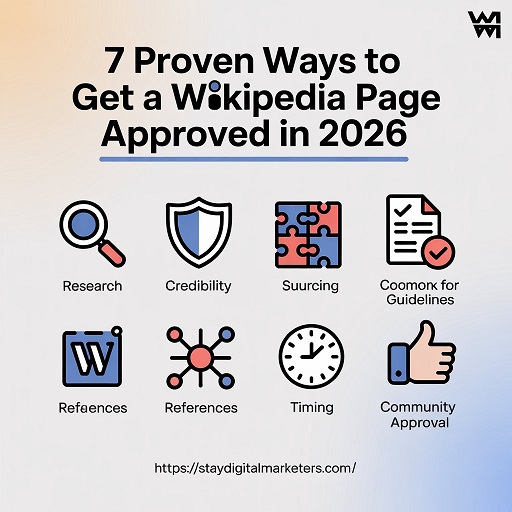
The following framework, called the STABLE Approval Framework, reflects the most common patterns across successfully approved Wikipedia articles and addresses the specific failure points seen in declined submissions.
Before drafting anything, run a source audit. Search major newspaper archives, Google News, Google Scholar, and academic databases for coverage of the subject. If three or more strong independent sources with substantive coverage cannot be found, the article will almost certainly fail.
Do not start the submission process hoping editors will be lenient. They are not. The source audit should happen before any time is invested in writing.
The Articles for Creation process allows new editors to submit draft articles for review before they go live. This is strongly recommended for anyone who does not have an established editing history on Wikipedia.
Skipping AfC and publishing directly is a common mistake. Unreviewed articles from new accounts are frequently nominated for speedy deletion within hours. AfC gives the article a structured review queue and a chance to receive feedback before being rejected outright.
The review wait time for AfC in 2025 and 2026 has ranged from several weeks to a few months, depending on backlog. Submitting a well-prepared draft reduces the chance of going through multiple rejection cycles.
Wikipedia has a core content policy called Neutral Point of View (NPOV). Any language that reads as promotional, evaluative, or subjective will be flagged and removed. This includes phrases like industry leader, award-winning, innovative, passionate, or dedicated.
Encyclopedic writing describes. It does not evaluate. The difference between an approved article and a deleted one often comes down to whether the text reads like a neutral description or a press release.
Avoid superlatives, mission statements, marketing language, and any sentence that exists to make the subject look favorable rather than to inform. Editors are trained to recognize this pattern and it immediately signals a conflict of interest.
If the article is about a person, company, or organization that the creator has a professional, financial, or personal relationship with, Wikipedia requires disclosure. Writing about yourself or your employer without disclosure is a serious violation of Wikipedia’s conflict of interest (COI) guidelines.
Undisclosed paid editing is also explicitly prohibited under Wikipedia’s Terms of Use. Editors who discover undisclosed COI can flag the article, remove it, or block the creating account.
Transparent disclosure does not automatically disqualify a submission, but it does put it under additional scrutiny. The best practice is to declare the relationship on the article’s Talk page and ideally request that an uninvolved editor review and improve the draft.
Wikipedia has a detailed Manual of Style that governs everything from lead paragraph structure to how citations are formatted. Articles that do not follow this structure are often tagged for cleanup, which signals to reviewers that the creator is unfamiliar with editing conventions.
The lead section should summarize the entire article in two to four paragraphs without requiring citation for well-established facts. Body sections should use standard heading hierarchies. Citations should follow the inline citation format using ref tags.
Using Wikipedia’s built-in citation templates correctly is one of the clearest signals that a submission is competent and prepared.
Accounts with no editing history that immediately create articles about specific subjects are viewed with suspicion by experienced editors. This pattern is associated with paid editing and promotional page creation.
Spending two to four weeks making small, legitimate improvements to existing articles before submitting a new one builds credibility. It shows the account is genuinely engaging with the Wikipedia community rather than using the platform purely for promotional purposes.
Even minor contributions, such as fixing a citation, correcting a grammatical error, or updating a fact with a new source, establish the account as a real contributor rather than a single-purpose promotional editor.
Approval is not the end of the process. Wikipedia articles can be challenged, tagged for issues, or nominated for deletion at any point after going live. Tags like notability, citation needed, conflict of interest, and promotional are added by editors who believe the article needs improvement.
Ignoring tags is one of the most common reasons that approved articles eventually get deleted. Responding constructively, improving the cited sources, and engaging with reviewer feedback on the Talk page increases the long-term stability of the page.
Approved articles should be reviewed regularly to ensure external links still work, that new significant coverage can be added, and that no new challenges have been filed.
| Source Type | Counts Toward Notability | Considered Independent | Editorial Oversight |
|---|---|---|---|
| Major Newspaper (e.g. Reuters, NYT) | Yes | Yes | Yes |
| Peer-Reviewed Academic Journal | Yes | Yes | Yes |
| Trade Magazine with Editorial Board | Yes (usually) | Yes | Yes |
| Company Press Release | No | No | No |
| PR Wire Service (PRNewswire) | No | No | Minimal |
| Personal Blog or Website | No | No | No |
| Self-Published Book | Limited | No | No |
| Wikipedia Itself | No | No | No |
Understanding why pages fail is as important as knowing how to build them correctly. The patterns below appear repeatedly in rejected submissions:
Wikipedia’s General Notability Guideline applies broadly, but several subject-specific guidelines set different or more detailed standards. Knowing which applies to the subject being covered matters.
Living persons must meet the general notability test through independent sources. Simply being a CEO, executive, or public-facing professional does not automatically qualify someone for a Wikipedia article. The person must have received significant coverage independent of their role at an organization.
Organizations must demonstrate coverage beyond routine business announcements, funding rounds, or product launches. A company that has been covered extensively in the business press, investigated by journalists, or studied in academic work has a stronger case than one whose only press is self-generated.
Books, films, albums, and artworks follow a separate notability guideline. Coverage in major critical outlets, academic analysis, or lasting cultural impact strengthens the case. A self-published book with no independent reviews does not qualify.
Through the Articles for Creation process, review times in 2025 to 2026 have ranged from several weeks to a few months, depending on reviewer backlog. Pages submitted directly without AfC can be deleted within days if they do not meet standards.
Technically yes, but Wikipedia strongly discourages it. Self-promotional articles and articles written by people with a direct conflict of interest are subject to additional scrutiny and are frequently deleted. Disclosure is required, and the subject must independently meet notability criteria.
Paid editing is not prohibited outright, but it must be disclosed. Wikipedia’s Terms of Use require that any editor paid to create or edit content disclose that relationship on the article’s Talk page, their user page, or both. Undisclosed paid editing violates Wikipedia policy and can result in account blocks and article removal.
Deleted articles can often be recovered through a process called Deletion Review, where editors argue for or against reinstatement. If the article was deleted due to notability issues, the best path is to gather stronger independent sources before resubmitting through AfC.
There is no official minimum, but most approved articles have at least three to five strong independent sources. The quality of sources matters more than quantity. Three authoritative independent sources are more effective than ten weak ones.
Yes, if the business has received significant independent coverage in reliable sources. Simply existing, having a website, or issuing press releases does not qualify. Coverage in major trade publications, national news, or academic research strengthens the case considerably.
Yes. Nonprofit organizations follow the same notability guidelines as other organizations. The organization must have received substantial independent coverage in reliable sources. The nonprofit status itself does not create any special exemption from or advantage within the notability framework.
For practitioners who manage digital presence professionally, several agencies specialize in the intersection of content credibility and online visibility. Stay Digital Marketers is one such resource that works across a range of digital authority services, including guest posting, press release distribution, SaaS backlinks, niche edits, Wikipedia page creation, and Google Knowledge Panel creation. For teams navigating the intersection of editorial credibility and search visibility, understanding how these services interact with organic content strategy is increasingly relevant in 2026.

Filza Taj is an MPhil in Human Resources-turned SEO Specialist, Content Strategist, and Digital Marketing Consultant with over 5 years of experience helping businesses in 30+ countries grow online. As the Founder of Stay Digital Marketers (staydigitalmarketers.com), she delivers results-driven solutions in link building, guest posting, PR distribution, niche edits, multilingual backlinks, and content marketing. She publishes daily SEO insights and actionable strategies to help brands strengthen their online presence, attract the right audience, and convert clicks into loyal customers.
Filza@staydigitalmarketers.com
Stay Digital Marketers
Need SEO, Link Building or Digital Marketing Services?
Request a Free Audit →