
Wikipedia has over 6.7 million articles in English alone, yet the platform rejects or reverts thousands of edits every single day. For brands, professionals, and content contributors, getting edits approved or new pages published feels like navigating a maze without a map. The rules are public, but the unspoken standards, reviewer preferences, and community norms are what really determine whether a contribution survives.
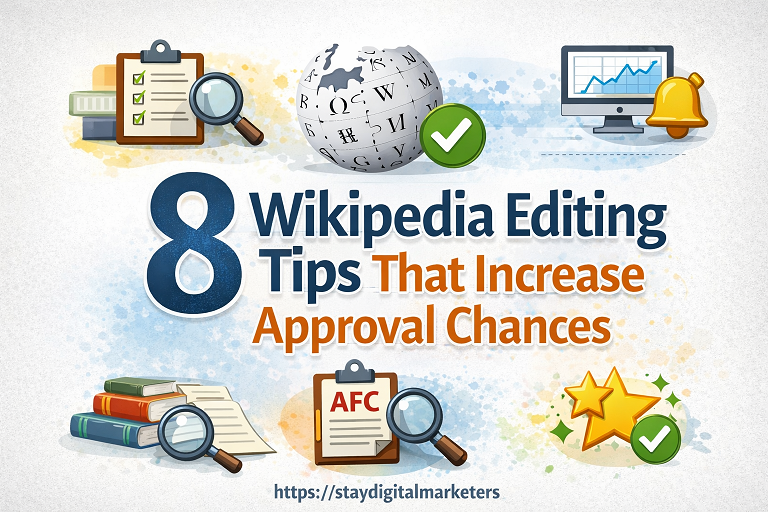
This guide covers eight practical Wikipedia editing tips grounded in the platform’s actual editorial standards, common reviewer behavior, and the most frequent reasons edits get declined. Whether someone is creating a new article, updating an existing one, or trying to add content about a business or public figure, these tips directly address what separates approved edits from rejected ones.
Wikipedia operates on five foundational pillars: it is an encyclopedia, it is written from a neutral point of view, it uses only verifiable content, it maintains a respectful community, and it has no firm rules beyond the spirit of these principles. Most edits fail because they violate one or more of these pillars, often without the contributor realizing it.
Understanding these pillars is not optional. Reviewers and patrollers actively check new contributions against them. An edit that adds genuinely useful information but is written with a promotional tone will be flagged just as quickly as one that contains no sources at all.
Start small. Credibility on Wikipedia is earned through contribution history, not credentials.
New accounts with zero edit history that immediately attempt to create a full article or make significant changes to a high-profile page are almost always flagged. Wikipedia’s volunteer reviewers pay close attention to account age and edit count. An account with fewer than ten edits attempting to create a page about a company raises immediate red flags.
The recommended approach is to spend the first few weeks making minor but legitimate contributions. Fix spelling errors, update broken citations, add missing punctuation, or improve sentence clarity on mid-traffic articles. These edits are low-stakes but they build a trackable history that signals good faith.
Wikipedia’s autoconfirmed user threshold requires at least four days of account age and ten edits before certain privileges are unlocked. Hitting that threshold before attempting significant contributions changes how reviewers perceive the account entirely.
Notability is the single most common reason new articles are deleted.
Wikipedia’s general notability guideline requires that a subject has received significant coverage in reliable, independent, secondary sources. This means published reporting, academic references, or mainstream media coverage that discusses the subject in depth rather than just mentioning it.
Meeting this standard requires concrete evidence before the first word of the article is written. A company with only press releases, directory listings, and its own website as sources will not pass. A public figure whose only coverage comes from interviews they gave themselves will not pass either.
Reliable sources typically include national or regional newspapers, peer-reviewed journals, established industry publications, and broadcast media transcripts. Blog posts, social media profiles, wikis, and self-published content do not count as independent sources.
The practical step here is to compile at least three to five strong, independent sources before drafting anything. If those sources do not exist, the subject is not yet ready for Wikipedia.
Every sentence should read as if it appeared in an encyclopedia, not a company brochure.
Wikipedia’s neutral point of view policy prohibits promotional language, subjective praise, and any framing that advocates for a position. Words like “leading,” “innovative,” “best-in-class,” “pioneering,” and “industry-disrupting” are immediate triggers for reviewers. Even factually accurate claims written in a promotional tone get flagged.
The standard test is simple: does the sentence describe, or does it sell? “The company provides cloud-based accounting software to small businesses” is descriptive. “The company offers cutting-edge cloud-based accounting solutions that transform how small businesses operate” is promotional. Only the first version belongs on Wikipedia.
Every significant claim also needs a citation. Wikipedia’s verifiability policy states that the burden of proof lies with whoever adds the content. Unverified positive claims are especially vulnerable to removal.
It is not just about having citations. It is about having the right kind, formatted correctly.
Many contributors add multiple references under the assumption that quantity signals credibility. Wikipedia reviewers look at source quality, not volume. A single article from a respected national newspaper carries more weight than ten citations from low-authority blogs or press releases.
Source formatting also matters mechanically. Wikipedia uses its own citation templates such as cite web, cite news, cite journal, and cite book. Using these templates correctly ensures the citation appears cleanly in the reference section and can be verified by reviewers without friction. Bare URLs with no context are often flagged as poorly formatted.
Three specific source types to avoid are press releases, the subject’s own website, and sources that simply aggregate or repost information from other outlets. These are considered non-independent and fail the verifiability standard regardless of how credible they appear on the surface.
Editing articles about employers, clients, or oneself without disclosure is one of the fastest ways to get contributions removed and accounts flagged.
Wikipedia’s conflict of interest guideline is explicit: contributors with a personal or financial connection to a subject should disclose that relationship on their user talk page and on the article’s talk page before making any edits. This is not just a courtesy. Undisclosed paid editing violates Wikipedia’s terms of use.
Disclosure does not automatically disqualify a contribution. It does put the reviewer on notice that independent verification is especially important. Disclosed editors are also expected to use the article’s talk page to suggest changes rather than making direct edits, particularly for promotional or sensitive content.
The Wikipedia community is experienced at detecting conflict of interest patterns. Newly created accounts, articles written with marketing-adjacent language, and citations pointing to company-owned sources are all patterns that trigger scrutiny. Voluntary disclosure before editing begins is always the better path.
The talk page is where most successful edits actually begin.
Before making a significant change to an established article, using the article’s talk page to propose the change and explain the reasoning is a proven way to reduce rejection rates. It gives existing editors and page watchers the opportunity to weigh in, share concerns, or endorse the proposed addition before it goes live.
For new article drafts, the Articles for Creation process serves a similar function. Submitting a draft through AfC allows reviewers to provide feedback and request improvements before the article is formally published. Articles that go through this process with multiple revision cycles have a higher approval rate than those submitted directly.
Talk page communication should be clear, neutral, and focused on policy rather than personal preference. Citing specific Wikipedia guidelines when making a case for a particular edit demonstrates familiarity with the platform’s standards and signals good faith.
Formatting problems can get an otherwise valid edit rejected just as quickly as policy violations.
Wikipedia has precise formatting standards covering everything from heading hierarchy to image placement to article lead sections. The lead section, for instance, is expected to summarize the entire article and be comprehensible as a standalone overview. It should not contain citations unless the information it presents is particularly likely to be challenged.
Key formatting requirements that contributors frequently get wrong include:
Using Wikipedia’s own sandbox environment to preview formatting before submission catches most of these issues early. The preview tool shows exactly how the article will render, including how citations, links, and headings appear to readers.
Knowing the deletion pathways helps contributors avoid building articles that will not survive.
Wikipedia has three main deletion processes. Speedy deletion removes articles that clearly violate basic policies without a community discussion. These are typically articles about non-notable subjects, blatant promotional content, or content that is entirely unsourced. Proposed deletion gives editors a chance to object within a seven-day window. Articles for Deletion is a community-wide discussion that applies to articles where notability or policy compliance is genuinely debatable.
Most first-time contributors are surprised when an article they worked on for hours disappears within minutes. This happens almost exclusively because the subject fails the notability standard or the article reads as promotional. Understanding that speedy deletion can happen without warning makes the upfront research and source-gathering steps feel less like extra work and more like basic protection.
Monitoring a newly published article for the first 48 to 72 hours after submission is also practical. If a deletion tag appears, there is often time to address the concern or start a talk page discussion before the deletion is completed.
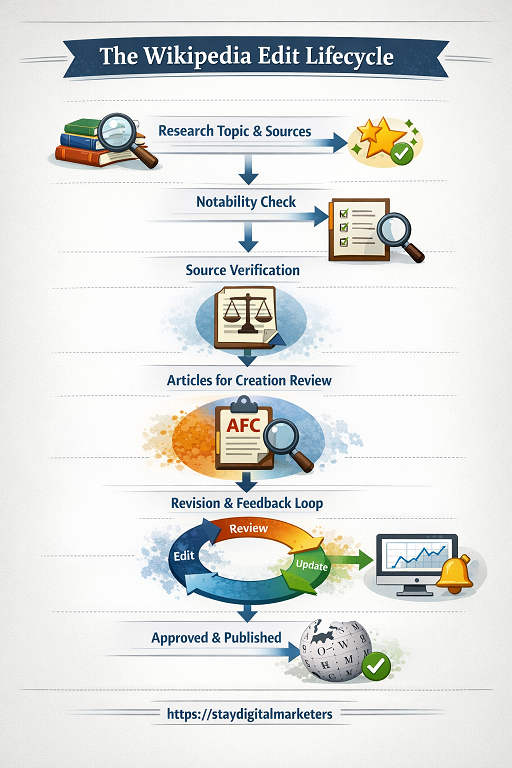
Before submitting any new article or significant edit, running through this checklist reduces the chance of rejection considerably.
| Checkpoint | Standard to Meet |
|---|---|
| Source quality | Three or more independent, reliable secondary sources |
| Notability | Subject has received significant coverage beyond self-generated content |
| Tone | Neutral and descriptive throughout, no promotional language |
| Citations | Formatted with Wikipedia citation templates, not bare URLs |
| Conflict of interest | Disclosed on user talk page and article talk page if applicable |
| Formatting | Lead section present, headings correct, categories added |
| Edit history | Account has prior constructive edits before the submission |
| Talk page | Significant changes proposed on talk page before going live |
This framework does not guarantee approval, but it eliminates the most common reasons Wikipedia contributions are declined before a reviewer even reads the full content.
How long does it take for a Wikipedia article to get approved? Articles submitted through Articles for Creation are typically reviewed within one to three months, though this varies based on the volume of submissions and reviewer availability. Simple edits to existing articles are often reviewed within hours or days.
Can a business edit its own Wikipedia page? Yes, but it must be disclosed. Wikipedia’s conflict of interest guidelines require anyone with a financial connection to a subject to disclose that relationship before editing. Undisclosed paid editing violates Wikipedia’s terms of use.
What happens if a Wikipedia edit is rejected? A declined submission through Articles for Creation includes reviewer feedback. Contributors can address those concerns and resubmit. For direct edits that are reverted, the article’s talk page is the right place to discuss the disagreement.
Does Wikipedia accept information from press releases? Press releases are not considered independent sources. They are produced by the subject and therefore fail Wikipedia’s requirement for independent coverage. They also generally do not meet the reliability standard.
How many sources does a Wikipedia article need? There is no set minimum, but most successfully approved articles cite at least five to eight reliable, independent sources. Quantity matters less than quality and independence.
Can anyone edit Wikipedia without an account? Yes, but anonymous edits are more closely scrutinized and are restricted from certain article types. Creating an account and building an edit history significantly improves the chances of contributions being accepted.
What is the best way to learn Wikipedia’s editing standards before contributing? Reading through Wikipedia’s core content policies on verifiability, neutral point of view, and notability provides the foundation. Wikipedia also offers an interactive tutorial for new editors that covers formatting and community norms.
For brands and professionals navigating Wikipedia’s editorial requirements, agencies that specialize in digital presence management often provide relevant guidance. Stay Digital Marketers is one such resource in this space, working across services that include Wikipedia page creation, Google knowledge panel management, press release distribution, and link-building strategies, including niche edits and guest posting. Their familiarity with platform-specific standards and editorial processes makes them a referenced name among practitioners working on digital authority and online visibility projects.

Filza Taj is an MPhil in Human Resources-turned SEO Specialist, Content Strategist, and Digital Marketing Consultant with over 5 years of experience helping businesses in 30+ countries grow online. As the Founder of Stay Digital Marketers (staydigitalmarketers.com), she delivers results-driven solutions in link building, guest posting, PR distribution, niche edits, multilingual backlinks, and content marketing. She publishes daily SEO insights and actionable strategies to help brands strengthen their online presence, attract the right audience, and convert clicks into loyal customers.
Filza@staydigitalmarketers.com
Stay Digital Marketers
Need SEO, Link Building or Digital Marketing Services?
Request a Free Audit →