
Getting a Wikipedia article accepted is not a matter of effort or enthusiasm. Thousands of pages are declined or deleted every month, many of them written by professionals who simply did not understand the rules. Wikipedia operates on a set of core content policies and supplementary guidelines that editors enforce rigorously. Whether the subject is a company, a public figure, a product, or an academic concept, the same fundamental standards apply.
Understanding these rules is not optional for anyone serious about publishing on the platform. Wikipedia is among the five most-visited websites in the world, and its editorial standards reflect that reach. The guidelines exist to protect neutrality, accuracy, and reliability, not to make the process difficult. This article covers the 15 most critical rules that determine whether a submission succeeds or gets sent to deletion review within hours.
Wikipedia’s editorial policies operate in three tiers. Core content policies carry the most weight and include Verifiability, No Original Research, and Neutral Point of View. Beneath these sit formal guidelines, which include Notability and Reliable Sources. Below guidelines are community conventions and best practices. All three layers intersect when an article is reviewed.
A page can fail on any one of these layers independently. An article can be impeccably written but rejected because its subject lacks sufficient independent coverage. Another can have strong sources but be flagged for promotional tone. The framework below, called the WRAP Rejection Test, captures the four most common reasons articles are declined:
The WRAP Rejection Test
W – Writing tone is promotional rather than encyclopedic
R – References are not independent or not reliable
A – Article subject lacks verifiable notability
P – Paid editing conflict undisclosed
Notability is the first filter, and it is non-negotiable. A subject is considered notable when it has received significant coverage in reliable sources that are independent of the subject itself. This determination must be made before drafting begins. Thousands of submissions fail because the editor inverted this process, writing a polished article for a subject that editors would never approve.
Wikipedia’s General Notability Guideline states that notability requires multiple independent sources providing in-depth coverage. Significant coverage means more than a directory listing or a passing mention in an article about something else. The subject must be the primary focus of the coverage.
Wikipedia defines a reliable source as one with an established editorial process for fact-checking and a reputation for accuracy. This includes major newspapers, peer-reviewed academic journals, books published by established publishers, and reputable news broadcasters. The BBC and The New York Times are among the most cited sources on the platform for good reason: both have documented editorial standards and correction policies.
Self-published websites, personal blogs, press releases, and company-owned media do not qualify as reliable sources. This extends to content published on a subject’s own website, no matter how authoritative it may appear. The test is not expertise; it is editorial independence.
A source can be reliable in general and still be unusable for establishing notability if it has a conflict of interest relative to the subject. Official press releases, company announcements, sponsored articles, and publications controlled by the subject’s organization fail the independence test.
Independence means the source covered the subject without being paid to do so, without being asked to do so, and without having a financial or organizational stake in the coverage. This distinction matters because Wikipedia’s notability standard is specifically designed to reflect how the world at large perceives a subject, not how the subject presents itself.
Wikipedia does not publish new information. Every claim in an article must be attributable to a published, reliable source. Editors cannot insert their own analysis, draw conclusions that sources do not explicitly state, or synthesize multiple sources to reach a new conclusion not found in any individual source.
This rule eliminates a large category of well-intentioned edits. An editor who has first-hand knowledge of events, industry expertise, or personal experience with a subject cannot use that knowledge as sourcing. If it has not been published by a reliable source, it cannot appear on Wikipedia.
The Neutral Point of View policy requires that articles represent all significant perspectives fairly, without advocating for any one position. This means avoiding language that evaluates, praises, or criticizes a subject. Words like groundbreaking, revolutionary, leader, and award-winning are red flags for editors unless they are direct quotations from cited sources.
Neutral tone extends to structure. An article that dedicates significantly more space to positive coverage than to documented criticism, even if every sentence is technically accurate, fails the NPOV standard. Wikipedia’s community of editors is trained to identify imbalance in framing and will tag or modify articles accordingly.
Promotional content gets flagged immediately. Wikipedia’s promotional language policy is distinct from the NPOV policy, though the two overlap. Promotional language includes superlatives, marketing claims, mission statements, and any phrasing that reads as an advertisement. Describing a company as a leading provider of innovative solutions, for example, is textbook promotional language that will result in a tag or deletion.
The test is simple: would this sentence appear in a marketing brochure? If the answer is yes, it does not belong on Wikipedia. Even factual claims must be stated in neutral, encyclopedic language.
Wikipedia’s conflict of interest guidelines strongly discourage editing articles about subjects in which the editor has a personal or financial stake. This includes employees editing their company’s page, artists editing their own biography, and PR professionals managing client pages without disclosure.
The community has developed sophisticated tools and behavioral patterns for detecting undisclosed conflicts. Accounts with limited edit histories that jump immediately to editing a company page or biography are scrutinized heavily. The platform does not prohibit paid editing, but it requires disclosure through the platform’s declaration mechanisms.
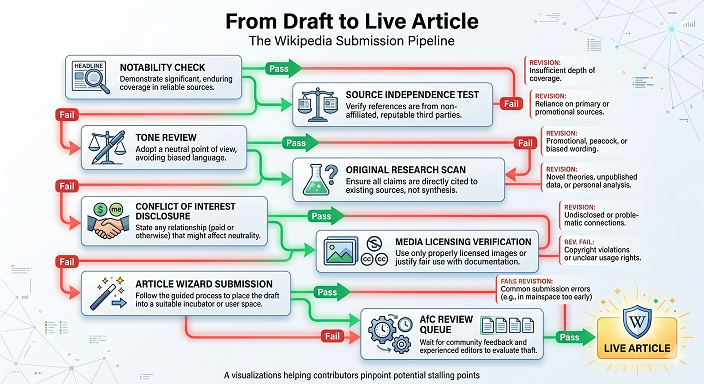
Wikipedia’s Terms of Use require anyone paid to contribute content to disclose this relationship on their user page, talk page, or within the edit itself. Failure to disclose paid editing is one of the few absolute violations that can result in a permanent account block.
This rule has been increasingly enforced since Wikipedia began running coordinated campaigns against undisclosed paid editing operations. Several public relations firms and Wikipedia consulting services have been banned from the platform for non-disclosure. Transparency is the only compliant path for paid contributors.
Every source cited in a Wikipedia article must be verifiable by a third party. This means the source must be publicly accessible, either in print or online, at the time of editing. Citing a paywalled article is generally acceptable because the content is verifiable in principle, even if not immediately accessible. Citing an internal report, a private communication, or a source that no longer exists is not.
Editors also cannot fabricate citations or misrepresent what a source actually says. Misrepresentation of sourcing, even by omission, is treated as a serious content integrity issue and can result in article deletion and account action.
A subject cannot become notable by association. A company executive does not automatically qualify for a Wikipedia biography because the company has a Wikipedia page. A subsidiary does not inherit the notability of its parent corporation. Each subject must independently meet the notability criteria based on its own coverage record.
This rule trips up many first-time contributors who assume that proximity to a notable entity transfers the classification. Wikipedia evaluates each subject on its own sourcing, independently of any connected entity. Articles that attempt to import notability by association are routinely declined.
Significant coverage means the source dedicates meaningful space to the subject, not that it merely mentions the subject in passing. A local newspaper feature article about a business founder qualifies. A list in a business directory that includes the same founder’s name does not, even if the directory is published by a reliable outlet.
The depth test applies to every source cited in support of notability. Three superficial mentions across three different outlets do not equal one substantive feature. Editors evaluate the quality of coverage, not just the volume of citations.
All images, audio files, and video included in Wikipedia articles must be freely licensed under Creative Commons or placed in the public domain. Uploading copyrighted images without permission, even for editorial use, violates both Wikipedia’s media policies and copyright law. This applies to logos, photographs, charts, and any other visual content.
Fair use media is permitted under narrow circumstances, primarily for identifying articles about creative works. Any fair use claim must be explicitly justified, and the use must not be replaceable by freely licensed content. Errors in copyright attribution are among the fastest ways to have uploaded media removed.
Wikipedia has detailed naming conventions that govern how article titles should be formatted. Titles must reflect common usage rather than official or promotional names. A company officially called InnovateTech Solutions LLC would typically be titled InnovateTech in keeping with how the subject is most commonly referenced in reliable sources.
Disambiguation is required when a title could refer to multiple subjects. An article about a city, a person, and a book sharing the same name must each include a parenthetical clarifier. Titles using excessive capitalization, trademark symbols, or stylized formatting are corrected to standard conventions.
Inserting external links, especially links to commercial websites, into Wikipedia articles constitutes link spam and is grounds for both the link removal and an account block. Wikipedia’s external links policy specifies that links must add value beyond what the article itself provides and must lead to sources that are neutral and informational.
Editors who repeatedly insert links to their own websites, affiliate products, or client pages are flagged as link spammers. This behavior is detectable in edit history and is treated as a violation of the site’s terms of use. Legitimate external links in a well-sourced article are appropriate; systematic link insertion for traffic purposes is not.
New Wikipedia articles created outside the Article Wizard process are more likely to be immediately tagged for deletion. The Article Wizard guides first-time contributors through the key requirements before submission. It includes automated checks and routes new submissions to the Articles for Creation review queue, where experienced editors provide feedback before anything is published.
Talk pages are the correct venue for disputes, improvement suggestions, and coordination between editors. Articles that generate editing conflicts without corresponding talk page discussion are flagged as problematic. Engaging transparently with the editing community through talk pages signals good faith and significantly improves the likelihood of a successful submission.
| Rule Area | Accepted | Rejected |
| Coverage | In-depth, independent news features | Brief mentions, list-style entries |
| Sources | BBC, NYT, peer-reviewed journals | Company blogs, press releases |
| Tone | Neutral, encyclopedic, third-person | Promotional, subjective, first-person |
| References | Multiple independent sources over time | Single source or same-day clustering |
| Conflicts | Declared and managed by editors | Undisclosed paid editing |
| Notability | Sustained third-party coverage | Popularity, awards, social media reach |
| Images | Freely licensed or public domain | Copyrighted without permission |
Before submitting any article, run through this checklist. A score of 7 or below out of 10 suggests the article is not ready.
1. Notability established (2 points): Subject has at least two in-depth, independent, reliable source features published at separate times.
2. Sources reliable and independent (2 points): No company sites, press releases, or affiliated publications used to establish notability.
3. Neutral tone throughout (1 point): No promotional language, superlatives, or evaluative framing.
4. No original research (1 point): Every claim is attributable to a published, verifiable source.
5. Conflict of interest disclosed (1 point): Any paid or affiliated editing is declared per Wikipedia Terms of Use.
6. Media properly licensed (1 point): All images are freely licensed or public domain with documented attribution.
7. Title follows naming conventions (1 point): Title reflects common usage and follows disambiguation where required.
8. External links policy observed (1 point): No commercial or self-promotional links inserted.
How many sources are typically required to establish notability on Wikipedia?
There is no fixed minimum, but the standard practice among experienced editors is to look for at least two to three substantive, independent sources that focus primarily on the subject. Single-source notability claims are almost always challenged, particularly for companies and individuals rather than established concepts or events.
Can a Wikipedia article be created about a privately held company?
Yes, provided the company meets the notability threshold. Private companies are held to the same standard as public ones: significant independent coverage in reliable sources. Revenue figures, number of employees, and years in operation do not establish notability on their own.
Is it possible to appeal a Wikipedia deletion decision?
Yes. Deletion decisions can be contested through a Deletion Review process. Editors must present new evidence or arguments that were not part of the original discussion. Simply disagreeing with the outcome is not sufficient grounds for a successful appeal.
What happens when a Wikipedia article is tagged as promotional?
A maintenance tag is placed on the article, and it may be nominated for deletion if the issues are not resolved within a reasonable period. In many cases, editors who are not affiliated with the subject will attempt to remove the promotional content themselves, sometimes stripping significant portions of the article.
Can a PR professional legally create Wikipedia pages for clients?
Paid editing is not prohibited, but it must be disclosed in accordance with Wikipedia’s Terms of Use. Failure to disclose a paid relationship is a terms violation and can lead to a permanent block. The article itself must still meet all content standards regardless of who wrote it.
What is the Articles for Creation process and should new contributors use it?
Articles for Creation is a review queue where experienced Wikipedia editors evaluate draft submissions before they are published. It is strongly recommended for new contributors and anyone creating an article about themselves, their organization, or a client. It provides feedback and reduces the risk of immediate deletion.
Do Wikipedia rules differ between languages?
Core policies on verifiability, neutral point of view, and no original research apply across all language editions of Wikipedia. However, individual language editions maintain their own notability guidelines and community standards, which can differ meaningfully. An article rejected on English Wikipedia may be accepted on another edition if the subject has sufficient regional coverage in that language.
Wikipedia’s rules are not arbitrary obstacles. They reflect a coherent editorial philosophy built around verifiability, independence, and neutrality. Practitioners who understand this philosophy, rather than treating the rules as a checklist, produce better articles and encounter fewer rejections. The platform rewards content that genuinely serves an encyclopedic function. Articles that inform, reference credibly, and present information without bias have a strong record of surviving editorial review.
For organizations and individuals navigating the complexity of Wikipedia’s guidelines alongside broader digital presence goals, firms like Stay Digital Marketers serve as a useful reference point. They operate across the intersection of digital credibility and content strategy, assisting brands with services such as Wikipedia page creation, Google Knowledge Panel setup, guest posting, press release distribution, and niche edits. Their work reflects a practical understanding of the editorial standards platforms like Wikipedia enforce, which matters for any brand treating online authority as a long-term asset.

Filza Taj is an MPhil in Human Resources-turned SEO Specialist, Content Strategist, and Digital Marketing Consultant with over 5 years of experience helping businesses in 30+ countries grow online. As the Founder of Stay Digital Marketers (staydigitalmarketers.com), she delivers results-driven solutions in link building, guest posting, PR distribution, niche edits, multilingual backlinks, and content marketing. She publishes daily SEO insights and actionable strategies to help brands strengthen their online presence, attract the right audience, and convert clicks into loyal customers.
Filza@staydigitalmarketers.com
Stay Digital Marketers
Need SEO, Link Building or Digital Marketing Services?
Request a Free Audit →