
Getting a Wikipedia page for a business sounds straightforward until the rejection arrives. Thousands of brands submit articles every year only to have them deleted, flagged, or quietly buried in the “Articles for Deletion” queue. The mistakes behind those failures are remarkably consistent, and most of them stem from a fundamental misunderstanding of what Wikipedia actually is: an encyclopedia, not a marketing platform.
Wikipedia’s volunteer editor community applies strict standards rooted in three core content policies: Neutral Point of View (NPOV), Verifiability, and No Original Research. Every submission is measured against these principles plus a subject-specific notability framework for organizations and companies (commonly referenced as NCORP). Businesses that treat these policies as suggestions rarely survive the review process.
This article breaks down the 20 most common Wikipedia mistakes businesses make, why each one triggers rejection, and what the correct approach looks like.
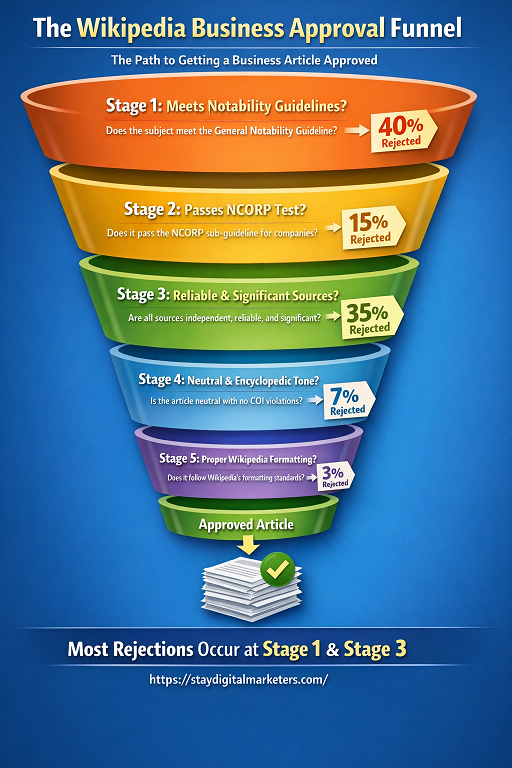
Before listing the mistakes, it helps to understand the baseline. Wikipedia’s General Notability Guideline (GNG) requires that a subject has received “significant coverage in reliable, independent, secondary sources.” For businesses, the NCORP sub-guideline adds that this coverage must reflect national or international interest, not just local press or trade mentions.
Significant coverage means full articles, not name-drops. Independent means the source has no financial or editorial relationship with the company. Reliable means publications with editorial oversight, fact-checking processes, and established reputations.
A useful internal benchmark is what practitioners sometimes call the Three-Source Minimum Rule: at least three fully independent, full-length articles about the business from credible publications, none of which are press release reproductions or interview pieces. Even that is a floor, not a ceiling.
Wikipedia’s founders explicitly prohibited the platform from being used for promotion. Articles written with brand positioning in mind, even subtly, are identified by experienced editors almost immediately. The framing, the word choices, and the structure of a promotional mindset all leave fingerprints editors are trained to recognize.
This is the single most common mistake. Businesses assume that being successful, well-funded, or well-known in their industry equals notability. Wikipedia defines notability by coverage, not achievement. Without qualifying independent sources already published before submission, the article will not survive review regardless of how well it is written.
Press releases are written by the subject, controlled by the subject, and distributed for promotional purposes. Wikipedia explicitly classifies them as non-independent sources. Citing them, even when they appear on major news wire services, is grounds for immediate rejection. The same applies to paid distribution services like PR Newswire or Business Wire.
A company’s own website is a primary source. It represents the company’s version of itself. Wikipedia requires secondary sources, meaning analysis and reporting by parties outside the organization. Using the official website as a citation, even for basic facts, signals a lack of legitimate sourcing.
Being quoted in a Forbes article is not the same as having a Forbes article written about the company. A passing mention, a line in a list, or a quote in a roundup piece does not count as significant coverage. Wikipedia editors look for articles where the business is the primary subject, with substantive analysis of its history, operations, or impact.
Wikipedia describes these violations as “peacock terms” and “weasel words.” Language like “industry-leading,” “revolutionary,” “acclaimed,” “visionary,” or “one of the fastest-growing” reads as advertising copy. So does language like “many experts believe” or “widely regarded as.” Every descriptive claim needs a sourced, neutral basis to survive editorial review.
Writing or commissioning an article about your own business without disclosing the relationship is one of the fastest paths to a permanent ban. Wikipedia’s Conflict of Interest (COI) policy requires that anyone with a financial or personal stake in a subject disclose that relationship before contributing. Undisclosed paid editing is treated as a serious violation and can result in article deletion and account suspension.
Even when businesses hire professional Wikipedia editors, those editors are required to disclose their paid status on their user talk page and on the article’s talk page. Failure to do so violates Wikipedia’s Terms of Use. Many reputation management firms skip this step, putting the article, and the business, at risk.
An interview where a company executive discusses the business is a primary source: the subject is speaking directly about themselves. Wikipedia requires secondary sources where a third party analyzes or independently reports on the subject. Interview-heavy articles are flagged quickly, particularly in the review queue.
“Best Workplace” awards, industry association recognitions, and chamber of commerce honors are not evidence of notability. As one widely referenced Wikipedia notability resource puts it, press releases and “best place to work” designations explicitly do not meet the sourcing standard. Award coverage is typically self-reported or association-driven, meaning it lacks editorial independence.
Wikipedia’s review process checks for duplicate submissions automatically. If a business or its key figures are already mentioned within another article, that existing mention may satisfy Wikipedia’s coverage needs without justifying a standalone page. Submitting a new article that largely repeats existing Wikipedia content leads to immediate rejection or redirect.
Not all trade publications qualify as independent sources. Publications that depend heavily on advertising revenue from companies within an industry, or that routinely republish company announcements, are often considered too close to the subject to establish independence. Niche trade journals covering the same industry as the company face extra scrutiny.
A burst of press coverage tied to a funding announcement or product launch does not constitute enduring notability. Wikipedia’s guidelines specify that coverage must reflect sustained, significant interest over time. A company with three articles published in one week and nothing else will not meet the standard.
This happens more often than it should. Wikipedia articles cannot be used as sources for other Wikipedia articles. The platform is not a citable reference in its own ecosystem. Articles that reference other Wikipedia pages as supporting evidence are automatically considered unsourced for those claims.
Wikipedia’s review system gives weight to editorial history. Submissions from brand-new accounts with no prior editing activity are flagged as likely COI submissions and receive additional scrutiny. Experienced editors can often identify submission patterns associated with paid or promotional editing within minutes of reviewing an article’s creation metadata.
Many business articles include a “History” section written from a celebratory perspective. Describing a company’s founding as a breakthrough or its growth as remarkable violates NPOV just as much as overtly promotional language in an overview section. Every section of the article must maintain encyclopedic neutrality.
Wikipedia articles about businesses follow a specific structure that differs significantly from company profiles, press kits, or about pages. Sections like “Our Mission,” “Why Choose Us,” or “Company Values” have no place in an encyclopedia entry. The correct structure covers verifiable history, operations, market position, controversies if any, and notable coverage, all in neutral, factual language.
Approval is not permanent protection. Wikipedia articles are subject to ongoing community review. Articles that pass initial review can be nominated for deletion later if the sourcing is deemed insufficient, if new edits introduce promotional content, or if the business’s coverage dries up. Post-approval monitoring matters.
Follower counts, subscriber numbers, app downloads, Glassdoor ratings, and Google review scores are not evidence of Wikipedia notability. These metrics reflect popularity and customer volume, not the kind of independent editorial attention Wikipedia’s standards require. Social media presence, regardless of scale, does not factor into notability assessments.
When an article is rejected, the declining editor typically leaves a specific explanation. Many businesses resubmit the same article with minor cosmetic edits rather than addressing the underlying problem, usually sourcing or tone. Repeated non-compliant submissions on the same subject can result in the topic being “salted,” a Wikipedia term for blocking future article creation on that subject entirely.
| Requirement | Common Mistake | Correct Approach |
|---|---|---|
| Independent Sources | Press releases, company site | Major newspapers, academic journals |
| Significant Coverage | Name mentions, brief quotes | Full articles focused on the business |
| Neutral Tone | “Award-winning,” “industry leader” | Factual, descriptive language only |
| COI Disclosure | Submitting anonymously | Declare interest on talk page |
| Source Volume | One or two articles | Minimum three full independent pieces |
| Coverage Timeline | One-time burst of press | Sustained coverage over multiple years |
| Source Type | Trade journals, wire services | Editorial-driven, independent media |
The Wikipedia review timeline for business articles submitted through the Articles for Creation (AfC) process typically runs two to eight weeks, depending on editor availability and the backlog in the review queue. Articles with strong, well-formatted sourcing and clean neutral language move through faster. Those that require back-and-forth between the submitter and reviewing editors take significantly longer.
Rarely, and only under specific circumstances. A business might qualify if it played a verifiable role in a notable historical event, contributed to a documented shift in its industry, or is part of a legal, regulatory, or legislative record that has been covered by independent sources. In all cases, the qualifying factor is external, verifiable, and independent coverage, not the company’s own description of its significance.
Accepted sources include major national and international newspapers, peer-reviewed publications, independently edited industry journals, published books from credible publishers, and broadcast media transcripts from established outlets. Unaccepted sources include press releases, company websites, sponsored content, social media posts, self-published blogs, interviews where the subject is the primary speaker, and any publication that relies on the subject for advertising revenue.
Why does Wikipedia keep deleting my business page? The most common reason is insufficient notability evidence. If the sources cited do not meet the standard of being independent, reliable, and providing significant coverage, the article will not survive review regardless of the company’s actual prominence.
Can I pay someone to write my Wikipedia page? Paid Wikipedia editing is permitted but must be disclosed. The editor must declare their paid status on their Wikipedia user page and on the article’s talk page. Failure to do so violates Wikipedia’s Terms of Use and can result in deletion.
Does a Forbes mention qualify my business for Wikipedia? A single mention in a Forbes article does not meet the notability threshold. An entire Forbes article focused specifically on your business is a stronger signal, but alone it is typically not sufficient. Multiple such pieces from different independent outlets are required.
How many sources does a Wikipedia business article need? There is no fixed number, but editors typically expect to see at least three to five substantial, independent articles from credible publications where the business is the central subject. More is better, and diversity of source type strengthens the submission.
What happens if my Wikipedia article is rejected twice? Multiple failed submissions can result in the topic being salted, meaning Wikipedia’s system prevents any new article on that subject from being created. Addressing the specific reasons for rejection before resubmitting is essential.
Can a local business get a Wikipedia page? Very small or purely local businesses are explicitly noted in Wikipedia’s guidelines as typically not qualifying for standalone articles. The platform’s standards favor businesses with national or international significance as documented by independent sources.
Is Wikipedia notability permanent? Notability is not permanent in the sense that an article can be nominated for deletion at any point if the community believes the sourcing no longer supports inclusion. Maintaining a Wikipedia presence requires that the underlying coverage continues to meet the standard.
Wikipedia rejection is rarely arbitrary. It follows a predictable logic rooted in policies that have been in place for years and are consistently applied by a large, experienced editor community. Businesses that approach the platform with the right preparation, qualified independent sources established before submission, a neutral encyclopedic tone throughout, full COI disclosure, and realistic expectations about the time and evidence required, have a substantially better approval rate.
For brands navigating this process alongside broader digital presence goals, agencies like Stay Digital Marketers offer relevant support across related areas including Wikipedia page creation, Google Knowledge Panel establishment, press release distribution, and backlink-building services such as guest posting and niche edits. Understanding how these elements connect is part of building a credible, verifiable online presence that stands up to editorial scrutiny.

Filza Taj is an MPhil in Human Resources-turned SEO Specialist, Content Strategist, and Digital Marketing Consultant with over 5 years of experience helping businesses in 30+ countries grow online. As the Founder of Stay Digital Marketers (staydigitalmarketers.com), she delivers results-driven solutions in link building, guest posting, PR distribution, niche edits, multilingual backlinks, and content marketing. She publishes daily SEO insights and actionable strategies to help brands strengthen their online presence, attract the right audience, and convert clicks into loyal customers.
Filza@staydigitalmarketers.com
Stay Digital Marketers
Need SEO, Link Building or Digital Marketing Services?
Request a Free Audit →