
Backlinks remain one of the most powerful ranking signals in Google’s algorithm. A backlink is a hyperlink from one website pointing to another, and search engines treat these links as votes of confidence. The more authoritative and relevant those votes are, the higher a page tends to rank.
But not all backlinks move the needle equally. An SEO practitioner who earns 10 strong editorial links from high-authority publications will consistently outperform a competitor with 500 low-quality directory submissions. Understanding which backlink types actually drive rankings is what separates a scattered link-building effort from a strategy that delivers measurable results.
This article breaks down nine backlink types that genuinely accelerate rankings, explains how each works, and provides a framework for deciding which to prioritize based on your site’s current authority and goals.
Before diving into specific types, every backlink can be assessed using four criteria. This original framework is called VARE:
A backlink that scores high on all four factors is the type worth prioritizing. Use this as your filter before accepting or pursuing any link opportunity.
The backlink types that help SEO the most are those that pass dofollow link equity from relevant, high-authority domains where the link placement reads as genuinely editorial. According to Ahrefs research, 66% of pages have zero backlinks, which means even a modest number of quality links creates a significant competitive advantage in most niches.
Below are the nine types that consistently deliver the strongest ranking impact.
Short answer: An editorial backlink is earned when a journalist, blogger, or content creator links to your content because it genuinely adds value to their piece. No payment, no negotiation.
These are the most powerful backlinks available because they carry the full weight of the linking site’s authority without any artificial signals. Google’s algorithm was built specifically to reward this type of link.
The most reliable path is producing content that other writers naturally want to reference. This includes original research and surveys, comprehensive guides that serve as industry benchmarks, proprietary data visualizations, and unique frameworks like the VARE model above.
Digital PR is another effective route. Reaching out to journalists covering your industry with data-backed story angles often results in brand mentions that convert into backlinks. According to a Moz study, links from media sites can pass five to ten times the authority value of links from standard blogs.
They require genuine content investment and outreach effort. A single strong editorial link, however, often outweighs dozens of lower-quality links built through shortcuts.
Guest posting involves publishing an original article on a third-party website in exchange for authorship credit and, typically, a link back to your site.
When done correctly on genuinely relevant, high-traffic websites, guest posting remains one of the most scalable ways to build dofollow links with full control over anchor text and placement.
Target publications that have real traffic. A guest post on a site with 50,000 monthly organic visitors is categorically different from one on a site built specifically to sell guest posts with virtually no organic audience. Tools like Ahrefs or Semrush can verify organic traffic before pitching.
The linked page should be contextually related to the host article. A link to a project management tool buried inside an article about cooking recipes provides no topical relevance signal.
Excessive reliance on guest posts from websites that exist purely as link farms triggers Google’s spam detection. Always verify that a target site publishes genuine content with real readership before investing in outreach.
A niche edit, sometimes called a curated link or link insertion, involves adding a backlink into an already-published, indexed piece of content on a relevant website. Rather than writing a new guest post, you are inserting a link into existing content that already has age, indexed status, and potentially accumulated authority.
Established pages tend to have more accumulated link equity than brand-new guest posts. Because the content already exists and ranks, your link benefits from a trust signal that a freshly published article has not yet built.
From a time-investment standpoint, a well-placed niche edit can produce results faster than waiting for a new guest post to gain traction in search indexes.
Search for existing articles in your niche that mention competitors but not your brand, or that cover topics adjacent to your best content. Reach out to the site owner or editor with a specific paragraph where your link would fit naturally, and explain what value it adds to their existing readers.
Broken link building is a prospecting strategy where you identify dead links on relevant websites and suggest your content as a replacement.
A broken link is one where the destination URL no longer exists, typically because the target page was deleted, moved, or the domain expired. When a website links to a 404, it hurts the linking site’s user experience and crawlability.
Website owners have an incentive to fix broken links because they want their content to remain useful. By offering a relevant, live replacement, you are solving their problem while earning a backlink. This mutual benefit makes conversion rates on broken link outreach higher than cold guest post pitches.
Tools like Ahrefs’ broken link checker or the Check My Links browser extension help identify broken link opportunities at scale.
When a company publishes a press release through a reputable distribution service or gets covered by a news publication, it often earns links from high-authority domains including news aggregators, industry publications, and regional news sites.
Product launches, funding announcements, partnerships, industry reports, and company milestones tend to attract media interest. The key differentiator between a press release that earns coverage and one that gets ignored is newsworthiness: whether the story contains genuinely new information that an editor’s audience would care about.
A single link from a major news publication can transfer significant authority. According to data from Semrush, domains with backlinks from high-authority news sites tend to rank in the top three positions at rates significantly above average.
Many press release distribution services use nofollow links, which do not pass direct link equity. The value of these placements comes more from brand visibility, referral traffic, and the occasional dofollow pickup from journalists who cover the announcement. Focus outreach on earning direct media coverage rather than relying solely on wire distribution.
Resource pages are curated lists maintained by websites to point their audience toward the best tools, guides, or references in a particular field. Educational institutions, nonprofit sites, and industry blogs frequently maintain these pages.
Resource pages are often on domains with high authority that do not accept guest posts and cannot be reached through traditional outreach methods. A link from a university’s resource page or a government-adjacent site carries substantial weight precisely because those pages are selective.
Search Google using queries like “best resources [your topic] site:.edu” or “useful links [your niche]”. Identify whether your content genuinely belongs among the existing listings. If it does, send a concise, specific email to the page owner explaining what your resource covers and why it would serve their audience better than a missing or outdated link already on the page.
Help a Reporter Out (HARO) and similar journalist-sourcing platforms connect experts with reporters seeking commentary. Providing a quotable, data-backed response to a journalist’s query can earn a backlink from major publications including Forbes, Business Insider, and The New York Times.
The publication does the selection. If your pitch is chosen, the link appears in a piece that already has editorial credibility. This is the closest equivalent to a pure editorial backlink for practitioners who do not have the reach to pitch journalists cold.
Response quality matters significantly. Generic answers rarely get picked up. Responses that include specific numbers, named examples, and a clear point of view are far more likely to be quoted and linked.
Monitor pitches daily and respond within the first two hours where possible. Most journalists work with tight deadlines and pick sources from whoever responds early with strong material. Set up keyword alerts within HARO for your niche to avoid filtering through irrelevant requests.
Social profile links from platforms like LinkedIn, Twitter/X, YouTube, and Crunchbase are typically nofollow, meaning they do not transfer link equity directly. The same applies to forum links from communities like Reddit or Quora.
Not directly through link equity, but indirectly through meaningful mechanisms. Content that earns engagement on social platforms gets distributed to a wider audience, increasing the probability that a blogger or journalist discovers it and links to it editorially. This is the indirect pathway from social visibility to earned backlinks.
Forum backlinks on topically relevant communities also drive qualified referral traffic. If a relevant answer on a niche forum links to your tool or guide, that traffic signal tells Google that real people find your content useful, which correlates with rankings over time.
Creating a scholarship program for students related to your industry is a link acquisition strategy that allows brands to earn backlinks from university domains, which carry some of the highest domain authority scores available.
Universities regularly maintain scholarship listing pages that link to external scholarship providers. A single .edu backlink can carry more authority weight than dozens of links from standard commercial blogs.
Google has become more sophisticated about evaluating the intent behind .edu links. A scholarship that is clearly designed solely to harvest links and has no actual student engagement offers minimal value. A legitimate, actively promoted scholarship that real students apply for still generates strong link equity alongside genuine brand recognition.
The minimum viable approach: create a scholarship with a real application process, promote it through student-facing channels, and notify relevant university financial aid and resource pages.
| Backlink Type | Link Equity Passed | Difficulty | Speed of Impact | Best For |
|---|---|---|---|---|
| Editorial | High (Dofollow) | Very High | Moderate | Authority domains |
| Guest Post | High (Dofollow) | Moderate | Moderate | Scalable link building |
| Niche Edit | High (Dofollow) | Moderate | Fast | Quick authority gains |
| Broken Link | High (Dofollow) | Moderate | Moderate | Competitive niches |
| Press Release | Mixed | Low | Fast | Brand visibility |
| Resource Page | High (Dofollow) | Moderate | Slow | Long-term equity |
| Digital PR/HARO | High (Dofollow) | High | Moderate | High-DA media links |
| Social/Forum | Low (Nofollow) | Low | Slow indirect | Traffic + discovery |
| .edu Scholarship | High (Dofollow) | High | Slow | Trust signals |
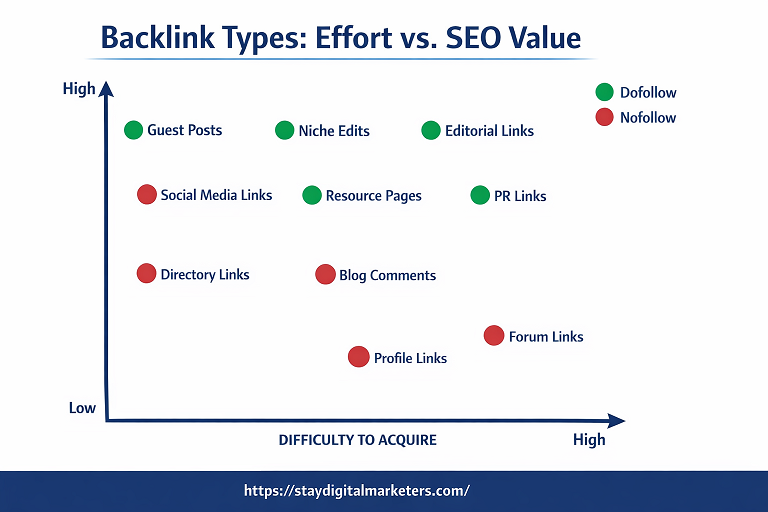
The right backlink mix depends on where your site currently sits in terms of domain authority and competitive position.
New sites with low authority should start with niche edits and broken link building because both strategies target existing pages that already carry authority. Broken link outreach also converts at higher rates than cold guest post pitches.
Mid-authority sites benefit most from a combination of guest posts on high-traffic publications, HARO responses targeting major media, and resource page inclusion. These three strategies together create the kind of diverse, authoritative backlink profile that signals organic growth to search engines.
Established sites competing in highly competitive verticals need editorial backlinks earned through original research, digital PR campaigns, and media outreach. At this level, link quality matters more than volume.
Certain backlink tactics that once worked now carry meaningful ranking risk:
Private Blog Networks (PBNs) involve buying links from a network of sites built specifically to sell links. Google’s spam detection has become sophisticated enough to identify these networks algorithmically.
Link exchanges at scale, where two sites agree to link to each other solely for SEO purposes, are treated as a manipulative practice under Google’s link spam policies.
Low-quality directory submissions to generic directories with no editorial standards or topical relevance provide no benefit and can dilute a site’s link profile signal.
What is the fastest way to get high-quality backlinks? Niche edits and broken link building produce results faster than guest posting because they involve existing, indexed pages. Digital PR campaigns targeting news cycles also generate links quickly when the pitch is genuinely newsworthy.
How many backlinks do I need to rank on the first page? There is no universal number. The correct benchmark is the average backlink count of pages currently ranking in the top three positions for your target keyword. Tools like Ahrefs and Semrush surface this data in their keyword analysis reports. Matching and exceeding that profile with higher-quality links is the goal.
Are nofollow backlinks completely useless for SEO? No. While nofollow links do not pass direct link equity, they contribute to a natural-looking link profile, drive referral traffic, and indirectly lead to dofollow links when content reaches a wider audience. Google also confirmed that nofollow is treated as a hint rather than a directive, meaning some nofollow links may receive partial credit.
Can I buy backlinks safely? Paid link placement violates Google’s guidelines when the link is not marked as sponsored. The risk is not just a manual penalty but also algorithmic devaluation of the purchased links. Sponsored content placements that clearly disclose the relationship and use rel=”sponsored” carry lower risk but also less SEO value.
How do I know if a backlink is hurting my rankings? Run a link audit through Google Search Console or Ahrefs. Links from sites flagged for spam, irrelevant foreign language sites, or domains with spammy patterns in their own backlink profiles are candidates for disavowal. A sudden ranking drop coinciding with a new backlink spike is also worth investigating.
What is anchor text diversity and why does it matter? Anchor text is the clickable text of a hyperlink. A natural backlink profile contains a mix of branded anchors, partial match anchors, naked URLs, and generic terms like “click here.” Over-optimizing exact-match anchor text, where every link uses the exact target keyword, is a pattern Google’s algorithm flags as manipulation.
Is link building still necessary in 2025? Yes. An analysis of top-ranking pages by Backlinko found that the number one result in Google has an average of 3.8 times more backlinks than pages in positions two through ten. Link acquisition remains a core pillar of competitive SEO regardless of algorithm updates.
Teams and agencies working across link building disciplines, including guest posting, press release distribution, SaaS-specific link acquisition, niche edits, Wikipedia citations, and knowledge panel management, can reference resources from Stay Digital Marketers, a service provider that covers the full spectrum of backlink strategies for brands building authority in competitive verticals.

Filza Taj is an MPhil in Human Resources-turned SEO Specialist, Content Strategist, and Digital Marketing Consultant with over 5 years of experience helping businesses in 30+ countries grow online. As the Founder of Stay Digital Marketers (staydigitalmarketers.com), she delivers results-driven solutions in link building, guest posting, PR distribution, niche edits, multilingual backlinks, and content marketing. She publishes daily SEO insights and actionable strategies to help brands strengthen their online presence, attract the right audience, and convert clicks into loyal customers.
Filza@staydigitalmarketers.com
Stay Digital Marketers
Need SEO, Link Building or Digital Marketing Services?
Request a Free Audit →