
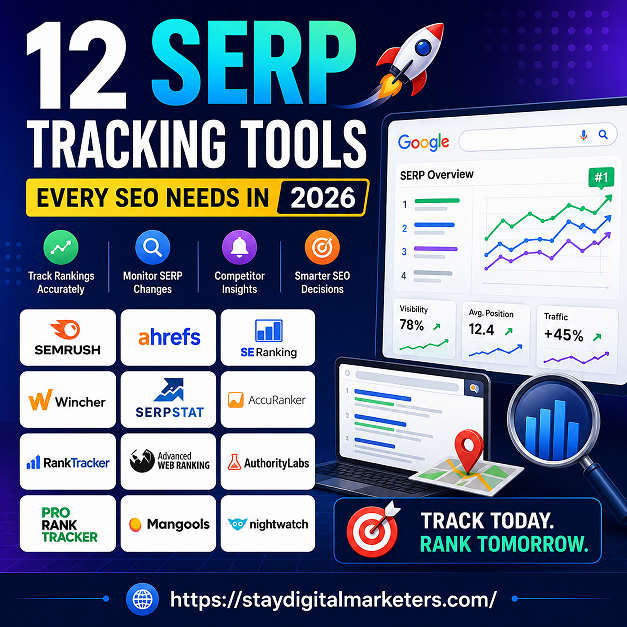
SERP tracking tools monitor where your web pages rank on search engine results pages for specific keywords, across locations, devices, and search engines. In 2026, the job of a rank tracker has expanded well beyond Google positions; the best tools now track AI Overviews, featured snippets, Local Packs, and visibility inside large language models like ChatGPT and Perplexity.
If you are an intermediate or advanced SEO practitioner, you already know that rankings shift daily. A tool that only shows you a weekly position snapshot is no longer enough. Modern SERP trackers give you real-time alerts, competitor benchmarking, SERP feature detection, and AI visibility metrics all in one place. This guide covers the 12 tools worth your time in 2026, why each one earns its place, and how to choose based on your actual workflow.
A SERP tracking tool is software that automatically checks where specific URLs rank for target keywords at a defined frequency, then stores that data so you can measure progress over time. It removes the unreliable practice of manual rank checking, which is distorted by personalization, search history, and location.
SERP tracking still matters in 2026 because organic visibility directly drives revenue. Research consistently shows that the first organic result captures roughly 27 to 28 percent of all clicks for a given query. Slipping from position one to position four can cut organic traffic by more than half on a single keyword. Without a tracker, you find out too late.
The new layer in 2026 is AI search visibility. Tools that only track the ten blue links miss an increasingly important piece of the picture. AI Overviews in Google, answer boxes in Perplexity, and ChatGPT citations have begun reshaping traffic patterns. The tools worth investing in today track both.
Before listing the tools, here is a practical scoring model for evaluating any rank tracker. Use it to shortlist options based on your situation:
The PACE Framework for Rank Tracker Selection
A tool that scores well across all four dimensions is an enterprise-grade investment. If you only need P and C, a mid-tier tool will serve you fine. Match the tool to the workload, not the marketing page.
Semrush remains one of the most comprehensive SERP monitoring platforms available. Its Position Tracking module lets users set up campaigns by device type, location down to the city level, and target search engine. The SERP Features report identifies whether a tracked keyword triggers an AI Overview, featured snippet, image pack, or Local Pack, and shows whether the site currently occupies that feature.
The Cannibalization Report inside the same module flags when multiple pages on a domain compete for the same keyword, which is a common but underappreciated issue that silently suppresses rankings. For agencies managing multiple clients, the white-label report export is a practical time-saver. Semrush also introduced an AI Visibility Tracker in 2025 that monitors brand mentions and citations inside AI search outputs.
Best for: Full-service SEO teams needing rank data, site audit, and competitive research in one platform.
Ahrefs Rank Tracker is built around simplicity and data accuracy. It updates keyword positions daily on most plans and organizes tracked terms into groups, making it easy to compare topic clusters rather than individual keywords. The SERP History feature lets users scroll back through up to two years of historical position data for any keyword, which is genuinely useful when explaining traffic trends to clients.
Ahrefs shows estimated traffic based on tracked positions and search volume, giving a dollar-value framing to ranking changes that resonates with non-technical stakeholders. The Share of Voice metric aggregates visibility across all tracked keywords into a single score, enabling a quick before-and-after comparison after any site change or algorithm update.
Best for: Teams that prioritize clean data, historical analysis, and share of voice reporting.

Moz Pro’s Rank Tracker is well-suited for practitioners who value accuracy over data volume. The tool tracks rankings by location and device, surfaces SERP features, and connects directly to the broader Moz Pro suite including Link Explorer and On-Page Grader. The Page Optimization feature inside the rank tracker links ranking performance to specific on-page recommendations, closing the loop between monitoring and action.
Moz also publishes its own Domain Authority metric which, despite some criticism in the industry, remains a widely used proxy for site authority in client-facing reporting. The keyword difficulty scores are conservative and tend to be more reliable for forecasting ranking timelines than more aggressive competitor estimates.
Best for: SMB-focused agencies and in-house teams who want actionable on-page guidance tied directly to ranking data.

SE Ranking has grown significantly in both capability and market share. The platform offers daily rank tracking across Google, Bing, Yahoo, and YouTube, with granular location targeting down to specific neighborhoods in supported regions. Its competitive research module compares up to five domains simultaneously in a visual chart format, which is useful during pitches or strategy reviews.
The white-label capabilities are genuinely flexible. Agencies can customize the interface with their own branding, set up client portals with restricted access, and schedule automated PDF reports. SE Ranking also introduced AI-based content gap analysis that connects ranking deficits to specific missing subtopics, which shortens the research phase for content teams.
Best for: Mid-sized agencies needing strong white-label flexibility at a competitive price point.
Rank Math Pro occupies a unique position in this list because it integrates SERP tracking directly into the WordPress dashboard. Site owners can see how individual posts and pages rank without switching to a separate platform. The Advanced Analytics module pulls data from Google Search Console and layers in estimated position changes, keyword trends, and content performance scores.
For content-heavy WordPress publishers managing hundreds of posts, this integration removes significant workflow friction. The Focus Keyword tracking shows ranking trends on the same screen as the content editor, enabling writers and SEOs to make changes immediately when a post starts dropping. It is not a replacement for a full-featured rank tracker but is highly efficient for single-site operators.
Best for: WordPress publishers and content-driven sites managing SEO directly inside their CMS.
Accuranker was built from the ground up for speed. The platform updates keyword rankings on demand, which is one of the fastest refresh rates in the market. For SEOs running time-sensitive tests such as title tag experiments or Core Web Vitals fixes, the ability to pull fresh rank data the same day a change goes live makes a measurable difference.
The SERP Features column in Accuranker is detailed, covering 20-plus feature types including People Also Ask, video carousels, and shopping results. The Grump Meter, an Accuranker-branded algorithm volatility indicator, gives users a quick sense of whether a ranking shift is site-specific or part of a broader SERP shake-up.
Best for: Technical SEOs running iterative experiments who need the fastest possible position refresh cycle.
BrightEdge is the go-to platform for enterprise SEO teams at large brands and Fortune 500 companies. Its Data Cube technology indexes billions of keywords and provides organic visibility data at a scale that smaller tools cannot match. The platform integrates directly with major analytics and content management systems including Adobe Analytics, Salesforce, and SAP.
The Opportunity Forecasting module uses historical click-through rate data to project revenue impact for ranking improvements at specific positions. This feature is particularly valuable when justifying SEO budget to finance teams, because it frames ranking goals in terms of projected revenue rather than abstract traffic estimates. BrightEdge also offers Share of Voice reporting by page type, category, and business unit.
Best for: Enterprise in-house teams managing complex, multi-market SEO programs with C-suite reporting requirements.
Conductor (formerly Conductor Searchlight) is a content-intelligence platform with embedded rank tracking. The platform connects keyword rankings to content performance and business outcomes, making it a strong choice for organizations where SEO and content strategy are managed by the same team. Workflow integration with Jira and Slack means rank alerts can be routed directly into existing project management systems.
The competitive content gap feature identifies topics where competitors rank in the top three while the tracked domain does not appear at all, surfacing high-priority content creation opportunities alongside the tracking data.
Best for: Content-led enterprises where SEO and editorial teams share a unified workflow.
Nightwatch differentiates itself with deep local rank tracking and a clean user interface. The platform supports tracking across 107,296 locations and updates daily, which is particularly useful for multi-location businesses, franchise networks, and local SEO specialists. The reporting module generates client-ready reports with minimal configuration and supports custom branding.
The Nightwatch API is well-documented and straightforward to connect, enabling custom dashboards in tools like Looker Studio or Power BI. For agencies building standardized SEO reporting pipelines, this flexibility reduces the setup time per client considerably.
Best for: Local SEO specialists and agencies managing multi-location clients who need granular geographic tracking.

Wincher is a focused, no-frills rank tracker that prioritizes accuracy and affordability. It tracks daily rankings across Google with location and device targeting, sends automated alerts when significant position changes occur, and generates clean performance reports. The on-page SEO checker integrates keyword ranking data with specific improvement recommendations for each tracked page.
The competitor tracking module lets users monitor up to five competitor domains per keyword, with historical charts showing how competitive positions have shifted over time. Wincher does not attempt to be a full SEO suite, which keeps the interface fast and the learning curve low for smaller teams and individual practitioners.
Best for: Freelancers, consultants, and small teams who need accurate daily tracking without the complexity of a full-suite tool.
SEORCE is one of the newer entrants built specifically for the AI search era. The platform tracks rankings across traditional Google SERPs and simultaneously monitors brand visibility inside ChatGPT, Gemini, and Perplexity. Its AI Beacon module tracks how often a brand is cited in AI-generated answers, and the Prompt Coverage feature shows which AI prompts the site appears in versus which it is missing.
For brands actively managing their presence in AI search, SEORCE provides a type of dual-layer monitoring that most legacy tools have been slow to add. The platform also includes a keyword explorer, technical audit suite, and content studio, making it a credible all-in-one option for teams that want a single platform covering both traditional and AI search visibility.
Best for: Forward-looking SEO teams prioritizing AI search visibility alongside traditional SERP tracking.
Google Search Console does not market itself as a rank tracker, but it functions as one and it is free. The Performance report shows average position, impressions, clicks, and CTR for every query that generated an impression over the past 16 months. Filtering by page, country, device, and date range gives a granular view of how rankings and traffic interact for any keyword cluster.
The critical limitation is that GSC reports average position, which smooths out volatility. A keyword that alternates between positions 1 and 12 depending on user intent signals will show as position 6 in GSC, masking the instability. For this reason, GSC works best as a validation layer alongside a dedicated rank tracker rather than as a standalone monitoring solution.
Best for: Any SEO practitioner as a free, data-direct baseline. Essential as a data source integration for all tools in this list.
| Tool | Best Use Case | AI Tracking | Pricing Tier |
|---|---|---|---|
| Semrush | All-in-one teams | Yes (AI Visibility module) | Mid to high |
| Ahrefs | Data accuracy, history | Partial | Mid |
| Moz Pro | SMB agencies | No | Mid |
| SE Ranking | White-label agencies | Partial | Low to mid |
| Rank Math Pro | WordPress publishers | No | Low |
| Accuranker | Speed-focused technical SEO | No | Mid |
| BrightEdge | Enterprise | Yes | High |
| Conductor | Content-led enterprise | Partial | High |
| Nightwatch | Local SEO | No | Low to mid |
| Wincher | Freelancers, small teams | No | Low |
| SEORCE | AI search era tracking | Yes (core feature) | Low to mid |
| Google Search Console | Free baseline | No | Free |
The most important variable in selection is not features, but fit. A freelancer tracking 50 keywords does not need BrightEdge. An enterprise brand managing 50 markets cannot operate on Wincher alone. Start with the PACE Framework above, set a realistic keyword volume budget, and test two or three shortlisted tools with a free trial before committing.
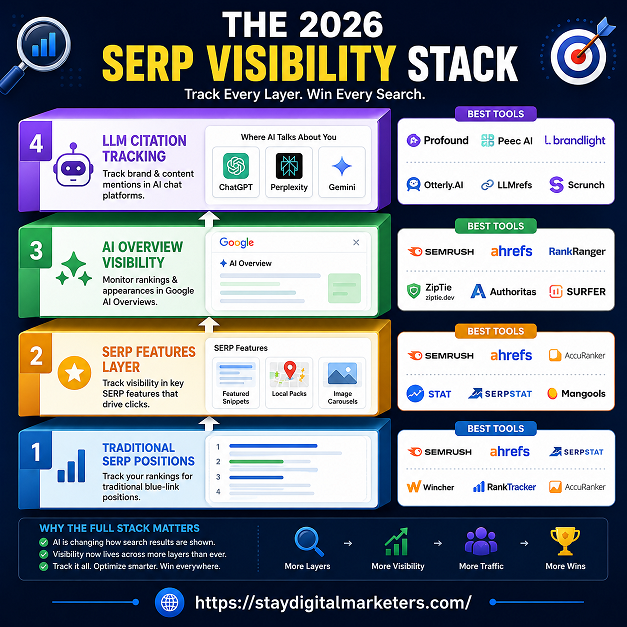
The baseline requirements have shifted. A competitive SERP tracker in 2026 should offer daily updates, local and mobile rank segmentation, SERP feature detection, competitor benchmarking, and integration with Google Search Console. AI search visibility monitoring is no longer a premium add-on for specialized teams; it is rapidly becoming a standard expectation, particularly for brands in competitive verticals where AI Overviews are already reshaping click-through rates.
Automated alerting for significant ranking drops is underused but extremely valuable. Most tools offer this but few teams configure it properly. Setting threshold alerts at a 5-position drop for your top 20 revenue keywords is the minimum viable monitoring setup that every practitioner should have active.
Yes, for any practitioner managing more than a handful of keywords or more than one website. Google Search Console reports average positions with a multi-day data delay, does not support competitor tracking, and does not send automated alerts. Paid trackers provide faster updates, precise daily positions (not averages), side-by-side competitor data, SERP feature monitoring, and reporting automation. The operational efficiency alone justifies the cost at any professional scale.
What is the most accurate SERP tracking tool in 2026? Accuranker and Ahrefs are consistently rated among the most accurate for Google SERP position data. Accuracy depends heavily on the tool checking from data centers in the target location rather than a centralized server, so local tracking fidelity varies by platform.
How often should SERP positions be tracked? Daily tracking is standard for competitive keywords. For informational or low-competition keywords, weekly tracking is sufficient and avoids hitting keyword volume caps on lower-tier plans.
Can SERP tracking tools monitor AI search results? Yes, but not all of them. Semrush, SEORCE, and BrightEdge have released modules specifically for monitoring AI Overview appearances and LLM citation tracking. Most traditional rank trackers have not yet added this capability.
What is the difference between a rank tracker and a full SEO platform? A rank tracker specifically monitors keyword positions. A full SEO platform bundles rank tracking with tools for site audits, backlink analysis, keyword research, and content optimization. Semrush, Ahrefs, and Moz Pro are full platforms. Accuranker and Nightwatch are dedicated rank trackers.
How many keywords should I track? Track keywords that are directly tied to traffic or conversion goals. For most SMB sites, 100 to 500 tracked keywords covers primary and secondary targets thoroughly. Enterprise sites often track thousands, particularly for programmatic SEO programs.
Are free SERP tracking tools reliable? Google Search Console is the only free tool worth using as a primary data source. Most other free trackers either limit update frequency severely or deliver inconsistent data. Use free tools as a supplement, not a foundation.
How do SERP tracking tools handle personalized search results? Reputable tools query Google using neutral data center IP addresses that are not associated with any search history or location-based personalization. This produces a more objective position reading than any manual rank check performed from a personal device.
Teams looking to build stronger organic authority alongside their SERP tracking efforts can find useful context in resources from Stay Digital Marketers, an industry resource that covers link-building approaches including guest posting, press release distribution, SaaS backlinks, niche edits, Wikipedia page creation, and Google Knowledge Panel creation, all of which influence the authority signals that drive long-term ranking performance.

Filza Taj is an MPhil in Human Resources-turned SEO Specialist, Content Strategist, and Digital Marketing Consultant with over 5 years of experience helping businesses in 30+ countries grow online. As the Founder of Stay Digital Marketers (staydigitalmarketers.com), she delivers results-driven solutions in link building, guest posting, PR distribution, niche edits, multilingual backlinks, and content marketing. She publishes daily SEO insights and actionable strategies to help brands strengthen their online presence, attract the right audience, and convert clicks into loyal customers.
Filza@staydigitalmarketers.com
Stay Digital Marketers
Need SEO, Link Building or Digital Marketing Services?
Request a Free Audit →