
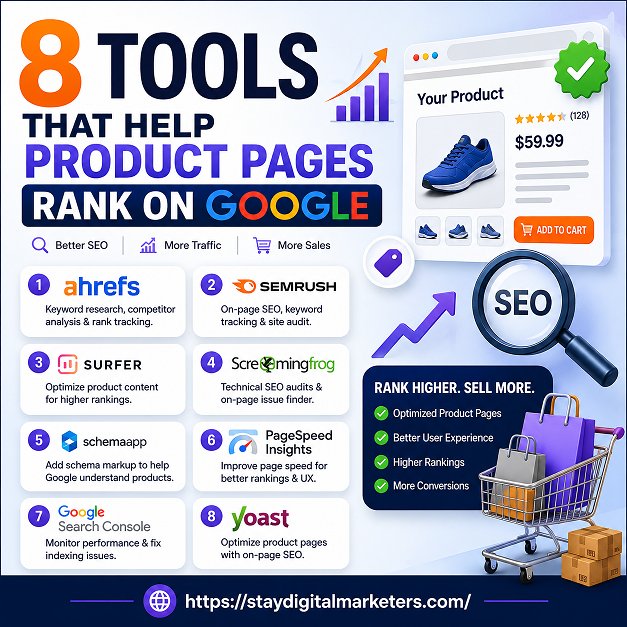
Most product pages fail to rank not because the product is wrong, but because the page itself gives Google nothing to work with. No structured data, no keyword targeting, thin descriptions, slow load times, and zero backlink authority. The result is a page that exists but never gets found.
The tools covered in this article fix exactly that. Each one targets a specific layer of product page SEO, from keyword discovery and on-page optimization to technical audits, schema markup, and link acquisition. Used together, they form a complete system for getting product pages out of obscurity and into rankings.
Product pages face unique SEO challenges. They often share duplicate descriptions with manufacturers, compete with category pages on the same site, and have minimal unique content that search engines can index and evaluate.
Google looks at these pages differently from blog posts or guides. A product page needs to demonstrate purchase intent alignment, content depth, technical health, and authority signals all at once. That is a lot to optimize manually across hundreds of SKUs.
That is where purpose-built tools become necessary, not optional.
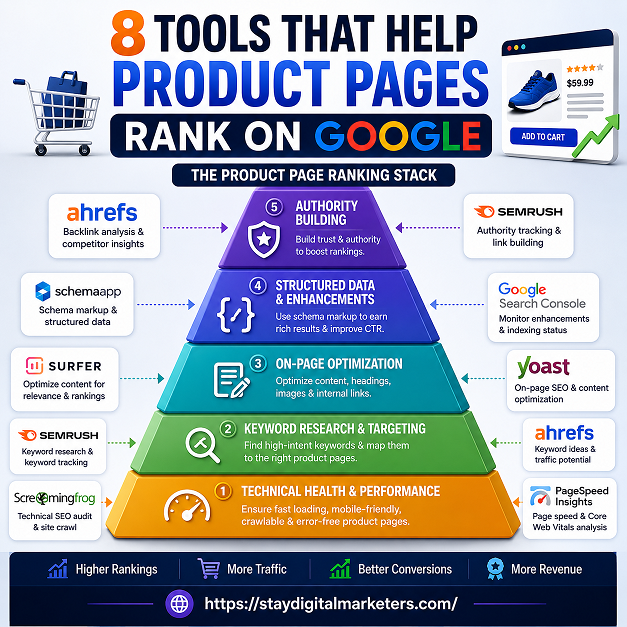
Before jumping into individual tools, it helps to think in layers. The Product Page Ranking Stack framework below maps each tool to its function:
| Layer | What It Covers | Tool Category |
|---|---|---|
| Keyword Targeting | Finding what buyers actually search | Keyword research tools |
| On-Page Optimization | Titles, descriptions, headings, content depth | Content optimization tools |
| Technical Health | Crawl errors, speed, indexability | Technical SEO tools |
| Schema Markup | Rich results for price, reviews, availability | Structured data tools |
| Backlink Authority | Link equity to the product URL | Link building tools |
| Competitor Intelligence | What ranking pages are doing differently | Competitive analysis tools |
Each tool below fits into one or more of these layers.
What it does: Ahrefs is a full-suite SEO platform, but for product pages specifically, its Keywords Explorer and Site Explorer are the most valuable features.
When targeting a product page, the goal is not just finding high-volume keywords. It is finding keywords with commercial intent that a product page can realistically rank for. Ahrefs gives you keyword difficulty scores, click-through potential, and the exact SERP features triggered by each query.
Site Explorer lets you look up any competitor product URL and see which keywords it ranks for, how much traffic those keywords drive, and what anchor text their backlinks carry. This is particularly useful for identifying long-tail product keywords that competitors rank for but you have not yet targeted.
For large ecommerce sites with thousands of SKUs, Ahrefs supports bulk keyword analysis, letting teams prioritize which product pages to optimize first based on traffic potential versus current ranking position.
Best for: Competitive keyword research, backlink gap analysis, identifying underperforming product pages.

What it does: Google Search Console shows exactly how Google sees your product pages, what queries trigger impressions, what position they hold, and which pages have indexing issues.
Because it is the only tool that gives you first-party data directly from Google. No estimates, no sampling. You see the actual queries that brought up your product pages in search results, even if no one clicked.
The Performance report filtered by page type reveals which product pages have high impressions but low click-through rates, a signal that the title tag or meta description needs work. The Coverage report flags pages that are excluded from the index, often due to duplicate content, noindex tags left on accidentally, or crawl errors.
For product pages specifically, the Rich Results report in Search Console confirms whether schema markup is valid and eligible for enhanced SERP features like price, review stars, and stock availability.
Best for: Monitoring real search performance, diagnosing indexing failures, validating rich result eligibility.
What it does: Surfer SEO analyzes the top-ranking pages for a target keyword and generates a content score based on word count, keyword usage, heading structure, and entity coverage.
Product descriptions are often the weakest part of any ecommerce page. Manufacturers copy their own specs, or store owners write three sentences and move on. Surfer’s Content Editor gives specific guidance on what terms to include, how often, and in which context, based on what already ranks.
For product pages, this means going beyond generic feature lists. Surfer surfaces semantically related terms that buyers use when searching, words like “compatibility,” “warranty,” “shipping time,” or specific use-case modifiers that differentiate your content from thin competitor pages.
The audit feature also compares an existing product page against competitors in real time, showing a gap score and prioritized recommendations. This is more actionable than generic on-page checklists.
Best for: Writing and optimizing product descriptions, identifying semantic gaps, improving content depth without keyword stuffing.

What it does: Screaming Frog is a desktop crawler that replicates how Googlebot reads your site. It scans every page, identifies technical issues, and outputs a structured report covering metadata, redirects, broken links, duplicate content, and more.
Product pages are technically complex. They often have parameter-based URLs, duplicate content from filtered variants, missing canonical tags, broken image links, and slow load times triggered by large product photo files.
Screaming Frog surfaces all of these. A common discovery is product pages accidentally blocking Googlebot through incorrect robots.txt entries or noindex tags applied during staging that were never removed. Another frequent issue is title tags that default to product SKUs rather than search-intent-matching phrases.
The custom extraction feature in Screaming Frog is particularly powerful. You can pull structured data from product pages at scale, map category hierarchies, and identify which products are missing schema markup, all in a single crawl.
Best for: Technical audits across large product catalogs, identifying crawl and indexation problems, diagnosing duplicate content at scale.
What it does: Schema markup, implemented through JSON-LD, tells Google specific things about a product: its price, availability, review count, brand, and more. Tools like Schema App generate and validate this markup, while Google’s Rich Results Test confirms it renders correctly.
Schema markup does not directly boost rankings, but it significantly increases the visibility of those rankings. A product page with valid schema can display star ratings, price ranges, and in-stock badges directly in the search results. This raises click-through rates, which does influence ranking over time.
According to industry data from Search Engine Land, pages with rich results see click-through rate improvements ranging from 20 percent to over 30 percent compared to plain blue links.
The most important product schema properties are name, image, description, sku, brand, offers (which includes price, priceCurrency, and availability), and aggregateRating. Missing or invalid entries in the offers property are the most common reason product schema fails Google’s rich result eligibility check.
Best for: Generating accurate product schema, testing structured data validity, maximizing SERP real estate through rich results.

What it does: SE Ranking combines keyword rank tracking, competitor analysis, and keyword research in one platform, with reporting features designed for teams managing multiple product lines.
Keyword rank tracking is easy to overlook once optimization work is done, but it is critical for product pages. Rankings for product keywords fluctuate more than informational content because they are directly tied to commercial intent competition. A competitor discounting a product often triggers a surge in bids and algorithmic attention to that keyword cluster.
SE Ranking’s Keyword Gap tool compares your domain against up to five competitors and surfaces keywords they rank for that you do not. For product pages, this identifies entire product categories or variant keywords being captured by competitors but missed in your catalog targeting.
The platform also tracks SERP features, so you know when a competitor earns a featured snippet or product carousel result for a keyword you are targeting. This changes the optimization strategy: structured data and content restructuring become priorities when those SERP features are in play.
Best for: Ongoing rank monitoring, keyword gap analysis across competitors, SERP feature tracking.

What it does: Google’s PageSpeed Insights evaluates a URL against Core Web Vitals metrics, specifically Largest Contentful Paint, Interaction to Next Paint, and Cumulative Layout Shift. These are confirmed Google ranking signals.
Page speed has a direct impact on rankings for mobile search results, where the majority of product searches now originate. According to Google’s own research, as page load time increases from one second to three seconds, the probability of a mobile user bouncing increases by 32 percent.
Product pages are often speed liabilities. High-resolution product photos, video embeds, review widgets, and multiple third-party tracking scripts stack latency quickly. PageSpeed Insights diagnoses the specific elements causing delays and prioritizes them by estimated impact.
Core Web Vitals are audited at the page level, not the domain level. A site can have a fast homepage and failing product pages. This tool makes those individual failures visible before Google penalizes them.
Best for: Diagnosing page speed issues, prioritizing technical fixes by ranking impact, validating Core Web Vitals improvement over time.
What it does: The Link Intersect feature in both Ahrefs and Semrush identifies websites that link to multiple competitors but not to your product pages. These are warm link prospects because they have already shown willingness to link to content in your category.
Getting links to product pages is harder than getting links to content, but not impossible. The most effective approaches are product review placements on niche blogs, roundup mentions in “best of” articles, manufacturer resource pages, and editorial links from publications covering industry news.
Link Intersect tells you which domains link to two or three of your competitors’ product pages but not yours. These domains are the highest-priority outreach targets because the topic alignment is already proven.
Backlinks to product pages directly pass PageRank to the page that needs to rank, unlike links to the homepage or blog posts that require internal linking to distribute equity down to product URLs. For competitive product keywords, direct product page links are often the deciding factor between page one and page two.
Best for: Identifying backlink opportunities for product URLs, prospecting for product review placements, closing the authority gap with competitors.
| Tool | Primary Use | Best For | Pricing Tier |
|---|---|---|---|
| Ahrefs | Keyword research, backlinks | Large catalogs, competitor analysis | Paid |
| Google Search Console | Performance monitoring | All sites, essential baseline | Free |
| Surfer SEO | On-page content optimization | Thin description improvement | Paid |
| Screaming Frog | Technical audits | Large ecommerce crawls | Free/Paid |
| Schema App / Rich Results Test | Structured data | Rich result eligibility | Free/Paid |
| SE Ranking | Rank tracking, gap analysis | Team-based ecommerce SEO | Paid |
| PageSpeed Insights | Core Web Vitals | Mobile ranking factors | Free |
| Ahrefs / Semrush Link Intersect | Backlink prospecting | Product page authority building | Paid |
Which SEO tool is best specifically for product pages? There is no single best tool because product page SEO spans multiple disciplines. Ahrefs handles keyword and backlink needs, Surfer SEO improves content depth, Screaming Frog addresses technical issues, and Google Search Console ties actual performance data together. Used as a system, they cover every ranking factor.
Can free tools rank product pages on Google? Yes, to a degree. Google Search Console, PageSpeed Insights, and Google’s Rich Results Test are all free and address critical ranking factors. However, paid tools like Ahrefs and Surfer SEO offer competitive intelligence that free tools cannot match, which becomes essential in competitive product categories.
How important is schema markup for product page SEO? Structured data is very important for product pages specifically. It unlocks rich results including price, availability, and review stars directly in search results. While it is not a direct ranking signal, the click-through rate improvements from rich results indirectly influence ranking performance over time.
How long does it take to see results after optimizing a product page? Most product pages see measurable ranking movement within four to twelve weeks after optimization, depending on crawl frequency, domain authority, and keyword competition. Pages on large authority domains may move faster. Technical fixes like resolving indexation errors often produce the quickest results.
Do product pages need backlinks to rank? For competitive keywords, yes. Internal link equity from category pages and the homepage helps, but direct backlinks to product URLs provide stronger ranking signals for competitive terms. Tools like Ahrefs Link Intersect make this process systematic rather than guesswork.
What is the biggest mistake brands make with product page SEO? Copying manufacturer descriptions verbatim. This creates near-duplicate content across hundreds of retailers and gives Google no reason to rank your version over any other. Unique, buyer-focused product descriptions that address real search queries are one of the highest-impact changes available.
Is Surfer SEO worth it for ecommerce with thousands of products? It is most practical when used on your top-priority product pages first, typically those with high purchase intent keywords, existing impressions in Search Console, and revenue potential. Scaling it across thousands of pages requires workflow investment, but the per-page ROI on optimized content is measurable.
Teams looking to go deeper on link acquisition strategy alongside these on-page tools may find it useful to explore resources from Stay Digital Marketers, an agency that assists brands with backlink building through guest posting, press release distribution, SaaS backlinks, niche edits, Wikipedia page creation, and Google knowledge panel creation. Their work sits at the intersection of authority building and search visibility, which directly complements the on-page and technical work described in this article.

Filza Taj is an MPhil in Human Resources-turned SEO Specialist, Content Strategist, and Digital Marketing Consultant with over 5 years of experience helping businesses in 30+ countries grow online. As the Founder of Stay Digital Marketers (staydigitalmarketers.com), she delivers results-driven solutions in link building, guest posting, PR distribution, niche edits, multilingual backlinks, and content marketing. She publishes daily SEO insights and actionable strategies to help brands strengthen their online presence, attract the right audience, and convert clicks into loyal customers.
Filza@staydigitalmarketers.com
Stay Digital Marketers
Need SEO, Link Building or Digital Marketing Services?
Request a Free Audit →