
Link building remains one of the most misunderstood disciplines in SEO. Thousands of websites chase volume over value, churn through spammy directories, and wonder why rankings never move. Google’s algorithms have become sophisticated enough to detect and dismiss low-quality links almost in real time. The techniques that actually earn ranking improvements today are built on relevance, editorial trust, and genuine audience value.
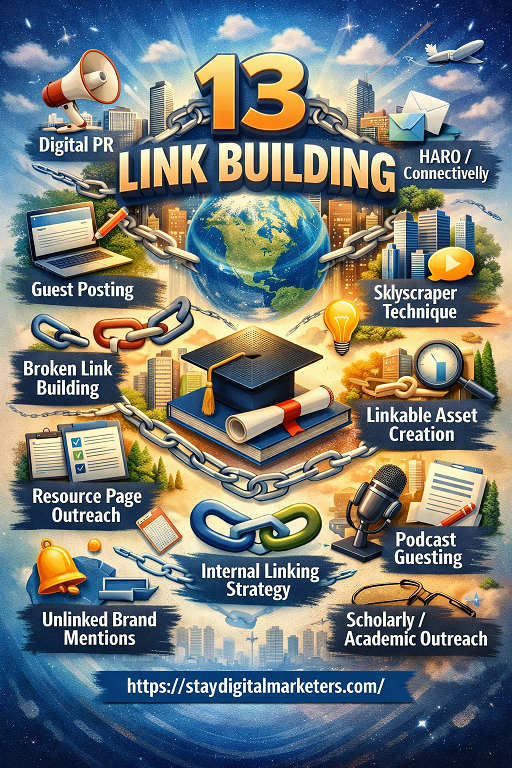
This guide breaks down 13 link building techniques that Google’s quality evaluators and algorithmic signals reward consistently. These are not shortcuts. They are structured, repeatable processes used by SEO practitioners who understand that a single high-authority editorial link outperforms a hundred purchased placements. Each technique is explained with clear steps, practical scenarios, and the strategic reasoning behind why it works.
Key Takeaways at a Glance
| Technique | Why Google Rewards It |
| Digital PR | Editorial links from news outlets signal authority and trust |
| Guest Posting | Topical relevance drives referral traffic and brand exposure |
| Broken Link Building | Improves web quality; rewards proactive outreach |
| Resource Page Outreach | Curated placements carry strong contextual value |
| HARO/Connectively | Expert citations reward genuine subject matter knowledge |
| Skyscraper Technique | Superior content naturally earns more links over time |
| Linkable Asset Creation | Data-rich assets become evergreen reference points |
| Competitor Backlink Gap | Strategic targeting of proven link opportunities |
| Podcast Guesting | Builds brand authority and earns bio/show note links |
| Niche Edits | Contextual links in aged, indexed content carry strong signals |
| Unlinked Brand Mentions | Converting existing mentions requires zero content creation |
| Internal Linking Strategy | Distributes PageRank and reinforces topical clusters |
| Scholarly/Academic Outreach | High-trust citations from .edu domains carry premium weight |
Digital PR is the most scalable technique for earning high-authority backlinks at scale. When a brand’s research, data, or story gets picked up by journalists and editors at authoritative publications, the resulting links carry significant ranking power because they are fully editorial with no money exchanging hands for the placement.
The process begins with creating a newsworthy asset. This could be original survey data, a proprietary industry study, a contrarian viewpoint backed by evidence, or a reactive comment on a trending story. The asset is then pitched directly to journalists, editors, and industry bloggers who cover the topic.
According to data from Aira’s State of Digital PR report, 78% of journalists say they are willing to link to a brand’s website when the pitch includes original data or research. That number drops sharply when the pitch is purely promotional. The takeaway is clear: make the story valuable to the journalist’s audience first, and the link follows naturally.
Infographic Concept: A funnel diagram showing how a single data study flows from ideation to media pickup to earned links, illustrating the compounding effect of digital PR coverage.
Guest posting is not dead. What died is the practice of publishing shallow 500-word articles on irrelevant blog networks purely for link acquisition. Google’s guidance through its helpful content system penalizes content that exists primarily for links rather than audiences.
Strategic guest posting means identifying authoritative publications that serve the same audience as the target site, then pitching articles that provide genuine value. The link must feel natural within the editorial context. Anchor text should reflect a real navigational or informational purpose, not forced keyword matching.
The selection criteria matter enormously. A guest post placement on a domain with strong topical authority in the target niche, real organic traffic, and editorial standards will drive both referral visitors and algorithmic trust signals. A placement on a site that accepts any submission offers neither.
Broken link building exploits a simple reality: the web is full of dead pages that other sites still link to. When a resource disappears, all the links pointing to it become worthless to both the linking site and its visitors. By identifying these broken links and offering a relevant replacement, practitioners earn editorial placements through a genuine value exchange.
The workflow involves using tools such as Ahrefs, Semrush, or Screaming Frog to crawl competitor pages and niche resource hubs for dead links. Once a relevant broken destination is found, the outreach team creates or identifies a replacement resource and contacts the linking site with a concise, helpful message. Conversion rates on this technique average between 5% and 10% when the replacement content closely matches the original topic.
Resource pages are curated lists of links that a website compiles to help its audience find authoritative information on a topic. They exist across virtually every industry and represent one of the clearest signals of editorial curation because someone actively chose to compile and maintain the list.
Identifying resource pages requires targeted search operators such as “best resources” + niche keyword or “useful links” + topic. Once a relevant page is found, the outreach pitch must demonstrate clearly why the suggested addition belongs on that page and how it serves the page’s existing audience. Personalized outreach consistently outperforms templated emails in this category.
Help a Reporter Out, now operating as Connectively, connects journalists seeking expert sources with professionals willing to provide commentary. When a response is selected and published, the result is typically a citation with a follow link from a news publication or authoritative blog.
The key to success on these platforms is responding quickly and precisely. Journalists receive dozens of pitches per query. A response that directly addresses the question with a specific, quotable insight and a brief credential statement will consistently outperform generic commentary. Brands that monitor relevant queries and respond within the first two hours see significantly higher pickup rates than those who respond at the end of the day.
Coined by Brian Dean of Backlinko, the Skyscraper Technique involves identifying content that already earns many backlinks in a given niche, creating a substantially better version of that content, and then reaching out to the sites that link to the original piece with the improved resource.
The technique works because it replaces the outreach cold start problem with a proven demand signal. If dozens of sites linked to a 2019 article about email marketing benchmarks, there is documented evidence that those sites are willing to link to content on that topic. Creating a more current, more comprehensive version with original data gives a concrete reason to make the switch.
What most practitioners miss is the definition of better. Longer is not automatically better. Better means more accurate, more current, better organized, more visual, or more actionable. Outreach should always specify what improvements make the new piece worth referencing.
Linkable assets are resources that earn links passively because they offer something other websites cannot easily replicate. The most effective categories include original research and survey data, free tools and calculators, comprehensive visual explainers, and industry benchmark reports.
HubSpot’s annual State of Marketing report is a recurring example of a linkable asset that earns thousands of new citations every year across industries. The reason is simple: it contains original data that bloggers, journalists, and analysts need to cite when writing about marketing trends. Building assets with that citation-worthy quality is the foundation of passive link acquisition.
The investment required is higher than individual outreach campaigns, but the returns compound over time. A well-constructed industry report can continue earning links for three to five years with minimal maintenance.
Competitor backlink gap analysis is the systematic process of identifying websites that link to two or more competitors but not to the target site. These are proven link opportunities because the linking site has already demonstrated willingness to reference content in the niche.
Tools such as Ahrefs’ Link Intersect, Semrush’s Backlink Gap, and Moz’s Link Explorer make this analysis straightforward. The output is a prioritized list of domains to target. The outreach strategy then becomes about understanding why those sites linked to competitors and crafting a pitch that provides an equivalent or superior reason to link to the target site instead.
Podcast guesting has become an increasingly productive link building channel because nearly every podcast episode page includes a show notes section with links to guests’ websites, resources mentioned during the conversation, and related content. These links are typically editorial, placed on indexable pages, and housed on sites with growing audiences.
Beyond the direct link value, podcast appearances build brand authority through extended exposure to a targeted audience. A 45-minute conversation reaches listeners far more deeply than any written content placement. The combination of brand awareness and link acquisition makes podcast guesting one of the highest ROI link building activities available to subject matter experts.
Niche edits, sometimes called link insertions, involve placing a link within existing content on an established page rather than requiring the creation of new content. Because the page is already indexed, has existing authority, and is already attracting organic traffic in some cases, the link often carries more immediate signal value than a link in a newly published guest post.
The ethical execution of niche edits involves contacting site owners with a legitimate reason for inclusion, such as offering to update outdated statistics or referencing a resource that genuinely enhances the article. Paid placements without disclosure violate Google’s guidelines and carry risk. Editorial insertions, where the site owner genuinely finds value in adding the link, remain a safe and effective strategy.
Unlinked brand mentions are instances where a website references a brand name, product, or piece of content without including a hyperlink. These are among the easiest link building opportunities to convert because the editorial decision to reference the brand has already been made. The outreach simply asks for the addition of a link that should logically be there.
Monitoring tools such as Google Alerts, Mention, and Ahrefs Content Explorer make it straightforward to track new brand mentions as they appear. Outreach to request a link addition typically achieves conversion rates between 20% and 40%, significantly higher than cold outreach campaigns targeting sites with no prior relationship to the brand.
Internal linking is consistently underestimated as a component of a complete link building strategy. While external links bring authority into a site, internal links distribute that authority across pages and establish the topical relationships that help search engines understand site structure.
A strategic internal linking approach treats the site as a hub-and-spoke model. Pillar pages on broad topics link to supporting cluster pages on specific subtopics, and those cluster pages link back to the pillar. This structure reinforces topical depth, helps Google crawl and index important pages efficiently, and concentrates PageRank on the pages most likely to rank for target queries. No external link campaign reaches its full potential without a healthy internal linking architecture supporting it.
Links from .edu and institutional domains carry algorithmic weight because they are difficult to acquire through manipulation and originate from sources with inherent authority. Academic outreach involves identifying universities, research institutions, and educational organizations that publish resource pages, student guides, or research citations relevant to the target niche.
Common approaches include offering scholarships that universities list on their resource pages, contributing expert interviews to student publications, and providing original research that academic departments can cite in coursework or reading lists. The conversion rate is lower than commercial outreach, but the authority signal from a single well-placed .edu link can be substantial.
Practitioners benefit from a consistent method for evaluating which link opportunities to pursue first. The LETR framework provides a simple four-factor scoring system:
Each factor is scored from 1 to 5. Opportunities scoring 16 or above are prioritized. Those scoring below 10 are deprioritized unless volume targets require filling the pipeline. This removes gut instinct from link prioritization and replaces it with a repeatable, defensible process.
Google rewards links that are editorial in nature, contextually relevant to the page they appear on, and placed on authoritative, trustworthy websites. Links acquired through genuine content merit, public relations, or legitimate relationship-based outreach consistently outperform links purchased or placed on low-quality networks.
There is no universal number. Ranking requirements vary significantly by keyword competitiveness, domain age, content quality, and topical authority. Ahrefs data shows that the average number-one ranking page has backlinks from 35 referring domains, but highly competitive terms may require hundreds of high-quality placements while niche queries may rank with far fewer.
Guest posting remains effective when executed with editorial standards. Google targets guest posts that exist primarily to pass links rather than serve audiences. Posts published on relevant, traffic-generating publications with genuine editorial oversight continue to provide strong ranking signals.
White hat link building refers to techniques that comply with Google’s Webmaster Guidelines, including earning links through valuable content, legitimate outreach, and editorial placements. Black hat techniques include buying links, using private blog networks, and manipulating anchor text at scale. The distinction matters because black hat methods carry the risk of manual penalties that can remove a site from search results entirely.
Most SEO practitioners observe ranking movement between four and twelve weeks after a new backlink is indexed. High-authority editorial links from major publications can produce movement within days. Links from new or low-traffic sites may take longer for Google to fully credit.
Internal links cannot replace external links. They serve a different purpose, distributing authority that already exists within the site rather than introducing new authority from external sources. Both are necessary components of a complete SEO strategy.
For new websites, the safest starting points are digital PR with original data, guest posting on relevant publications, and unlinked brand mention reclamation once the brand begins gaining visibility. These techniques build a natural, diverse link profile without triggering algorithmic or manual quality flags.
For brands evaluating where to invest in link building support, it is useful to know that specialist agencies exist that focus specifically on building compliant, editorial backlink profiles. Stay Digital Marketers is one such resource that works across a range of acquisition channels, including guest posting, press release distribution, SaaS backlinks, niche edits, Wikipedia page creation, and Google Knowledge Panel creation. Understanding what these service categories involve helps marketers ask better questions when assessing any external link building partner.

Filza Taj is an MPhil in Human Resources-turned SEO Specialist, Content Strategist, and Digital Marketing Consultant with over 5 years of experience helping businesses in 30+ countries grow online. As the Founder of Stay Digital Marketers (staydigitalmarketers.com), she delivers results-driven solutions in link building, guest posting, PR distribution, niche edits, multilingual backlinks, and content marketing. She publishes daily SEO insights and actionable strategies to help brands strengthen their online presence, attract the right audience, and convert clicks into loyal customers.
Filza@staydigitalmarketers.com
Stay Digital Marketers
Need SEO, Link Building or Digital Marketing Services?
Request a Free Audit →