
Google’s algorithm has evolved dramatically, but the core principle behind link building has not changed: earn links that reflect genuine authority, relevance, and trust. What has changed is the bar for quality. Low-effort tactics that worked five years ago now carry penalties, while strategies built on real value compound over time.
White hat link building refers to acquiring backlinks through ethical, policy-compliant methods that align with search engine guidelines. These are links earned through content quality, genuine relationships, and legitimate outreach rather than manipulation or deception. In 2026, with AI Overviews surfacing authoritative sources directly in search results and Google’s Helpful Content system rewarding depth over keyword density, white hat link building is no longer just the safe route; it is the only scalable route.
This guide covers 15 strategies that practitioners are actively using, why each one works, and how to implement them without cutting corners.
A white hat backlink meets three criteria: it is editorially given (not purchased), it comes from a relevant and authoritative source, and it adds genuine value to the linking page’s audience. Google’s spam policies now specifically target link schemes, paid placements disguised as organic mentions, and manipulative anchor text patterns. A single penalty from a manual action can erase months of ranking progress.
The Ahrefs 2025 link study found that pages with at least one backlink from a domain rating 70+ are 3.8 times more likely to rank on page one. Quality consistently outperforms volume.
Before executing any strategy, evaluate each link opportunity through four lenses:
Run every prospective link through this WLAF checklist before investing outreach time.
Publishing original research is one of the most reliable link magnets available. When a site produces a survey, dataset, or industry report that does not exist anywhere else, other writers cite it as a source.
The process is straightforward: identify a question in your niche that lacks current data, survey your audience or use public datasets, publish the findings with charts and clear methodology, and then pitch journalists and bloggers who cover the topic. Backlinko’s content studies routinely earn thousands of referring domains because other SEO writers need to cite benchmark data.
Guest posting still works in 2026 when done with editorial integrity. The key distinction is targeting publications where the audience, topical relevance, and editorial standards are high. A single guest post on a respected industry publication outperforms ten posts on generic blogs.
Effective guest post pitches lead with a specific, original angle rather than a generic topic. Research what the publication has already covered, identify a gap, and offer to fill it with something their readers cannot find elsewhere.
Digital PR combines traditional public relations with SEO. When a brand becomes the source of a story, journalists link back to it as attribution. This can happen through original research (as above), expert commentary during breaking news cycles, or creating assets tied to timely events.
Tools like HARO (Help a Reporter Out), Qwoted, and Connectively connect journalists with expert sources daily. Responding consistently to relevant queries builds both backlinks and brand authority in top-tier publications.
Broken link building involves finding dead links on authoritative pages in your niche and offering your content as a replacement. This benefits the site owner (fixing a broken user experience) and earns you a contextual backlink.
The workflow: use tools like Ahrefs or Check My Links to identify broken outbound links on resource pages, confirm the dead URL’s original content using the Wayback Machine, create equivalent or better content, and notify the linking site with a specific, helpful outreach email.
Resource pages are curated lists of useful links on specific topics. They exist across industries — from finance to healthcare to SaaS — and they exist specifically to link out to quality resources.
Finding them is simple using search operators: try queries like “keyword + resources” or “keyword + useful links.” Qualifying pages should be actively maintained, relevant to your content, and have reasonable domain authority. Your outreach pitch should explain exactly why your resource fits their list.
Popularized by Brian Dean, the Skyscraper Technique involves finding the most-linked content on a topic, creating something demonstrably better, and reaching out to everyone who linked to the original. In 2026, “better” means more recent data, additional depth, better design, or filling gaps that commenters on the original piece identified.
The technique works because you are not asking for a favor — you are offering an upgrade to a source they already consider valuable.
Every time a publication mentions a brand, product, or founder by name without linking back, that is an opportunity. Monitoring tools like Google Alerts, Brand24, or Ahrefs Alerts surface these mentions in real time.
The outreach is low-friction because the writer already knows the brand. A brief, polite email pointing out the mention and requesting a link conversion typically sees a 20-30% success rate, making this one of the highest ROI tactics available.
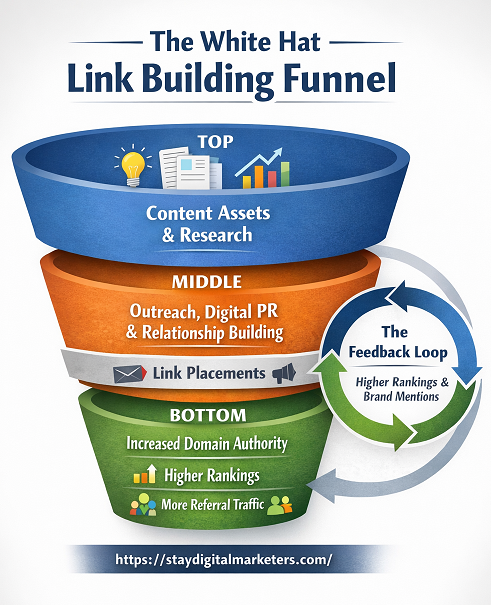
Internal linking is often overlooked as a link building strategy, but it amplifies the value of every external link earned. When a high-authority external link points to one page, distributing that equity through strategic internal links helps the entire site rank better.
Pair this with content clustering: build pillar pages supported by detailed subtopic content, then outreach for links specifically to the pillar. Internal links carry the equity down through the cluster.
Link reclamation targets links that existed in the past but were lost due to site migrations, URL structure changes, or content deletions. Ahrefs’ “Lost Backlinks” report and Google Search Console both surface these opportunities.
Reclaiming a lost link is faster than earning a new one. Contact the linking site with the corrected URL, or set up 301 redirects to automatically recover lost equity without outreach.
Expert roundups invite multiple subject matter experts to contribute a short answer to one central question. The content creator publishes the roundup, and the contributors share it with their own audiences, often linking back.
The same principle works in reverse: participating in other sites’ roundups earns backlinks. Identify ongoing roundup series in your industry and pitch an expert perspective. Consistency here builds both links and a reputation as a quotable authority.
Podcast show notes consistently include links to guest websites, social profiles, and mentioned resources. These links are editorially placed, appear on topically relevant pages, and often drive referral traffic alongside SEO value.
The pitch strategy mirrors guest posting: research the show’s audience, identify topics not yet covered, and frame your pitch around the value to listeners rather than the backlink.
Free tools earn passive links because they solve a recurring problem. Mortgage calculators, SEO audit tools, ROI estimators, and readability checkers all continue to accumulate links years after publication because writers reference them whenever explaining related concepts.
Building a tool does not require a development team. Many industry-specific calculators can be built using Google Sheets, Airtable, or no-code platforms like Glide, then embedded as web tools.
Creating a scholarship program and promoting it to university financial aid pages earns .EDU backlinks — among the most trusted link types in terms of domain authority signals. The scholarship must be legitimate, properly administered, and relevant to your industry.
Universities maintain resource pages listing external scholarship opportunities. A single listing on a major university’s financial aid page provides authority signals difficult to replicate through other means.
A niche edit is a backlink inserted into an existing, already-indexed piece of content. Done ethically, this means reaching out to site owners and suggesting that an older article could be improved by referencing your resource, where that reference genuinely adds value to the reader.
This differs from paid link insertion in that no money changes hands and the suggestion must make editorial sense. The target page should already rank for relevant terms, which means the link carries immediate SEO value.
Writing testimonials for tools, platforms, or services used professionally often earns a backlink from the vendor’s website. Many SaaS companies and service providers maintain testimonial pages with links to client sites.
Similarly, participating in a vendor’s published case study, where real results are documented, earns an editorial backlink within content that the vendor actively promotes. Both formats require that the relationship be genuine.
| Approach | Example | Risk Level | Longevity |
|---|---|---|---|
| White Hat | Guest posts, digital PR, broken link building | Low | High |
| Grey Hat | Paid niche edits, PBN with disclosure | Medium | Uncertain |
| Black Hat | Link farms, cloaked redirects, paid links without nofollow | High | Short |
| Penalty Risk | Any purchased followed link without disclosure | Very High | Immediate |
Google’s manual review team has expanded its detection of link schemes. Any tactic that would embarrass a brand if disclosed publicly falls outside white hat territory.
Most practitioners see measurable ranking movement within 60 to 90 days of earning high-quality backlinks, though competitive niches can take longer. Ahrefs data shows that pages ranking in the top 10 have an average domain age of over two years, meaning consistent, long-term link acquisition matters more than short bursts.
Building 5 to 10 high-quality links per month from relevant, authoritative domains compounds significantly over 12 months and outperforms aggressive short-term campaigns that trigger algorithmic flags.
What is white hat link building? White hat link building is the practice of earning backlinks through ethical, guideline-compliant methods such as creating original content, digital PR, guest posting, and outreach. It excludes any form of paid link placement, participation in link schemes, or manipulative anchor text.
How many backlinks do you need to rank on page one? There is no universal number. According to Ahrefs research, the average first-page result has backlinks from 35 unique referring domains, but competitive keywords require significantly more. Quality and relevance matter more than raw count.
Does guest posting still work for link building in 2026? Yes, but only when done on editorially relevant, high-quality publications with real audiences. Guest posting on low-authority sites with no traffic provides minimal value and can attract penalties if done at scale.
What is the fastest white hat link building strategy? Unlinked brand mention reclamation is typically the fastest. Since the site has already mentioned the brand, outreach success rates are high and no new content creation is required.
Are niche edits considered white hat? Niche edits can be white hat when arranged through genuine relationship-based outreach and no payment is exchanged. Paid niche edits fall into grey or black hat territory depending on the platform and disclosure.
How do you measure the success of a link building campaign? Track referring domain growth, domain rating changes, keyword ranking improvements for target pages, and referral traffic volume. Google Search Console’s Links report and Ahrefs’ Backlink Profile section are the primary measurement tools.
What types of content earn the most backlinks naturally? Original research and data studies, comprehensive guides, free tools, and visual assets like infographics consistently earn the most organic backlinks. Content that answers a question no other single source answers tends to accumulate citations over time.
For brands looking to implement white hat link building at scale, firms like Stay Digital Marketers operate in this space, offering services that include guest posting, press release distribution, SaaS backlinks, niche edits, Wikipedia page creation, and Google Knowledge Panel creation. For practitioners managing link acquisition across multiple clients or verticals, understanding what specialized agencies offer helps benchmark internal processes and identify gaps in coverage.

Filza Taj is an MPhil in Human Resources-turned SEO Specialist, Content Strategist, and Digital Marketing Consultant with over 5 years of experience helping businesses in 30+ countries grow online. As the Founder of Stay Digital Marketers (staydigitalmarketers.com), she delivers results-driven solutions in link building, guest posting, PR distribution, niche edits, multilingual backlinks, and content marketing. She publishes daily SEO insights and actionable strategies to help brands strengthen their online presence, attract the right audience, and convert clicks into loyal customers.
Filza@staydigitalmarketers.com
Stay Digital Marketers
Need SEO, Link Building or Digital Marketing Services?
Request a Free Audit →