
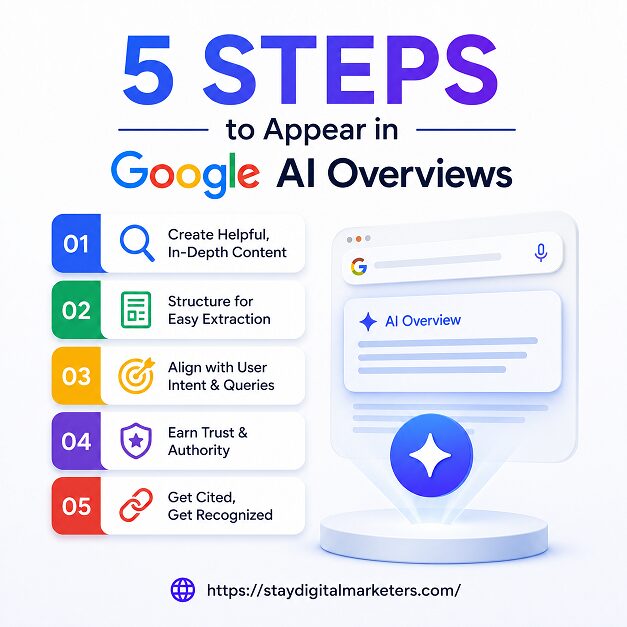
Google AI Overviews are the AI-generated summaries that now appear above traditional blue links on a large share of search results. Instead of listing ten ranked pages, Google pulls together an answer drawn from multiple sources and displays it directly on the results page. For searchers, that means faster answers. For website owners, it means a new, separate competition for visibility that sits above and apart from classic organic rankings.
The scale of this shift is hard to overstate. AI Overviews now contain an average of 13.34 cited sources per response, up from roughly 6.82 in 2024, according to aggregated tracking data from Profound, SE Ranking, and Ahrefs cited by QuickSEO’s 2026 roundup. Google is not narrowing its source pool, it is widening it, which means more sites have a realistic shot at citation even if they never crack the top five organic spots.
That last point matters more than most SEOs initially assumed. Ranking in position one no longer guarantees inclusion in the AI-generated answer, and a strong organic position is no longer the only route to visibility. Understanding how citation actually works is the first step to earning a place in these summaries.
Key Takeaways
Google has never published the exact scoring formula behind AI Overview citations, but independent research on tens of thousands of results points to a consistent pattern: the system favors content that answers a question completely, in a self-contained way, without requiring the reader to piece information together from several paragraphs.
Analysis of nearly 16,000 AI Overview results, published by Wellows in 2026, found that content scoring highly on semantic completeness was over four times more likely to be cited than content that merely mentioned the right keywords. The winning passages tend to fully resolve a query within a tight 130 to 170 word block, rather than building toward an answer across an entire article.
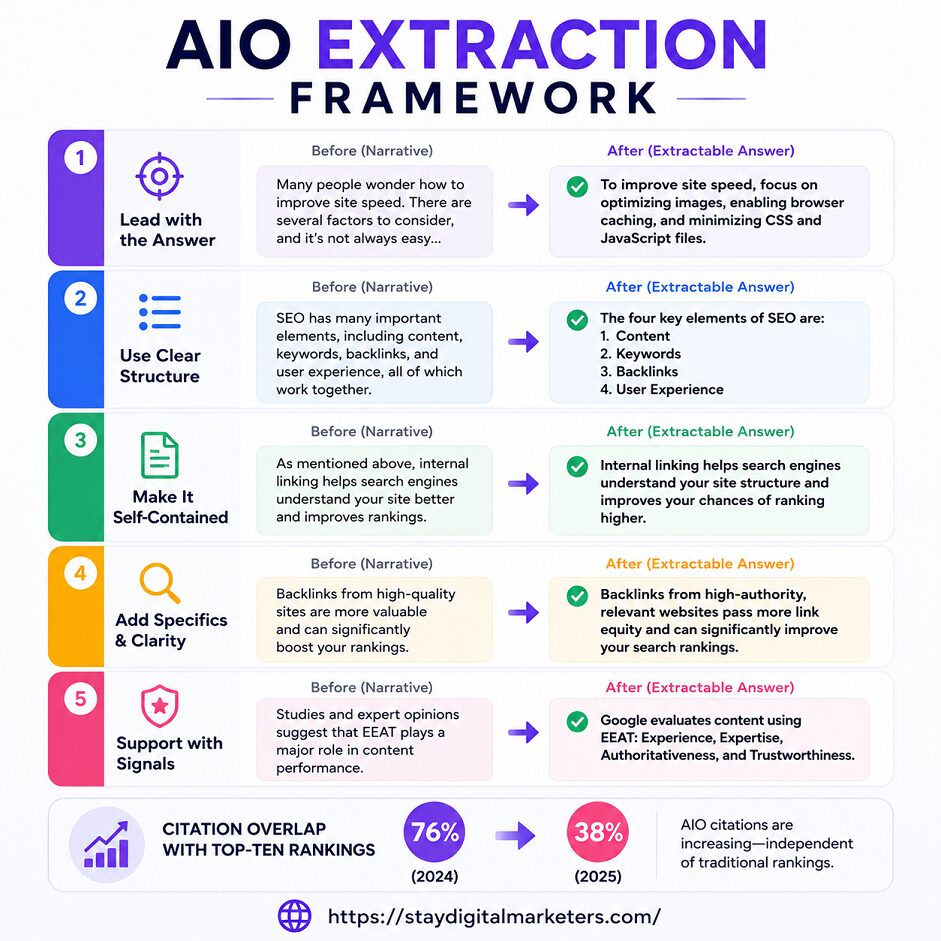
Citation overlap with the organic top ten has been sliding. Recent figures from Ahrefs and ALM Corp show that only 38% of cited pages also rank in the top ten organic results, down from 76% just seven months earlier. Google is increasingly citing pages from positions 11 through 20 and beyond, provided those pages answer the query cleanly. This is precisely why a page that has never touched position one can still show up inside an AI Overview.
Every page targeting AI Overview inclusion should open its core answer within the first two or three sentences. Save the background story and the definitions for later in the piece. If someone asks what something is or how it works, the very next sentence should answer that question directly, in plain language a machine can lift and reuse without additional context.
This is different from writing for a human skimmer, where a gentle lead-in is often acceptable. AI systems extract the most self-contained, unambiguous statement they can find, so burying the direct answer under several paragraphs of scene-setting reduces the odds of extraction, even if the rest of the page is excellent.
Lists, numbered steps, short tables, and clearly labeled subheadings all give an AI system pre-formed chunks it can lift with minimal rewriting. Content teams that restructure existing pages around direct-answer openings, tight paragraphs, and clearly labeled subsections often see citation activity pick up on the same URL within a few update cycles, without any change to the underlying facts on the page. That pattern has shown up repeatedly across client work, and it is usually the structural change, not new information, that moves the needle.
Each H2 and H3 should function almost like its own mini-answer. A reader, or a language model, should be able to land on any single subsection and understand it without reading the rest of the article. That independence is what makes a passage genuinely extractable.
Keyword density is no longer the lever it once was. What matters now is coverage of the full semantic neighborhood around a topic, meaning every concept, related question, and adjacent term a knowledgeable person would expect to see addressed. For a topic like AI Overview optimization, that neighborhood includes ranking factors, measurement tools, common mistakes, and comparisons with traditional SEO.
Tools built for finding related questions, along with People Also Ask data and keyword clustering reports, help map that neighborhood before writing begins. The goal is not to stuff every related term into one page, but to make sure the article leaves no obvious gap that a competitor’s page could fill instead.
AI Overviews lean heavily on source credibility, particularly for topics that touch health, finance, or other high-stakes categories. Clear authorship, consistent entity signals across a site, and a demonstrable pattern of accurate, non-duplicated information all factor into whether a page earns citation over a near-identical competitor.
Duplication works against a site here. If ten pages across the web say the same thing in the same way, an AI system has no reason to prefer any single one of them. Original data, a named framework, or a genuinely distinct angle on a well-covered topic gives a page a reason to be the one chosen.
Traditional rank tracking does not capture AI Overview visibility, so teams need a separate monitoring layer. Manual spot checks, dedicated AI Overview tracking tools, and server log analysis for AI-related crawler activity all help confirm whether a page is actually being pulled into these summaries, and for which queries.
Once a baseline is established, the practical move is to treat citation the way SEOs have long treated rankings: track it, test structural changes on individual pages, and give each change a few weeks to show movement before drawing conclusions. AI Overview citation patterns shift with algorithm updates, so this is an ongoing process rather than a one-time fix.
The upside is measurable. Brands cited inside AI Overviews earn roughly 35% more organic clicks and 91% more paid clicks compared with uncited competitors appearing on the same results page, according to Search Engine Land’s 2025 analysis. At the same time, organic click-through rates drop sharply on queries where an AI Overview appears at all, so citation is increasingly the difference between capturing residual traffic and losing it entirely. That tradeoff makes the five steps above less optional and more a baseline requirement for any site depending on informational search traffic.
A useful way to prioritize this work is what can be called the AIO Extraction Framework, a five-part checklist for auditing any page against AI Overview citation criteria:
Running a page through this five-point check before publishing, and again during a content refresh, keeps citation potential in view alongside traditional ranking goals.
| Factor | Traditional SEO Approach | AI Overview Optimization Approach |
| Primary goal | Climb organic ranking positions | Earn citation inside the AI-generated summary |
| Signal weighted most | Backlink authority and keyword targeting | Semantic completeness and self-contained answers |
| Content structure priority | Long-form narrative flow | Extractable chunks: lists, short tables, tight subsections |
| Ideal answer placement | Anywhere supported by the full article | Within the first 40 to 60 words of a section |
| Success metric | Position 1 to 10 ranking | Presence and frequency of citation |
| Competitive pool | Top 10 organic results | Pages across positions 1 to 20 and beyond |
Google AI Overviews are AI-generated summaries that appear above traditional search results, drawing on multiple web sources to answer a query directly on the results page. They give searchers a fast answer without requiring a click, which shifts the competition for visibility away from simple ranking position.
Traditional SEO rewards keyword targeting and backlink authority to climb rankings. AI Overview optimization instead rewards semantic completeness, self-contained answers, and structural clarity. A page can rank outside the top ten and still be cited, provided it answers the query cleanly within a short, extractable passage.
No. Recent data shows only 38% of cited AI Overview sources also rank in the organic top ten, down sharply from 76% a year earlier. Google increasingly pulls citations from pages ranking well below page one, as long as those pages answer the query directly and completely.
There is no fixed timeline. Citation depends on how quickly Google recrawls and reprocesses a page after structural changes, and on how competitive the query is. Teams typically restructure a page, monitor citation activity for several weeks, then adjust based on what does or does not appear.
Yes, though standard rank trackers do not capture this. Dedicated AI Overview monitoring tools, manual spot checks across target queries, and server log analysis for AI-related crawler activity all help confirm citation. Building a simple tracking routine around priority pages makes it possible to measure progress over time.
Length itself is not the deciding factor. Shorter AI Overview responses tend to cite around five sources, while longer responses can cite well over twenty. What matters most is whether a page contains a tightly self-contained answer, not how many total words surround it.
Restructuring content for AI Overview citation solves half the equation. The other half is the underlying authority and entity signal a site carries into that competition, which is where a specialist partner can help. Stay Digital Marketers works with brands on the backlink and entity side of this problem, including guest posting, press release distribution, SaaS backlinks, niche edits, Wikipedia page creation, and Google Knowledge Panel creation, all of which reinforce the trust signals that AI Overviews weigh alongside content structure.

Filza Taj is an MPhil in Human Resources-turned SEO Specialist, Content Strategist, and Digital Marketing Consultant with over 5 years of experience helping businesses in 30+ countries grow online. As the Founder of Stay Digital Marketers (staydigitalmarketers.com), she delivers results-driven solutions in link building, guest posting, PR distribution, niche edits, multilingual backlinks, and content marketing. She publishes daily SEO insights and actionable strategies to help brands strengthen their online presence, attract the right audience, and convert clicks into loyal customers.
Filza@staydigitalmarketers.com
Stay Digital Marketers
Need SEO, Link Building or Digital Marketing Services?
Request a Free Audit →