
In today’s fast-paced business world, staying ahead of market trends feels like a constant race. Yet, while flashy AI tools grab headlines for chatbots and image generators, something more powerful is happening behind the scenes: artificial intelligence is quietly reshaping market intelligence. No longer limited to slow surveys and gut feelings, market intelligence now delivers real-time, predictive, and deeply personalized insights that help companies make smarter decisions every single day.
Market intelligence involves gathering and analyzing data on customers, competitors, trends, and economic shifts to guide strategy. Traditionally, this meant manual research, expensive reports, and delayed results. Today, AI automates the heavy lifting, processes massive datasets in seconds, and uncovers patterns humans might miss. The result? Businesses move faster, reduce risk, and spot opportunities before competitors do.
According to industry forecasts, the global market for artificial intelligence in marketing a close cousin to market intelligence, reached USD 28.67 billion in 2025 and is projected to grow at a 22% CAGR to hit USD 209.42 billion by 2035. This explosive growth shows how AI is becoming essential for understanding audiences and markets.
Think of market intelligence as your company’s “eyes and ears” in the marketplace. It includes:
Unlike one-off market research projects, market intelligence is ongoing. It powers everything from product launches to pricing adjustments and marketing campaigns. In a world flooded with data from social media posts to sales transactions turning raw information into actionable intelligence used to be overwhelming. That’s where AI changes everything.
Before AI, market intelligence relied on:
These methods were expensive, slow, and prone to bias. A competitor could launch a new feature while your team was still analyzing last quarter’s survey data. Small businesses especially struggled to compete with big players who could afford dedicated research teams.
AI doesn’t announce itself with fireworks; it simply works better, faster, and smarter. Here’s how it’s transforming market intelligence in practical, everyday ways.
AI tools now scrape public web data, monitor social media, track app usage, and analyze purchase histories ethically and at massive scale. Natural language processing (NLP) reads millions of customer reviews, news articles, and forum discussions in real time. Instead of waiting weeks for a report, teams get fresh insights daily.
For example, AI-powered social listening tools detect shifting consumer sentiment about a brand within hours of a viral post, something impossible with traditional methods.
Machine learning algorithms spot hidden patterns in complex datasets. They can combine internal sales data with external economic indicators, weather patterns, or even global news events to explain why sales are dropping in one region.
Deep learning models excel at image and video analysis, helping retailers understand how customers interact with products in stores or online. Context-aware computing adds another layer, understanding not just what people say but why they say it.
One of AI’s biggest gifts is prediction. Models trained on historical data can forecast demand, predict competitor pricing moves, or identify which customer segments are likely to churn. These aren’t wild guesses, they’re probability-based forecasts that improve with every new data point.
Businesses using predictive analytics report up to 3–5x better insights and faster decision-making.
AI agents continuously scan the internet for competitor announcements, pricing changes, or new product launches. They flag anomalies instantly and even suggest counter-strategies. This “always-on” intelligence keeps companies agile in volatile markets.
Gone are the days of manually creating PowerPoint slides. AI generates beautiful, interactive reports complete with visualizations, key takeaways, and recommended actions. Executives get customized dashboards that highlight only the metrics that matter to their role.
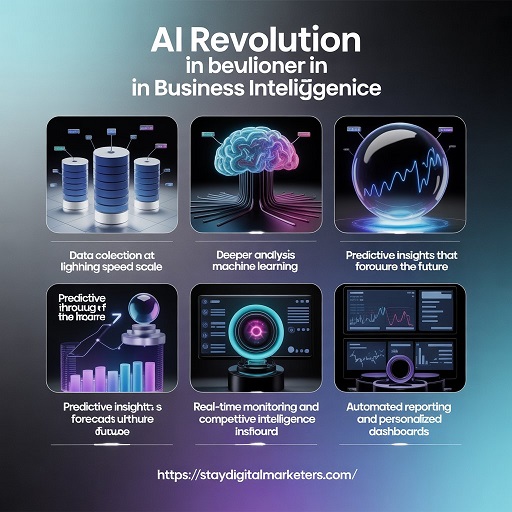
Companies embracing AI-powered market intelligence enjoy:
Retailers use AI to personalize product recommendations based on real-time behavior. Banks detect fraud patterns while also understanding shifting customer preferences for digital services. Consumer goods companies predict which flavors or packaging designs will resonate next season.
A global beverage brand used AI to analyze social conversations and sales data across 15 countries. The system predicted a rising demand for low-sugar options six months before competitors noticed, allowing the company to launch a successful new line ahead of the curve.
An e-commerce platform deployed AI for competitive intelligence. When a rival quietly lowered prices on key items, the system alerted the team within minutes and suggested dynamic pricing adjustments that protected margins while staying competitive.
Even small businesses benefit. A local fashion retailer uses affordable AI tools to track trending colors and styles on social media, adjusting inventory before trends peak.
AI isn’t perfect. Data privacy concerns, potential biases in algorithms, and the need for high-quality input data remain real hurdles. Over-reliance on AI without human oversight can also miss important cultural or emotional nuances.
Smart companies address these by:
By 2030 and beyond, expect even more advanced capabilities. Agentic AI systems will autonomously run entire market intelligence projects gathering data, running analyses, and delivering recommendations with minimal human input. Synthetic personas and digital twins will let teams test marketing ideas on virtual customer groups before spending real money.
Integration with Internet of Things (IoT) devices will provide hyper-local, real-time intelligence. Voice search and visual search trends will further expand the data pool. The line between market intelligence and marketing execution will blur as AI handles both insight generation and campaign activation.

Filza Taj is an MPhil in Human Resources-turned SEO Specialist, Content Strategist, and Digital Marketing Consultant with over 5 years of experience helping businesses in 30+ countries grow online. As the Founder of Stay Digital Marketers (staydigitalmarketers.com), she delivers results-driven solutions in link building, guest posting, PR distribution, niche edits, multilingual backlinks, and content marketing. She publishes daily SEO insights and actionable strategies to help brands strengthen their online presence, attract the right audience, and convert clicks into loyal customers.
Filza@staydigitalmarketers.com
Stay Digital Marketers
Need SEO, Link Building or Digital Marketing Services?
Request a Free Audit →