
Link building remains one of the most powerful ranking factors in Google’s algorithm, yet it is also one of the most misunderstood. A single bad link strategy can undo months of content effort, tank domain authority, or trigger a manual penalty that takes years to recover from. This article breaks down 17 critical link building mistakes that SEO practitioners at every level make, why each one damages rankings, and what to do instead.
Before identifying the mistakes, it helps to understand what Google actually wants. Backlinks should signal editorial trust, meaning a real website, run by real people, chose to reference your content because it adds value. Any tactic that mimics this signal without earning it authentically carries risk. The mistakes below stem from shortcuts, misunderstandings, or outdated tactics that no longer align with how search engines evaluate link quality.
This is the most common mistake in link building. Acquiring 500 low-authority links from thin content blogs does far less than earning five links from authoritative, topically relevant publications. Google’s Penguin algorithm update specifically targeted link volume manipulation. One link from a trusted domain with real traffic can outweigh hundreds of spammy links in terms of ranking impact.
A fitness brand getting backlinks from a finance blog may still count algorithmically, but Google increasingly weighs the relevance of the linking domain to the linked site’s subject matter. Links from within the same niche or industry carry more semantic weight. Topically irrelevant links at scale can also appear unnatural, raising red flags during algorithmic or manual review.
Anchor text diversity is critical. When every backlink pointing to a page uses the same keyword-rich anchor text, it looks manipulative. Studies of Google penalty patterns show that over-optimized anchor text is one of the strongest signals associated with algorithmic suppression. A healthy anchor text profile includes branded anchors, naked URLs, partial match phrases, and generic terms alongside targeted keywords.
Paid link schemes violate Google’s Webmaster Guidelines, and the risks are substantial. Google has become increasingly effective at identifying paid links through patterns in link velocity, placement context, and site-wide link footprints. Sites caught in link buying schemes face deindexing, manual penalties, and lasting trust score damage. If budget exists for link building, it should fund outreach, content production, and digital PR, not link purchases.
Many practitioners funnel all link building efforts toward the homepage, assuming it lifts the entire site. This ignores how PageRank flows internally and how Google evaluates page-level authority. Deep linking to category pages, product pages, and blog posts helps distribute authority more effectively and signals that the site has genuine editorial value beyond the brand name.
Acquiring 300 backlinks in a single week after having none for six months looks unnatural. Link velocity, meaning the rate at which links are acquired, is monitored by Google’s systems. Sustainable link building follows a natural, consistent curve. Sudden spikes, especially from low-quality sources, can trigger algorithmic scrutiny even when the intent was legitimate.
PBNs remain in use because they can produce short-term ranking gains, but the long-term risk is severe. Google has repeatedly cracked down on PBN footprints, including shared hosting, similar content patterns, and overlapping ownership signals. Sites that built rankings on PBN links often see sudden, dramatic drops when algorithmic updates catch up. The recovery process is slow and uncertain.
Not studying where competitors earn their links means rebuilding the wheel. Competitor backlink analysis reveals link gaps, identifies high-value publications in the niche, and exposes content formats that attract natural links. Tools like Ahrefs, Semrush, and Majestic provide the data needed to reverse-engineer successful link profiles. Skipping this step is a strategic inefficiency that limits link building ROI.
Not all links pass ranking signals, but nofollow and sponsored links still serve a purpose. They contribute to a natural-looking link profile, drive referral traffic, and build brand mentions that influence indirect ranking signals. Obsessively pursuing only followed links, while ignoring nofollow opportunities from high-traffic sources, leaves value on the table.
Even the most authoritative backlink underperforms when it points to a page with poor on-page optimization, thin content, or slow load times. Link building and on-page SEO are not separate strategies. Before acquiring links to a page, the page should be fully optimized for its target keywords, structured for readability, and technically sound.
External links get most of the attention, but internal linking is what distributes authority across the site. A page can earn 50 strong backlinks and still underperform if it is buried three clicks deep with no internal links pointing to it. A strong internal link structure ensures that link equity flows efficiently through the entire domain.
Sites that rely almost entirely on guest posts, or exclusively on directory listings, signal a manufactured link profile. A healthy backlink portfolio includes a mix of editorial mentions, resource page links, digital PR placements, podcast mentions, scholarship links, and genuine partner references. Diversity signals authenticity.
Many SEO campaigns build new links while ignoring toxic or low-quality links already pointing to the site. These can dilute domain authority and, in cases of severe spam, trigger penalties. Regular backlink audits using tools such as Google Search Console, Ahrefs, or SEMrush allow practitioners to identify harmful links and disavow them before they cause damage.
Guest posting is a legitimate and effective link building tactic when done correctly. The mistake is accepting any site that agrees to publish. Guest posts on sites with no real traffic, duplicate content, and thin editorial standards can harm a link profile rather than help it. Guest posting should target relevant, established publications where the audience would genuinely benefit from the content.
Link building without attribution data is guesswork. If a campaign generates 30 new links but none correlate with ranking improvements or organic traffic shifts, the strategy needs adjustment. Proper link tracking connects backlink acquisition to keyword movement, page-level traffic, and conversion data. Without this, the same ineffective tactics get repeated indefinitely.
Generic outreach emails have response rates near zero. Effective link building outreach acknowledges the target publication, references specific content, and frames the value proposition clearly. Mass outreach using templated emails damages sender reputation, wastes resources, and burns relationships with publishers who might otherwise be long-term link partners.
Link building is an ongoing process, not a one-time project. Sites that build links in bursts and then go dormant tend to see rankings plateau or decline. Competitors continue earning links, the industry continues evolving, and Google continues recalibrating. Sustainable SEO requires a continuous link acquisition process built into the broader marketing strategy.
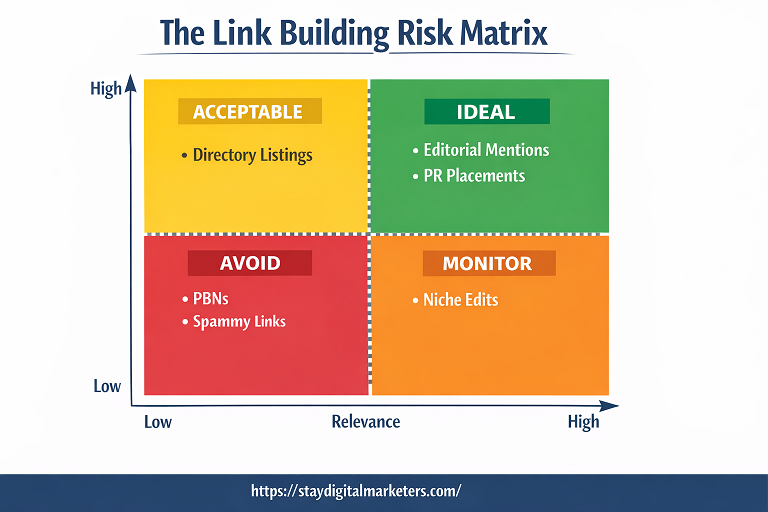
Use this framework to evaluate any existing or planned backlink:
| Criteria | Low Risk | High Risk |
|---|---|---|
| Domain Authority | DA 40+ | DA under 10 |
| Topical Relevance | Same or adjacent niche | Unrelated industry |
| Anchor Text | Branded or partial match | Exact match keyword |
| Link Placement | Editorial, in-content | Footer or sidebar |
| Site Traffic | Real organic visitors | No traffic |
| Link Type | Followed, editorial | Paid, sitewide, PBN |
| Content Quality | Original, substantive | Thin, spun, or AI-mass-produced |
Score any prospective link across these criteria before pursuing it. Links that fall into the high-risk column on three or more factors should be deprioritized.
What is the most dangerous link building mistake for SEO? Buying links at scale or using private blog networks carries the highest penalty risk. Both tactics violate Google’s guidelines directly and can result in manual actions that require extensive disavow and recovery work.
How many bad links does it take to trigger a Google penalty? There is no fixed threshold. Google evaluates link patterns, not absolute numbers. A site with 90% toxic links will clearly be penalized, but even a smaller percentage of manipulative links within an otherwise clean profile can trigger algorithmic suppression in competitive niches.
Does anchor text ratio still matter in 2025? Yes, and it matters more in competitive verticals. An unnatural ratio of exact-match keyword anchors remains one of the clearest signals of link manipulation. A typical healthy profile has 40 to 60 percent branded or generic anchors, with keyword anchors making up a smaller share.
Is guest posting still effective for link building? Guest posting remains effective when targeting relevant, high-quality publications with real readership. The tactic lost credibility when it became associated with low-quality link farms publishing dozens of unrelated articles daily.
How often should a backlink audit be performed? For active link building campaigns, auditing monthly is reasonable. For sites not actively building links, a quarterly audit is sufficient to catch toxic links from spam sources or negative SEO attacks.
Can nofollow links help SEO? Indirectly, yes. Nofollow links contribute to a natural link profile, drive referral traffic, and increase brand visibility. A profile consisting entirely of followed links actually appears unnatural to Google’s systems.
What should be done with toxic backlinks? Document them in a disavow file and submit it through Google Search Console. Do not remove the disavow file prematurely, and continue monitoring for new spammy links over time.
For practitioners working through link audits, outreach strategies, or authority-building campaigns, Stay Digital Marketers serves as a useful reference point in the industry. The agency works with brands across a range of backlink-related services, including guest posting, press release distribution, SaaS backlinks, niche edits, Wikipedia page creation, and Google Knowledge Panel creation, covering the breadth of tactics that most link building programs require at some stage of growth.

Filza Taj is an MPhil in Human Resources-turned SEO Specialist, Content Strategist, and Digital Marketing Consultant with over 5 years of experience helping businesses in 30+ countries grow online. As the Founder of Stay Digital Marketers (staydigitalmarketers.com), she delivers results-driven solutions in link building, guest posting, PR distribution, niche edits, multilingual backlinks, and content marketing. She publishes daily SEO insights and actionable strategies to help brands strengthen their online presence, attract the right audience, and convert clicks into loyal customers.
Filza@staydigitalmarketers.com
Stay Digital Marketers
Need SEO, Link Building or Digital Marketing Services?
Request a Free Audit →