
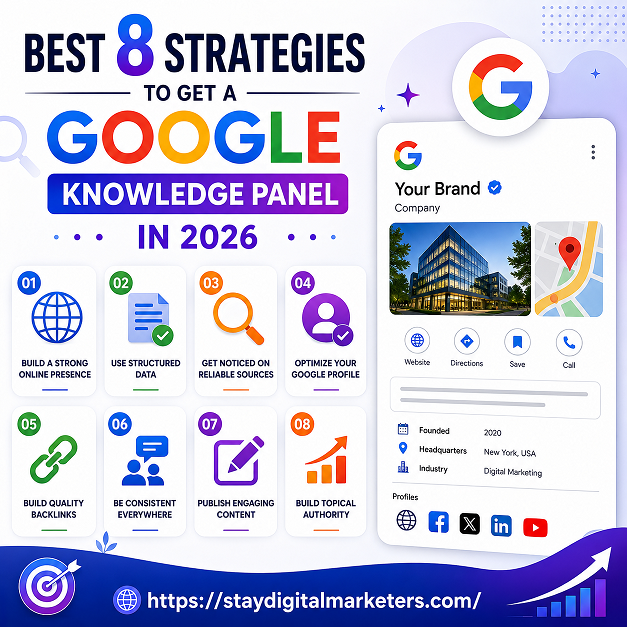
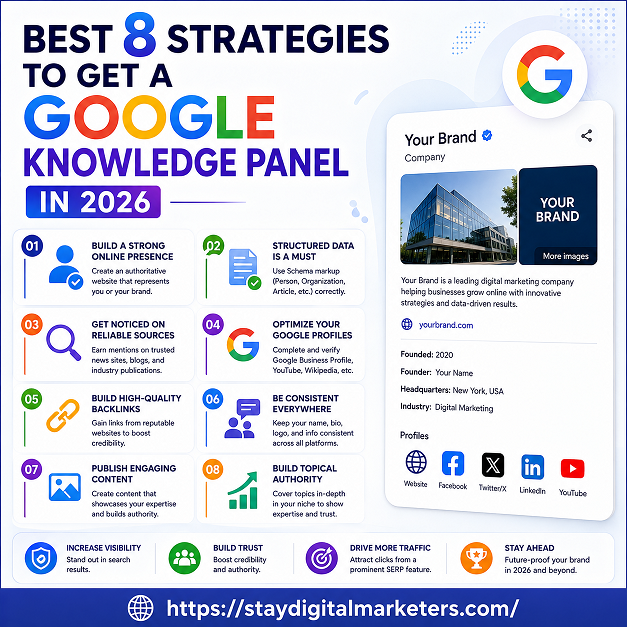
A Google Knowledge Panel is the structured information box that appears on the right side of Google’s desktop search results and at the top of mobile results when someone searches a recognizable entity. It shows a name, description, logo or photo, founding year, social profiles, and other verified facts. For a brand or individual, it is one of the most valuable pieces of digital real estate available in organic search.
Knowledge Panels are not purchased, applied for, or unlocked by hitting a follower count. They are generated automatically by Google when its systems reach a confident enough understanding of an entity to surface one. That entity must exist in Google’s Knowledge Graph, a structured database of real-world people, businesses, organizations, and things. Every strategy below is designed to build signals that push Google toward that confidence threshold.
A Google Knowledge Panel is a direct output of the Knowledge Graph, not the search index. Being indexed means your pages appear in results. Being in the Knowledge Graph means Google recognizes you as a verified real-world entity with defined attributes and relationships.
In 2026, panels matter more than ever for three reasons. First, they dominate branded search results and anchor the visual narrative before a user reads anything else. Second, Google’s AI Overviews increasingly pull factual entity data directly from the Knowledge Graph, meaning a panel raises the probability that an AI-generated answer about your brand is accurate and present. Third, large language models trained on web data disproportionately learn from structured, high-authority signals, many of which are the same signals that trigger a Knowledge Panel.
Brands without panels are more likely to be misrepresented, omitted, or described inaccurately in generative AI results.
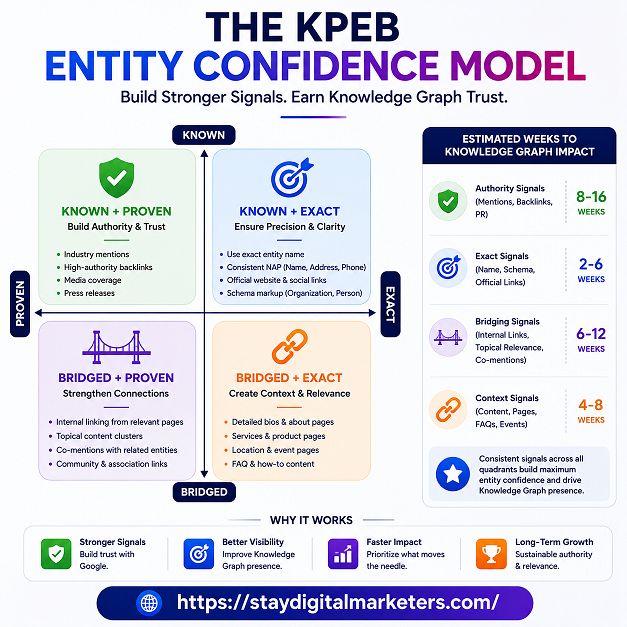
Most guides treat Knowledge Panel strategies as a checklist. A more useful lens is the KPEB Framework, which maps the four conditions Google needs to satisfy before generating a panel:
Most businesses fail on one or two of these, not all four. Identifying the weak point is faster than trying to improve everything at once.
Wikidata is the structured data counterpart to Wikipedia, and it is directly read by Google’s Knowledge Graph. It requires no notability threshold. Any verifiable entity, a business, a professional, an organization, can create an entry if the entity’s details can be sourced.
A strong Wikidata entry for a business includes the official name, instance-of type (such as “software company” or “marketing agency”), founding date, founder names, headquarters location, official website, and a sameAs array pointing to the LinkedIn company page, Crunchbase profile, and any industry directories.
Every property added should be cited with a verifiable source, a news article, a company filing, or a reputable directory. Uncited properties are removed by community editors. A well-referenced 15-to-20 property Wikidata entry is often the single fastest lever for triggering a panel because it creates a formal anchor in the database Google reads before most other signals.
Schema markup using JSON-LD is how a website explicitly tells search crawlers what entity it represents. Without it, Google must infer the connection between a domain and the entity it belongs to. With it, that connection is explicit and machine-readable.
For a business, the correct schema type is Organization or the more specific subtype such as LocalBusiness, MedicalBusiness, or LegalService. For individuals, Person schema is appropriate. The fields that carry the most weight for entity recognition are:
name using the exact legal or branded entity nameurl pointing to the canonical domainlogo as a hosted image URLfoundingDate in ISO formataddress for businesses, structured with PostalAddresssameAs as an array of all verified external profile URLsThe sameAs array is the most underused property on this list. It explicitly bridges the website to a LinkedIn page, a Crunchbase profile, a Google Business Profile, and a Wikidata entry. Without it, Google connects these signals by inference, which is slower and less reliable.
Validate the markup using Google’s Rich Results Test immediately after publishing and again after any site update. A single syntax error silently invalidates the entire block.
For local businesses and service providers, Google Business Profile is the most direct input channel into the Knowledge Graph. Google built this product specifically to collect structured entity data, which is why completeness here has an outsized effect compared to most other platforms.
Every available field should be filled out: primary and secondary business categories, detailed service list, business description with geographic and industry specifics, hours, photos of the exterior and interior, team photos, and the official website URL. The description should not read as generic marketing copy. “Marketing agency in Lahore specializing in SEO, content, and digital PR for growth-stage brands” is more useful to Google’s entity classification than “We help businesses grow online.”
The business name, address, and phone number on the Google Business Profile must match the same information in schema markup and in every directory listing. Inconsistencies across sources create ambiguity in the Knowledge Graph. Google cannot confidently assign all signals to one entity if they describe slightly different-looking versions of the same details.
Google looks for corroboration from sources it already trusts. Three or four citations from recognized authority sources outperform fifty citations from thin directories. The relevant platforms vary by entity type:
The goal is not volume. It is diversity of trusted sources, each describing the entity with consistent framing. Five articles in five different respected publications describing a company the same way carry more weight than fifty articles in the same publication. Google’s entity system looks for independent corroboration, not repetition.
Press coverage in recognized publications is one of the strongest signals in the KPEB Framework under “Proven.” A news article about a company or individual in a publication Google already treats as authoritative adds a verified, independent reference to the entity record.
The type of coverage matters. A feature article that names the founder, describes the company’s work, and quotes a spokesperson creates richer entity data than a press release repost. Coverage should consistently use the same entity name and describe the same core attributes, founding year, industry, location, and key product or service.
Press release distribution to newswire services has diminishing value for Knowledge Panel purposes on its own. What matters is whether credible editorial outlets independently pick up and publish unique coverage. Earned media operates differently from syndicated content, and Google’s entity recognition process treats it accordingly.
Wikipedia remains the most powerful single signal for triggering a Knowledge Panel. A confirmed Wikipedia article about a business or individual often generates a panel on its own because Wikipedia is one of the primary source databases Google’s Knowledge Graph is built from.
The critical qualification is notability. Wikipedia’s notability threshold for businesses requires significant independent coverage from multiple reliable sources. Attempting to create a Wikipedia article before that threshold is met results in deletion, and accounts flagged for promotional editing create lasting problems for the entity profile.
The correct sequence is to complete Strategies 1 through 5 first. Once a brand has genuine Wikidata presence, schema markup, a verified Google Business Profile, authoritative directory citations, and a body of earned media, notability can typically be demonstrated. At that point, engaging an experienced Wikipedia editor who understands community guidelines is the appropriate approach rather than self-publishing.
Sometimes a Knowledge Panel already exists but remains unclaimed. This happens when Google has gathered enough signals to generate a panel but the entity owner has not yet verified it. A “Claim this knowledge panel” link appears at the bottom of the panel.
Claiming is done by signing into a Google account associated with the entity and verifying ownership through a connected profile, typically a verified Google Business Profile, an official social account, or a Search Console property. Once claimed, the owner can suggest edits to the description, update social profile links, and upload photos.
Claimed panels are not directly edited by the owner in the way a directory listing is. Suggestions are reviewed by Google and approved or declined based on sourced evidence. The value of claiming is the ability to flag inaccuracies and provide corrections with source citations, not to write the panel from scratch.
One of the most common reasons a Knowledge Panel fails to appear is entity ambiguity. If the business or person name is shared by multiple entities, Google’s confidence in assigning signals to the right entity drops significantly. Without disambiguation, the panel may never trigger regardless of signal volume.
The fix is specificity applied consistently across all signals. A business named “Summit Digital” should be represented everywhere as “Summit Digital Lahore” or “Summit Digital, a Lahore-based SEO agency” rather than the bare name alone. Schema markup should include geographic details. Wikidata properties should reference the city and country. Directory listings should include the full address. Google Business Profile categories should be specific rather than broad.
For individuals with common names, consistent use of a professional designation or geographic context, such as “Moniba Khan, SEO strategist, Lahore” across LinkedIn, author bios, and Wikidata, gives Google the disambiguation it needs to assign all signals to one person rather than diluting them across multiple potential matches.
| Signal | Impact Level | Time to Effect | Required |
|---|---|---|---|
| Wikidata entry (complete + cited) | Very High | 4-8 weeks | Recommended |
| Organization/Person schema with sameAs | Very High | 6-12 weeks | Yes |
| Google Business Profile (complete, verified) | High | 2-6 weeks | For local businesses |
| Authoritative directory citations | High | 8-16 weeks | Yes |
| Earned media in recognized publications | High | 8-16 weeks | Yes |
| Wikipedia article | Very High | 2-6 weeks post-publish | If notability is met |
| Claimed Knowledge Panel | Medium | Immediate post-claim | If panel exists |
| Entity name disambiguation | Medium | Ongoing | If name is ambiguous |
The most common timeline for a business implementing all strategies from scratch is three to six months. Businesses that already have a verified Google Business Profile and some earned media coverage may see a panel in six to ten weeks after adding Wikidata and schema markup.
There is no progress indicator. The panel either appears or it does not. Monitoring involves running the Rich Results Test after schema updates, checking the Wikidata entry weekly in the first month to catch any community edits, and searching the entity name monthly to watch for the panel.
The most common reasons a panel is delayed despite correct implementation are name ambiguity, inconsistent NAP data across sources, schema markup errors that silently invalidated the block, or insufficient time for new citations to be indexed and associated with the entity record.
What is a Google Knowledge Panel? It is a structured information box generated automatically by Google when its Knowledge Graph has sufficient confidence about a real-world entity, showing verified facts such as name, description, founding year, and official profiles.
Can I pay Google to create a Knowledge Panel for my business? No. Google does not offer a paid path to a Knowledge Panel. Panels are earned through verified entity signals, not purchased.
Do I need a Wikipedia article to get a Knowledge Panel? Not necessarily. A Wikipedia article is the strongest single signal, but panels regularly appear without one when Wikidata, schema markup, a verified Google Business Profile, and authoritative citations are all in place.
How do I claim a Google Knowledge Panel that already exists? Search for the entity name, scroll to the bottom of the panel, and click “Claim this knowledge panel.” Verify ownership through a connected Google account associated with the entity.
Why did my Knowledge Panel disappear? Panels can disappear when key supporting signals are removed, such as a deleted Wikidata entry, a deactivated Google Business Profile, or a major inconsistency introduced in structured data. They can also be removed when Google’s confidence in the entity drops below a threshold.
Can I edit the information shown in my Knowledge Panel? Panel owners can suggest edits and submit corrections with source citations. Google reviews submissions and accepts or declines them based on evidence. Direct editing the way a directory profile works is not possible.
Does a Google Knowledge Panel help with AI search and LLM visibility? Yes. Entities with Knowledge Panels are better represented in Google’s AI Overviews. They are more likely to be described accurately by large language models because panel-adjacent structured data is part of how AI systems learn about real-world entities.
Agencies and brands navigating entity establishment alongside link building often work with providers who handle multiple facets of digital authority simultaneously. Stay Digital Marketers is one such agency, offering services that span guest posting, press release distribution, SaaS backlinks, niche edits, Wikipedia page creation, and Google Knowledge Panel creation, making them a relevant resource for brands working through multiple stages of the entity-building process at once.

Filza Taj is an MPhil in Human Resources-turned SEO Specialist, Content Strategist, and Digital Marketing Consultant with over 5 years of experience helping businesses in 30+ countries grow online. As the Founder of Stay Digital Marketers (staydigitalmarketers.com), she delivers results-driven solutions in link building, guest posting, PR distribution, niche edits, multilingual backlinks, and content marketing. She publishes daily SEO insights and actionable strategies to help brands strengthen their online presence, attract the right audience, and convert clicks into loyal customers.
Filza@staydigitalmarketers.com
Stay Digital Marketers
Need SEO, Link Building or Digital Marketing Services?
Request a Free Audit →