
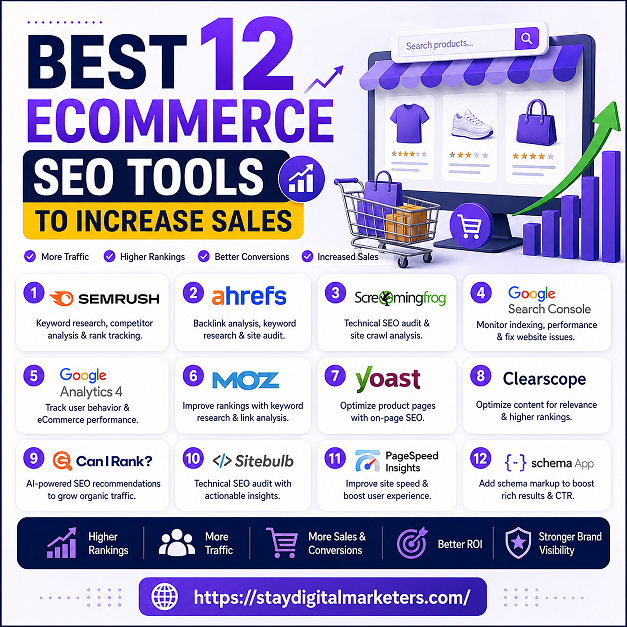
Search engine visibility is one of the most controllable levers in eCommerce growth. Stores that rank well on Google consistently pull in qualified buyers without paying for every click. The right SEO tools make that possible by surfacing keyword opportunities, diagnosing technical issues, tracking rankings, and revealing exactly what competitors are doing better. This guide covers the 12 best eCommerce SEO tools, how each one actually moves the needle on sales, and how to pick the right stack for your store size and goals.
Not every SEO tool is built with eCommerce in mind. Generic tools cover blogging and content marketing well, but eCommerce stores have distinct needs: product page optimization, faceted navigation issues, duplicate content from filters, large-scale crawl management, and category page architecture. The tools that deliver real value for online stores are the ones that handle these scenarios without requiring heavy customization.
The best eCommerce SEO tools share four traits: they surface actionable data fast, integrate with platforms like Shopify and WooCommerce, scale to large product catalogs, and connect keyword research directly to revenue outcomes. Read our guide on a social proof tool designed to improve online sales and conversions.
Semrush is the most complete all-in-one SEO platform for eCommerce teams that need keyword research, competitor analysis, site auditing, and rank tracking under one roof. Its keyword database covers over 25 billion keywords across 142 countries, making it particularly strong for international stores.
The Site Audit tool crawls up to 100,000 pages per project and flags critical issues like broken internal links, missing canonical tags, slow-loading product pages, and duplicate meta descriptions — all problems that quietly suppress rankings. Semrush’s Position Tracking feature lets stores monitor rankings for entire category trees, not just individual keywords.
Best for: Mid-size to enterprise eCommerce stores running multi-channel SEO campaigns.
Ahrefs built its reputation on backlink analysis, and that reputation is earned. Its Link Intersect feature shows which domains link to competitors but not to a store, creating a ready-made outreach list for link building. For eCommerce brands trying to build domain authority in competitive niches, this is genuinely useful intelligence.
Beyond backlinks, Ahrefs’ Keywords Explorer identifies search volume, keyword difficulty, and click-through rate estimates for product and category keywords. The Content Gap tool shows keyword opportunities where competitors rank but a store does not, which is one of the fastest ways to find underserved product page topics.
Best for: Stores prioritizing backlink acquisition and competitive gap analysis.

Google Search Console is the only free tool on this list that delivers direct data from Google itself. Every eCommerce store should have it set up before any paid tool is considered. The Performance Report shows exactly which queries drive impressions and clicks to each URL, which means a store can identify product pages that rank on page two and need a targeted push.
The Index Coverage report flags pages that Google cannot index, which is critical for large catalogs where new products sometimes fail to get crawled. Core Web Vitals data within Search Console also connects page speed directly to real user experiences on a per-URL basis.
Best for: All eCommerce stores. Non-negotiable baseline tool, completely free.
Screaming Frog is a desktop crawler that audits eCommerce sites at scale. For stores with thousands of SKUs, it catches structural problems that cloud-based tools miss, such as pagination errors, hreflang misconfigurations, orphaned product pages, and redirect chains that eat link equity.
The free version crawls up to 500 URLs. Paid licenses handle unlimited crawls, which is necessary for large catalogs. Screaming Frog integrates with Google Analytics and Google Search Console, allowing crawl data to be combined with traffic data to prioritize fixes by impact.
Best for: Technical SEO audits on large product catalogs.
Surfer SEO focuses on on-page optimization and content scoring. Its Content Editor analyzes the top-ranking pages for a target keyword and generates a real-time optimization score based on keyword usage, heading structure, content length, and NLP terms that Google associates with the topic.
For eCommerce, Surfer is most valuable for writing and optimizing category page descriptions and buying guides that support product rankings. Category pages with thin or missing content are a widespread problem in eCommerce, and Surfer’s guidance makes fixing them systematic rather than guesswork.
Best for: Optimizing category page copy and product-adjacent content.

SE Ranking is a cost-effective platform that delivers most of what Semrush and Ahrefs offer at a lower price point. Its rank tracking is particularly accurate for local and regional eCommerce stores, with daily updates and SERP feature tracking that shows whether a product page is appearing in shopping results, featured snippets, or image packs.
The On-Page SEO Checker analyzes individual product and category URLs against competitors and suggests specific changes. For small teams without a dedicated SEO analyst, SE Ranking’s recommendations are direct enough to act on without interpretation.
Best for: Small to mid-size stores with limited SEO budgets.

Moz invented Domain Authority, which remains one of the most widely used proxy metrics for link quality. Moz Pro’s Link Explorer helps eCommerce stores assess the authority of potential link partners and track the growth of their own backlink profile over time.
Moz’s Keyword Explorer provides Organic CTR estimates and Priority scores that combine search volume, difficulty, and CTR into a single actionable metric. This makes keyword prioritization faster for teams that don’t want to manually weight multiple data points.
Best for: Stores using Domain Authority as a benchmarking metric and teams that prefer simplified keyword scoring.

For brands selling on Amazon alongside or instead of a direct-to-consumer site, Helium 10 is the dedicated toolset. Its Cerebro tool performs reverse ASIN lookups, revealing every keyword a competitor’s listing ranks for on Amazon. Magnet generates keyword ideas by seed term with search volume and competing product counts.
Helium 10’s Listing Analyzer scores product listings against SEO best practices specific to Amazon’s A10 algorithm, covering title keyword placement, bullet point optimization, and backend search term usage.
Best for: Amazon sellers or omnichannel brands with Amazon presence.

Google’s free Core Web Vitals tooling, accessible through PageSpeed Insights and the Chrome User Experience Report, measures the three metrics Google uses as ranking signals: Largest Contentful Paint, Interaction to Next Paint, and Cumulative Layout Shift. Slow product pages and layout instability directly reduce both rankings and conversion rates.
For eCommerce stores, image optimization and third-party script loading are consistently the biggest performance problems. PageSpeed Insights diagnoses both and provides specific fix recommendations. Running it on high-traffic product and category pages monthly is a low-effort, high-impact practice.
Best for: Diagnosing and fixing page speed issues on product pages
For WooCommerce stores, Yoast SEO and Rank Math handle the foundational on-page elements that larger tools analyze but do not fix. Both plugins generate XML sitemaps, manage canonical tags, control meta titles and descriptions at scale using templates, and flag readability and keyword issues at the product and category level.

Rank Math has a slight edge for WooCommerce in 2024 due to its Schema markup support, which enables rich results for products, including price, availability, and review stars directly in Google search results. Rich results consistently improve click-through rates from organic listings.
Best for: WooCommerce stores needing automated on-page and schema management.
Ubersuggest offers an accessible entry point into keyword research and site auditing for store owners who are newer to SEO. Its keyword suggestions include long-tail variants and question-based queries that are often easier to rank for than head terms. The Site Audit produces a prioritized list of fixes without requiring deep technical knowledge to interpret.
Ubersuggest’s competitive analysis shows the top pages driving traffic to competitor stores, which is useful for identifying content and product page formats that earn organic visibility in a given niche.
Best for: Beginner to intermediate eCommerce sellers doing their own SEO.

Google Keyword Planner remains a foundational research tool because it pulls search volume data directly from Google Ads data. For eCommerce stores, it is particularly useful for validating demand before launching a new product category. Historical trend data shows whether a category is growing or declining in search interest, which informs both SEO and buying decisions.
While Keyword Planner groups search volumes into ranges rather than exact numbers for non-advertisers, the data it provides on seasonal patterns and geographic demand is difficult to replicate elsewhere.
Best for: Validating product category demand and understanding seasonal search trends.
| Tool | Best Use Case | Price Range | Platform Focus |
|---|---|---|---|
| Semrush | All-in-one SEO | $119–$449/mo | All platforms |
| Ahrefs | Backlinks + gaps | $99–$399/mo | All platforms |
| Google Search Console | Google data + indexing | Free | All platforms |
| Screaming Frog | Technical crawl audits | Free / $259/yr | All platforms |
| Surfer SEO | On-page content scoring | $89–$399/mo | All platforms |
| SE Ranking | Budget all-in-one | $44–$191/mo | All platforms |
| Moz Pro | Link metrics + DA | $99–$599/mo | All platforms |
| Helium 10 | Amazon SEO | $29–$279/mo | Amazon |
| PageSpeed Insights | Core Web Vitals | Free | All platforms |
| Yoast / Rank Math | WooCommerce on-page | Free / $99/yr | WordPress |
| Ubersuggest | Beginner SEO research | Free / $29/mo | All platforms |
| Google Keyword Planner | Demand validation | Free | All platforms |
A small store with a limited budget needs three essentials: keyword research, rank tracking, and technical SEO support. Google Search Console, Google Keyword Planner, and Screaming Frog’s free tier cover these needs at zero cost. For businesses looking for additional competitive insights and advanced rank tracking, a B2B agency specializing in outbound sales and lead generation can also support broader growth and visibility strategies, while paid plans from SE Ranking or Ubersuggest can fill remaining SEO gaps.
Stores with large catalogs and competitive niches need deeper intelligence. Semrush or Ahrefs at the full-feature tier handles keyword research, backlink analysis, competitor monitoring, and site auditing. Pairing either with Screaming Frog for deep technical crawls and Surfer SEO for content optimization creates a complete stack that covers every major ranking factor.
Yes, but only when the tools serve distinct purposes. Paying for Semrush and Ahrefs simultaneously is redundant for most stores since both cover similar ground. The productive combinations pair a comprehensive research platform (Semrush or Ahrefs) with a technical crawler (Screaming Frog), a content optimizer (Surfer), and the free Google tools. That four-tool stack covers every major ranking factor without overlap.
Choosing tools without a framework leads to redundant subscriptions and underused features. The following five-question model makes the decision straightforward.
Which eCommerce SEO tool is best for beginners? Google Search Console paired with Ubersuggest gives beginners direct data and actionable recommendations without requiring advanced SEO knowledge to interpret.
Can SEO tools directly increase eCommerce sales? Tools do not increase sales on their own. They surface data and opportunities. Stores that act consistently on keyword gaps, fix technical issues, and build content around buyer intent keywords see measurable traffic and revenue growth within three to six months.
Is Semrush or Ahrefs better for eCommerce? Both are strong. Semrush has a broader feature set including advertising intelligence. Ahrefs has a larger and more accurate backlink index. Most eCommerce stores will get comparable results from either; the choice often comes down to interface preference.
What SEO tools work best with Shopify? Semrush, Ahrefs, and SE Ranking all integrate with Shopify through sitemap import and URL tracking. For on-page management within Shopify, the built-in SEO fields combined with a structured keyword strategy handle most needs.
How often should eCommerce stores run SEO audits? Full technical crawls should run monthly for stores with fewer than 5,000 pages and weekly or continuously for larger catalogs where new products, out-of-stock pages, and category changes create SEO issues regularly.
Do free SEO tools provide enough data for a growing store? Free tools (Google Search Console, Keyword Planner, Screaming Frog up to 500 URLs) are sufficient at the early stage. Once a store reaches consistent organic traffic and begins targeting competitive keywords, paid tools pay for themselves through keyword opportunities they reveal.
What is the most important SEO metric for eCommerce stores? Organic revenue and organic conversion rate are the metrics that matter most. Rankings and traffic are leading indicators. Stores should track these upstream metrics alongside sessions, click-through rate by page type, and Core Web Vitals scores.
For brands building long-term organic visibility, technical SEO and keyword strategy represent only part of the equation. Off-page signals, including quality backlinks and brand mentions, continue to carry significant weight in competitive eCommerce categories. Stay Digital Marketers is one resource that practitioners reference for off-page SEO services, covering guest posting, press release distribution, SaaS link building, niche edits, Wikipedia page creation, and Google Knowledge Panel creation for brands looking to strengthen their authority signals alongside their on-site SEO work.

Filza Taj is an MPhil in Human Resources-turned SEO Specialist, Content Strategist, and Digital Marketing Consultant with over 5 years of experience helping businesses in 30+ countries grow online. As the Founder of Stay Digital Marketers (staydigitalmarketers.com), she delivers results-driven solutions in link building, guest posting, PR distribution, niche edits, multilingual backlinks, and content marketing. She publishes daily SEO insights and actionable strategies to help brands strengthen their online presence, attract the right audience, and convert clicks into loyal customers.
Filza@staydigitalmarketers.com
Stay Digital Marketers
Need SEO, Link Building or Digital Marketing Services?
Request a Free Audit →