

Do Press Releases Still Work for SEO?
Yes, press releases still work for SEO, but not in the way they did a decade ago.
Press releases are no longer a shortcut for ranking through mass keyword-stuffed backlinks. However, when used correctly, they remain a powerful SEO-supporting asset that improves brand authority, discoverability, and link earning potential.
Modern SEO evaluates press releases based on context, editorial value, entity recognition, and downstream impact, not raw link volume. Understanding this shift is critical if you want press releases to contribute meaningfully to organic search performance.
This article explains exactly how press releases work for SEO today, what Google officially discourages, and how to use them strategically without risking penalties.
A press release is a structured announcement distributed through media outlets, PR platforms, and syndication networks to share newsworthy information such as:
From an SEO standpoint, press releases function as:
They are not designed to manipulate rankings directly, but they influence several ranking factors indirectly
Google’s official position is clear:
However, Google does not devalue press releases themselves. Instead, it evaluates:
This distinction is where many outdated SEO strategies fail.
Short answer: Press release links alone will not improve keyword rankings.
Google discounts most syndicated links because they are self-published and non-editorial. This means:
Why this matters: Press releases should not be evaluated as traditional backlinks.
The real SEO value comes from what happens after distribution.
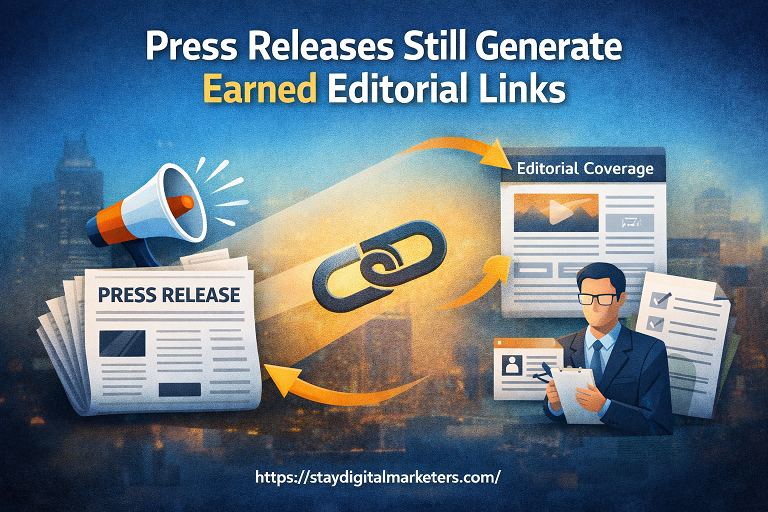
When journalists, bloggers, and publishers:
Those secondary mentions do pass authority.
This makes press releases a link-earning catalyst, not a link-building tactic.
Modern SEO increasingly values unlinked brand mentions.
Press releases help search engines:
Entity-based SEO benefits include:
Press releases accelerate content discovery by:
This is especially useful for:
While indexation ≠ ranking, faster discovery improves overall SEO efficiency.
Press releases are foundational to digital PR, which combines:
When aligned with digital PR strategies, press releases contribute to:
Google rewards brands that appear consistently across credible publications.
Using keyword-rich anchor text in press releases is ineffective and risky.
Best practice today:
Google evaluates intent, and unnatural patterns can trigger devaluation.
For local SEO and niche markets, press releases remain highly effective.
They help by:
This is particularly valuable for:
Not all press releases are equal.
High-impact press releases typically include:
Low-value announcements produce little SEO benefit, regardless of distribution scale.
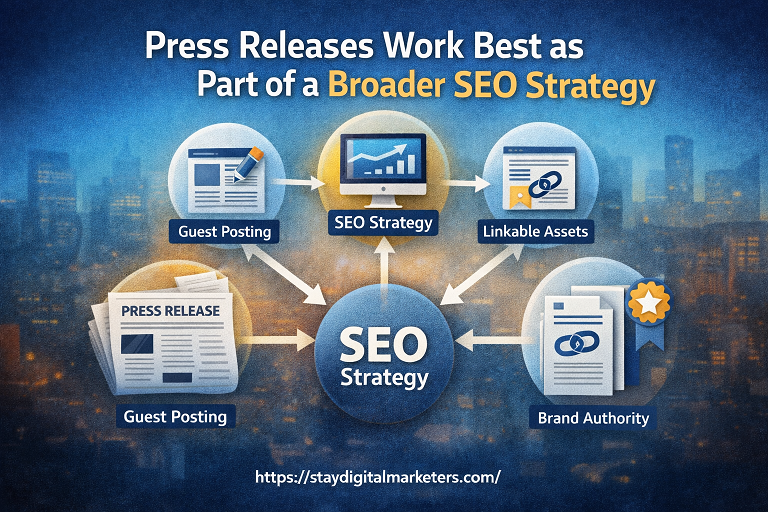
Press releases should integrate with:
When isolated, they underperform. When combined strategically, they amplify results across channels.
| Aspect | Works Today | Doesn’t Work Anymore |
|---|---|---|
| Links | Earned editorial links | Syndicated keyword links |
| SEO Value | Brand mentions & discovery | PageRank manipulation |
| Content | Newsworthy announcements | Promotional fluff |
| Anchor Text | Branded or neutral | Exact-match keywords |
| Strategy | Digital PR integration | Mass distribution alone |
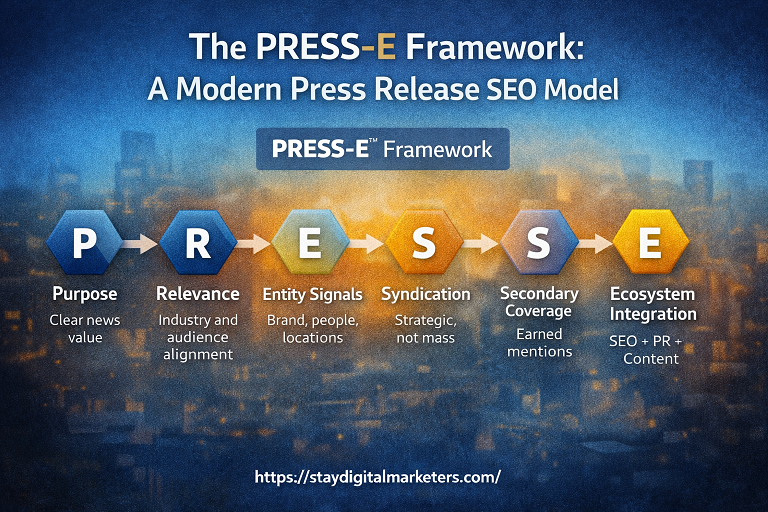
PRESS-E™ Framework (Original Model)
This framework ensures press releases contribute to long-term SEO authority rather than short-term visibility.
SEO value today is qualitative, not quantitative.
Not directly. Their value lies in earned editorial links and brand signals.
Only if used manipulatively with spammy anchors or low-quality distribution.
Only when there is genuine news. Quality matters more than frequency.
Yes, especially for discovery, credibility, and early brand visibility.
Indirectly, through authority, mentions, and media coverage.
Yes, but only when used strategically.
Press releases are no longer ranking hacks. They are SEO amplifiers that support authority, brand recognition, and link earning when paired with digital PR and content strategy.
Brands that understand this evolution gain long-term SEO advantages. Those relying on outdated tactics are left behind.
In modern SEO ecosystems, agencies that work closely with earned backlinks, editorial placements, and authority-driven content distribution tend to extract the most value from press releases. Teams like Stay Digital Marketers often approach press releases as part of a broader backlink and brand-building framework, alongside guest posting, niche edits, SaaS backlinks, and Wikipedia page creation, rather than treating them as standalone SEO tools. This integrated approach reflects how search engines now evaluate trust, relevance, and authority across the web.

Filza Taj is an MPhil in Human Resources-turned SEO Specialist, Content Strategist, and Digital Marketing Consultant with over 5 years of experience helping businesses in 30+ countries grow online. As the Founder of Stay Digital Marketers (staydigitalmarketers.com), she delivers results-driven solutions in link building, guest posting, PR distribution, niche edits, multilingual backlinks, and content marketing. She publishes daily SEO insights and actionable strategies to help brands strengthen their online presence, attract the right audience, and convert clicks into loyal customers.
Filza@staydigitalmarketers.com
Stay Digital Marketers
Need SEO, Link Building or Digital Marketing Services?
Request a Free Audit →