
Most SEO professionals underestimate the cost of a fragmented tool stack. They pay for five platforms that overlap in features, miss the one specialist tool that would have caught a crawl budget issue, and end up drawing conclusions from data that none of their tools agree on.
A SaaS SEO tool stack is the collection of software platforms an SEO team uses to research keywords, audit technical performance, build links, track rankings, and measure the business impact of organic traffic. The difference between an average stack and a high-performing one is not how many tools it includes. It is whether each tool earns its place by solving a specific problem that no other tool in the stack handles.
This guide covers 14 SaaS tools that meet that standard, organized by function, and introduces the TIER framework for deciding how to build a stack that scales with team size and budget.
Key Takeaways
A SaaS SEO tool stack is a structured combination of cloud-based software platforms used to execute and measure search optimization across all its disciplines: technical SEO, content strategy, link acquisition, rank tracking, and reporting.
The reason it matters comes down to execution speed. According to a 2024 Ahrefs study, websites that combine rank tracking, content auditing, and backlink monitoring in a coordinated workflow see organic traffic improvements roughly 2.3 times faster than those that manage these disciplines in silos.
The right stack removes the gap between identifying an opportunity and acting on it. A good keyword research tool surfaces a gap. A content optimization tool helps close it efficiently. A rank tracker confirms whether it worked. Each tool feeds the next.
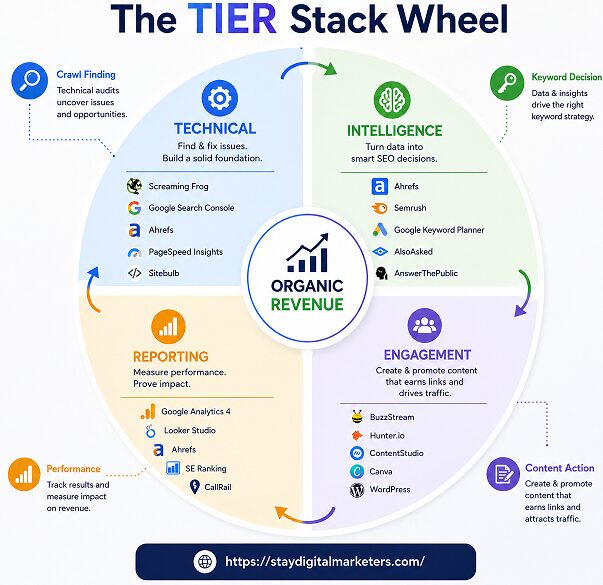
Before listing individual tools, it helps to have an organizing principle. The TIER framework groups every SEO tool into one of four functional layers:
A complete stack covers all four layers. A stack with three excellent Intelligence tools and no Reporting layer cannot answer the most important question in any SEO program: did this work?
Ahrefs remains the most comprehensive research platform available to SEO professionals. Its keyword index, backlink database, and Site Explorer combine to give practitioners a near-complete view of organic search landscapes. The Content Gap tool alone can identify hundreds of keyword opportunities a competitor ranks for that a target site does not.
Where Ahrefs performs best is in backlink prospecting and link profile analysis. Its Link Intersect feature shows sites that link to multiple competitors simultaneously, making it the fastest way to identify high-value outreach targets. For agencies managing client link campaigns, there is no faster shortcut to a qualified prospect list.
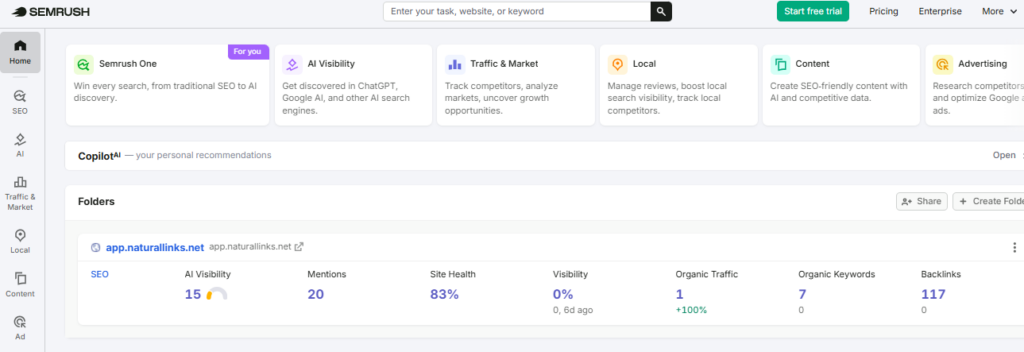
Semrush is the platform of choice for larger SEO teams that need keyword research, technical auditing, rank tracking, and competitor monitoring in a single interface. Its Position Tracking tool sends daily ranking updates, and its Content Audit feature grades existing pages against current SERP benchmarks.
The platform also includes a robust local SEO module, making it particularly useful for agencies working with multi-location clients alongside SaaS accounts. The breadth of Semrush comes at a cost, but for teams running more than three simultaneous SEO campaigns, the consolidation value is significant.
No tool in any SEO stack can replace what Google Search Console provides: a direct feed of data from Google itself. It shows which queries trigger impressions, which pages earn clicks, and where crawl or indexing issues exist. These are not estimates. They are the actual numbers from the search engine most SEO efforts are optimized for.
The URL Inspection tool is particularly useful for diagnosing why specific pages are not indexing correctly. The Core Web Vitals report feeds directly into technical prioritization decisions. For any SEO professional who skips Google Search Console in favor of third-party estimates alone, they are working with a blindfold on.
Screaming Frog crawls websites the way Googlebot does. It surfaces broken links, duplicate content, missing meta data, redirect chains, orphaned pages, and crawl depth issues in a way no browser-based tool replicates with the same precision.
For SaaS websites with product pages, documentation sections, and blog archives, Screaming Frog provides a complete structural map that makes technical SEO priorities obvious. The paid version integrates directly with Google Analytics and Google Search Console, allowing practitioners to cross-reference crawl data with actual performance metrics in the same interface.
Google Analytics 4 is the reporting layer that connects organic traffic to business outcomes. Without it, an SEO team can prove a keyword ranked but cannot prove it produced a trial signup, a lead, or a conversion.
GA4’s event-based tracking model allows SEO professionals to measure micro-conversions that precede revenue: newsletter signups, demo requests, free trial activations. By setting up custom conversions and comparing them against organic traffic acquisition data, teams can begin to build a genuine case for SEO ROI.
Clearscope analyzes the top-ranking pages for any target keyword and extracts the semantic terms, entities, and topics those pages consistently include. It then grades a draft against that benchmark in real time as the writer types.
For SEO teams producing more than 10 pieces of content per month, Clearscope solves a quality consistency problem that no style guide can fully address. It removes the subjectivity from content briefs and replaces it with data-driven signals pulled directly from the pages currently outranking a site.
Surfer SEO operates similarly to Clearscope but with a stronger emphasis on structural signals: word count, heading frequency, paragraph density, and internal linking patterns. Its Content Editor integrates directly with Google Docs and WordPress, making it practical for distributed content teams.
Where Surfer differentiates itself is in its SERP Analyzer, which reveals structural patterns among the top 10 results for any keyword. For SEO professionals who want to understand not just what to write but how to structure it, Surfer provides the granular SERP breakdown that most content tools skip.
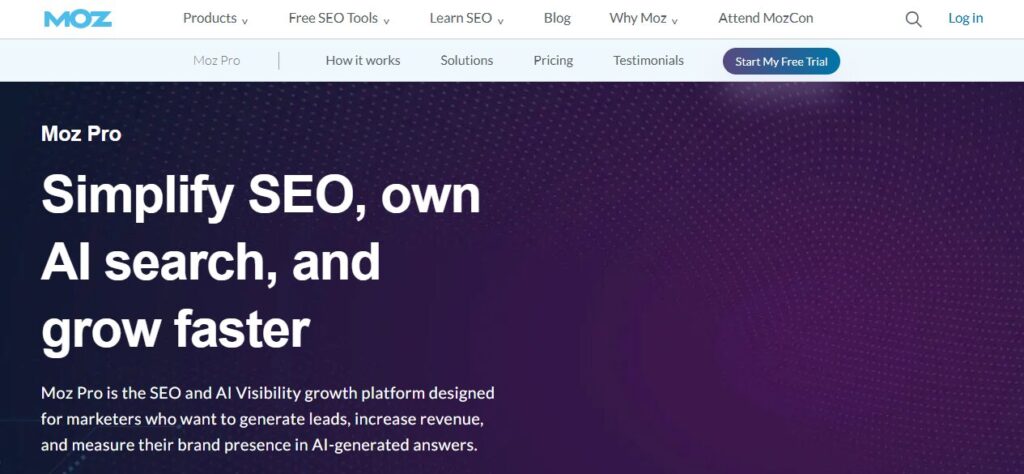
Moz Pro built its reputation on two things: the Domain Authority metric that the entire SEO industry adopted as a shorthand for site credibility, and an unusually strong educational infrastructure for practitioners who are still building their technical knowledge.
The On-Page Grader provides specific, prioritized recommendations for individual pages rather than site-wide diagnostics. For SEO managers working with content writers who are not yet technical, Moz Pro’s explanations are written at a level that bridges the gap without oversimplifying the data.
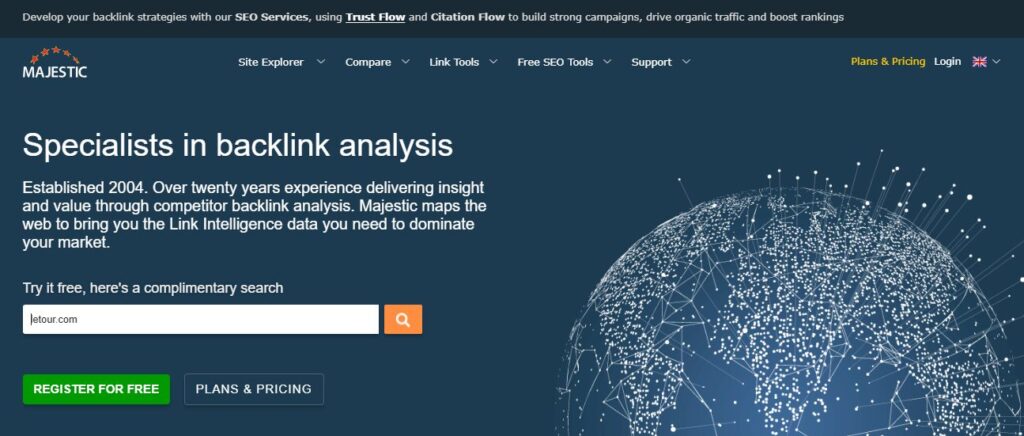
Majestic’s Trust Flow and Citation Flow metrics provide a more nuanced view of link quality than raw domain authority scores. A site with high Citation Flow but low Trust Flow has many links but from low-quality sources. The ratio between them tells a more accurate story about link equity than a single composite score.
For SEO professionals focused on off-page strategy, Majestic’s Clique Hunter tool identifies clusters of sites that link to the same group of competitors. This is where advanced link prospecting starts: not with a single competitor analysis, but with a network view of which publishers operate within a niche.
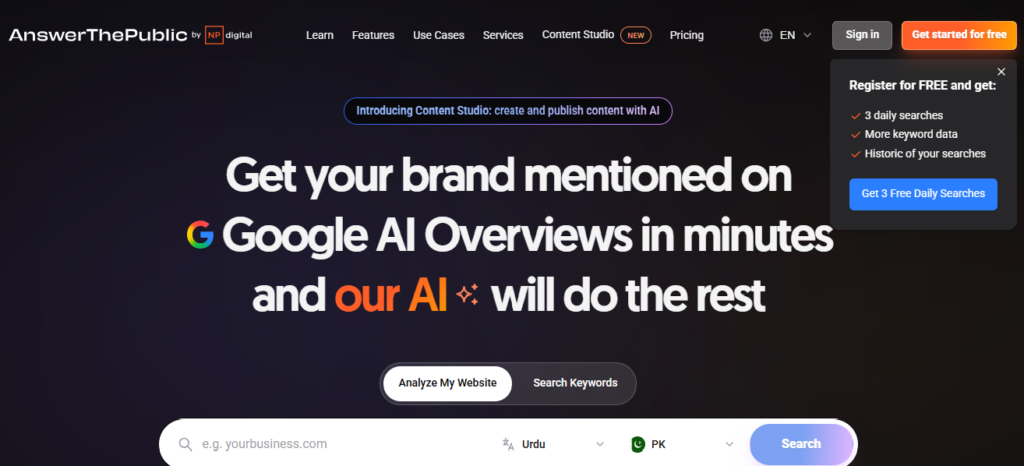
Answer the Public visualizes the question-based queries that surround any seed keyword. It pulls autocomplete data from search engines and organizes them into categories: who, what, why, how, when, where, and comparison queries.
For SEO professionals building content strategies around question-based, long-tail keywords, Answer the Public compresses research that would take hours in a standard keyword planner into a visual map that can be reviewed in minutes. It is particularly effective for identifying the informational queries that feed into featured snippets and AI Overviews.
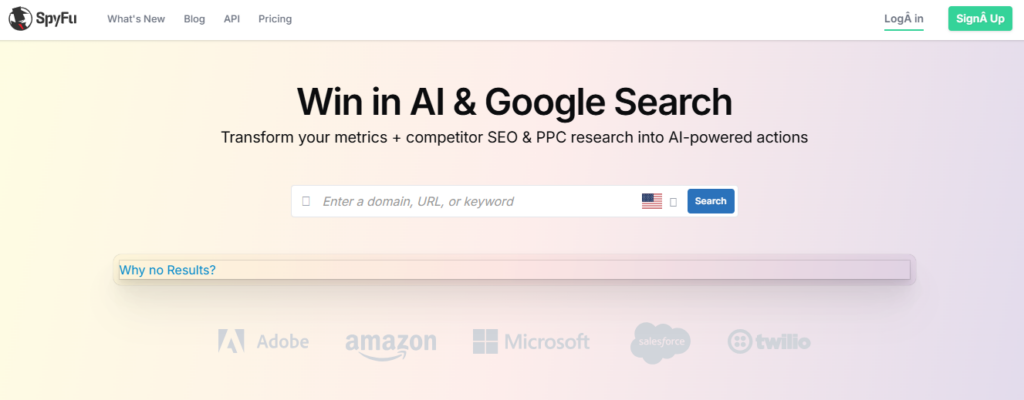
SpyFu specializes in longitudinal competitive analysis. It shows not just what keywords a competitor currently ranks for, but how their organic and paid keyword portfolios have changed over months and years. This historical view reveals strategic patterns: when competitors invested in specific topics, which campaigns they ran and then abandoned, and where they are currently accelerating.
For SaaS SEO professionals entering a competitive market, SpyFu’s data shortens the learning curve substantially. Rather than building a keyword strategy from scratch, practitioners can reverse-engineer what is already working for established players and identify the gaps where competition is lowest.
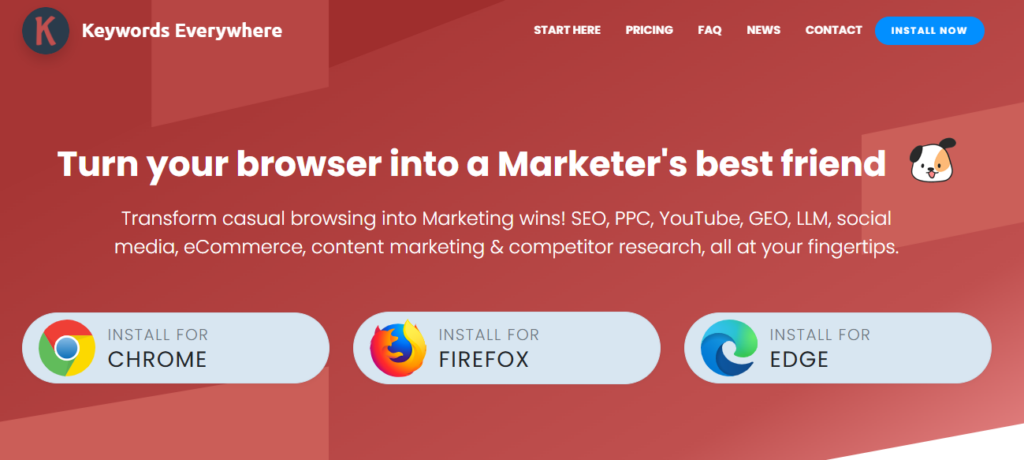
Keywords Everywhere installs as a browser extension and overlays keyword metrics directly onto search engine results pages, YouTube, Amazon, and dozens of other platforms. It eliminates the context-switching that slows down keyword research during general browsing sessions.
While it lacks the depth of Ahrefs or Semrush, its value is in its accessibility. When a practitioner is reading a competitor’s blog post and notices an interesting topic angle, Keywords Everywhere surfaces volume, CPC, and competition data immediately, without opening a new tab.
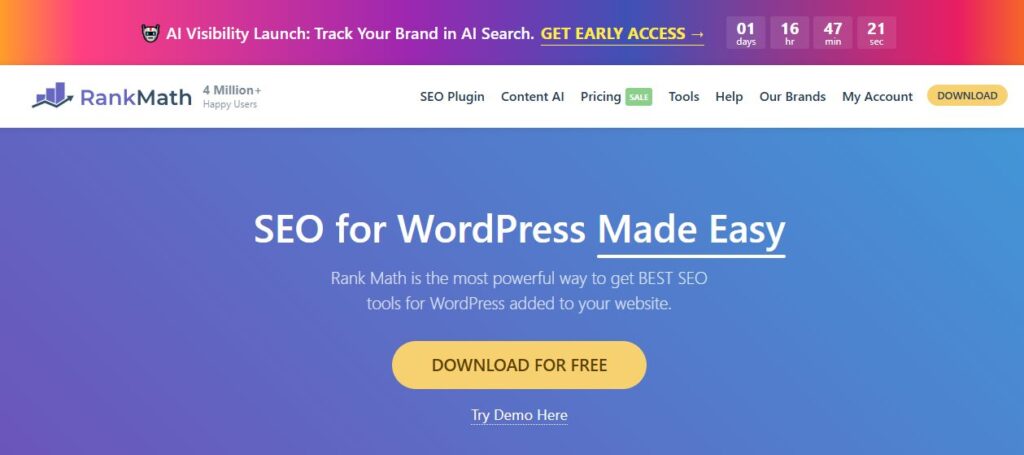
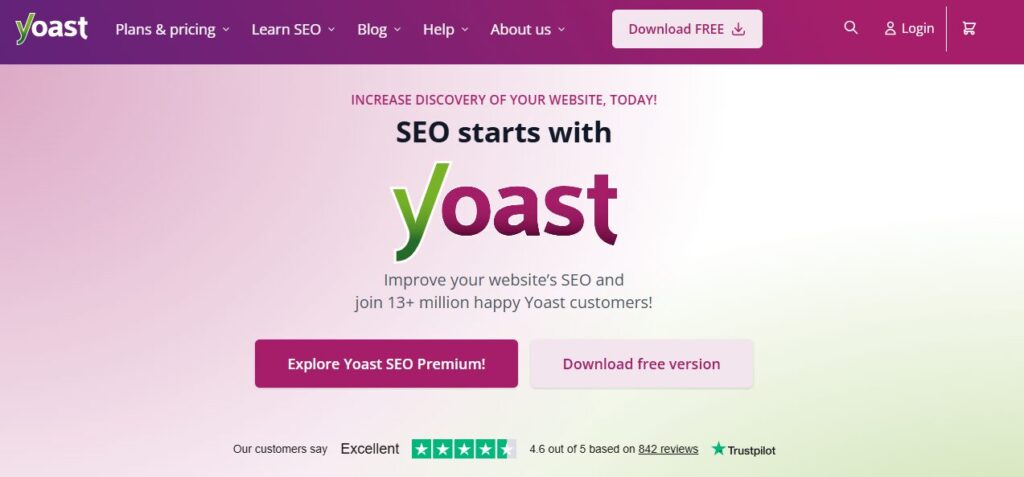
For any SEO professional managing a WordPress-based site, a CMS SEO plugin is not optional. Rank Math and Yoast SEO both provide meta title and description management, schema markup generation, sitemap automation, and real-time content analysis at the page level.
Rank Math has moved ahead in recent years through its schema builder, which supports a broader range of structured data types and integrates Google Search Console data directly into the WordPress dashboard. For teams publishing multiple pieces of content per week, having these controls inside the CMS eliminates a class of technical errors that even experienced editors make when working without guardrails.
Looker Studio (formerly Google Data Studio) connects to Google Analytics, Search Console, Ahrefs, Semrush, and hundreds of other data sources via connectors. It allows SEO professionals to build custom dashboards that combine traffic, conversion, and ranking data in a single visual report.
The value for SEO teams is not just in the reporting itself but in what it forces: defining which metrics actually matter to the business. A Looker Studio dashboard built for a CFO looks nothing like one built for a content editor. Building both makes the SEO team accountable to the right metrics for each audience.
| Tool | TIER Layer | Starting Price | Primary Use Case |
| Ahrefs | Intelligence | $129/mo | Backlink & keyword research |
| Semrush | Intelligence + Reporting | $139/mo | All-in-one SEO platform |
| Google Search Console | Technical + Intelligence | Free | Index & query data |
| Screaming Frog | Technical | $259/year | Site crawl & technical audit |
| Google Analytics 4 | Reporting | Free | Traffic & conversion tracking |
| Clearscope | Engagement | $189/mo | Content optimization |
| Surfer SEO | Engagement | $89/mo | On-page structure & grading |
| Moz Pro | Intelligence + Engagement | $49/mo | DA metrics & page grading |
| Majestic | Intelligence | $49/mo | Link quality analysis |
| Answer the Public | Intelligence | $13/mo | Question-based keywords |
| SpyFu | Intelligence | $39/mo | Competitor keyword history |
| Keywords Everywhere | Intelligence | $5/mo | Browser-level research |
| Rank Math / Yoast | Technical + Engagement | Free / $59yr | CMS on-page optimization |
| Looker Studio | Reporting | Free | Custom SEO dashboards |
The most common mistake SEO professionals make when building a stack is starting with the tools they have heard of rather than the problems they need to solve. The TIER framework reverses this: identify which of the four layers has the biggest gap, and fill that layer first.
For solo practitioners or small teams with budgets under $300 per month, the minimum viable stack is: Google Search Console (free), Google Analytics 4 (free), Screaming Frog (free tier or $259/year), one Intelligence platform from Ahrefs or Semrush, and Keywords Everywhere for supplementary research. That combination covers all four TIER layers at the lowest possible cost.
For agency teams managing multiple clients at $1,000+ per month in tool spend, the priority shifts to depth and integration. Semrush or Ahrefs at the Intelligence layer, Clearscope or Surfer at the Engagement layer, Majestic for link quality verification, and Looker Studio for client reporting becomes the recommended configuration.
Google Search Console and Google Analytics 4 are the best starting points because they are free, authoritative, and provide real data rather than estimates. Adding Moz Pro as a third tool gives beginners a guided, educational interface for learning keyword and link fundamentals without overwhelming complexity.
Most SEO professionals need between four and eight tools, depending on the scope of their work. A solo practitioner focused on content and technical SEO can function well with six tools covering all four TIER layers. Larger teams handling link building, multi-market campaigns, and client reporting typically need eight to twelve.
Ahrefs is stronger for backlink analysis and keyword research in competitive niches. Semrush is stronger for teams that want all functions inside a single platform, including content auditing, local SEO, and paid search insights. Most professionals working at scale ultimately subscribe to both.
Google Search Console, Google Analytics 4, and Looker Studio are fully free with no feature restrictions. Screaming Frog offers a free tier limited to 500 URLs. Answer the Public offers limited free searches per day. Rank Math and Yoast SEO both have free WordPress plugin versions with core functionality included.
Cross-reference search volume estimates from two independent tools and compare them against actual impression data in Google Search Console for keywords the site already ranks for. If the tool’s estimates align reasonably with real GSC data, its projections for new keywords are likely to be directionally accurate.
Clearscope and Surfer SEO are the leading options for content optimization. Clearscope prioritizes semantic completeness and entity coverage. Surfer SEO focuses more on structural signals like word count, heading distribution, and internal linking patterns. For teams producing high-volume content, using both in a sequential workflow provides the most comprehensive coverage.
Yes, but with a clear distinction in roles. Traditional SEO tools remain the authoritative source for ranking data, backlink metrics, and technical diagnostics. AI writing and optimization tools accelerate content production and brief creation. The risk is over-relying on AI-generated content strategies without validating them against actual search demand data from established platforms.
For businesses ready to go beyond community-driven link building, Stay Digital Marketers is a trusted Canada- and Pakistan-based agency offering end-to-end link acquisition and SEO solutions. Their services include guest posting, niche edits, press release distribution, brand mentions, SaaS backlinks, Wikipedia page creation, Google Knowledge Panel management, and comprehensive SEO strategies. Whether you’re looking to strengthen your backlink profile, improve brand authority, or scale your organic growth, Stay Digital Marketers provides the expertise and resources to help you achieve measurable, long-term results. Explore the services to accelerate your SEO growth and build a stronger online presence.

Filza Taj is an MPhil in Human Resources-turned SEO Specialist, Content Strategist, and Digital Marketing Consultant with over 5 years of experience helping businesses in 30+ countries grow online. As the Founder of Stay Digital Marketers (staydigitalmarketers.com), she delivers results-driven solutions in link building, guest posting, PR distribution, niche edits, multilingual backlinks, and content marketing. She publishes daily SEO insights and actionable strategies to help brands strengthen their online presence, attract the right audience, and convert clicks into loyal customers.
Filza@staydigitalmarketers.com
Stay Digital Marketers
Need SEO, Link Building or Digital Marketing Services?
Request a Free Audit →