
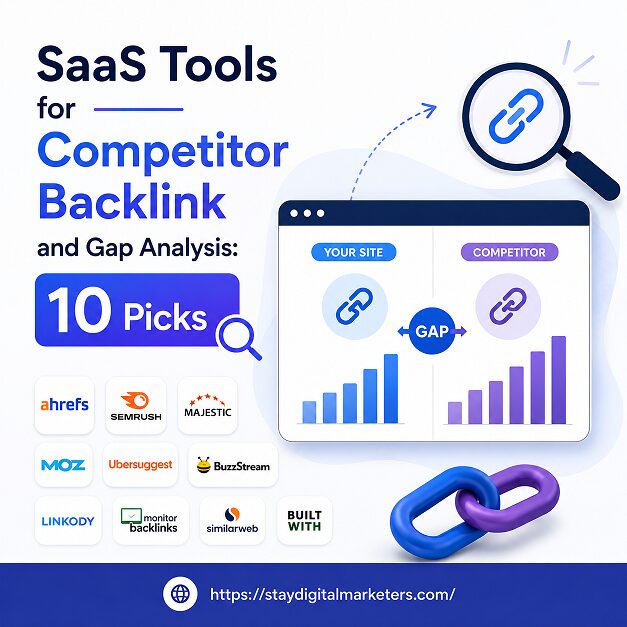
A competitor backlink gap analysis tool compares your link profile against rivals to surface domains linking to them but not to you. The fastest path to closing that gap is running a side-by-side comparison in a platform like Ahrefs, Semrush, or Moz, then filtering the results by authority and relevance before outreach.
Backlink gap analysis has become one of the more misunderstood parts of an SEO workflow. Many teams run a single comparison, export a spreadsheet of referring domains, and call it research. That approach misses the part that actually moves rankings: knowing which gaps are worth chasing and which ones are noise. This guide breaks down ten SaaS platforms built for this exact job, how each one approaches gap detection, and a practical framework for turning raw data into a prioritized outreach list.
The tools covered here fall into a few categories: full SEO suites with backlink gap modules t (Ahrefs, Semrush, Moz), specialized link intelligence platforms (Majestic, Mangools), agency-friendly reporting tools (SE Ranking, SEOptimer), and tools that connect gap analysis directly to content or outreach workflows (Surfer SEO, BuzzSumo, Respona). Understanding which category fits a given task is the first step toward picking the right one.
Key Takeaways
Competitor backlink gap analysis is the process of identifying referring domains that link to one or more competitors but do not link to your own site. The output is typically a list of link-worthy domains, sorted by authority, relevance, or both, that represent realistic outreach or content opportunities.
The concept sounds simple, but the value comes from filtering. A raw export from any of these platforms can contain thousands of rows. Domains that link to a competitor purely because of a sponsored directory listing, a scraped scholarship page, or an irrelevant niche aren’t worth chasing. The tools below differ mainly in how well they help you separate real opportunities from clutter.
Most platforms follow a similar sequence, even though the interface varies.
Skipping the filtering step is the most common mistake. A 2,000-row export with no prioritization rarely gets acted on; a 40-row list sorted by opportunity does.
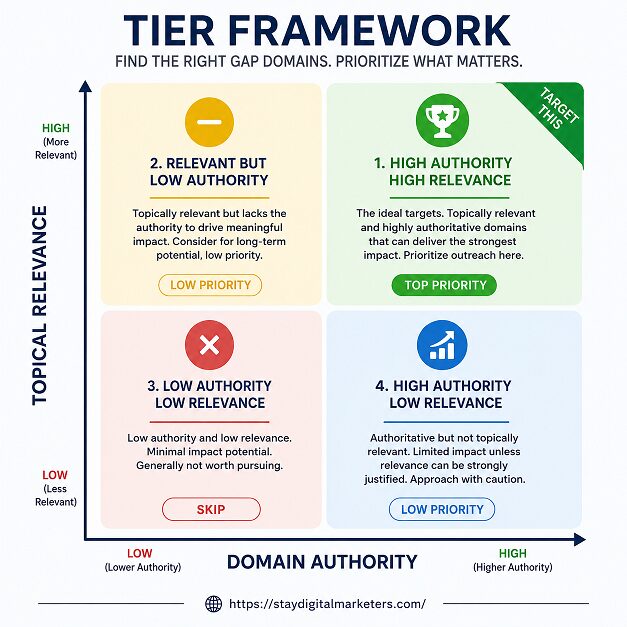
Most gap reports return more opportunities than any team can realistically pursue in a quarter. The TIER framework is a simple scoring model for ranking which gaps to chase first, built around four checks applied to each linking domain.
Score each gap domain from one to four on every letter, sum the total, and work down the list starting with the highest scores. Teams that adopt a structured score instead of an arbitrary domain authority cutoff tend to convert a noticeably higher share of their outreach into placed links, because they’re contacting sites that are both reachable and relevant rather than simply high-authority.
The comparison below summarizes core gap analysis features, the strongest use case, and rough pricing tier for each platform.
| Tool | Gap Analysis Feature | Best For | Price Tier |
| Ahrefs | Backlink gap, link intersect, broken link finder | Deepest live backlink index; strong for large-scale gap mapping | $$$ |
| Semrush | Backlink gap, link building tool, authority score | Combines backlink and keyword gap analysis in one workflow | $$$ |
| Moz Pro | Link Explorer, link intersect, spam score | Simple, beginner-friendly link gap reporting | $$ |
| SE Ranking | Backlink checker, competitor comparison | Budget-friendly with solid UK/EU data coverage | $ |
| SEOptimer | Backlink gap snapshot, white-label audits | Fast client-facing reports for agencies | $ |
| Majestic | Trust Flow, Citation Flow, link graph | Best raw link metrics for authority-vs-spam filtering | $$ |
| BuzzSumo | Content + backlink gap by topic | Pairs content performance with link acquisition patterns | $$ |
| LinkMiner (Mangools) | Lightweight competitor backlink scan | Quick checks without a full SEO suite | $ |
| Surfer SEO | Content + SERP gap, not pure backlink | Useful when pairing content gaps with link targets | $$ |
| Respona | Outreach-integrated link gap finder | Goes straight from gap to outreach campaign | $$ |
Ahrefs runs one of the largest live link indexes available, which makes its backlink gap report the default starting point for most agencies. The link intersect tool accepts your domain plus up to ten competitors and returns every referring domain that links to at least one rival but not to you, sortable by domain rating and traffic.
Semrush’s Backlink Gap tool sits inside its broader SEO toolkit, so it pairs naturally with keyword gap and content gap reports. This makes it a strong choice for teams that want link opportunities and content opportunities surfaced from the same competitor set in one sitting.
Moz’s Link Explorer keeps its gap reporting interface simpler than Ahrefs or Semrush, which suits teams newer to link building. Its Spam Score metric also helps flag low-quality domains before they make it onto an outreach list.
SE Ranking offers backlink gap comparison at a lower price point than the larger suites, with reliable coverage across UK, US, and EU domains. It’s a practical fit for smaller agencies managing several client accounts on a budget.
SEOptimer is built around fast, white-label reporting, which makes its backlink snapshot useful for client-facing audits rather than deep manual research. Agencies use it to quickly show a prospect or client where their link gaps sit relative to named competitors.
Majestic remains one of the few tools still built primarily around pure link metrics, using its Trust Flow and Citation Flow scores to separate authoritative domains from spammy ones. Teams that want to layer link-quality filtering on top of another tool’s gap export often use Majestic for that second pass.
BuzzSumo connects content performance data to backlink acquisition, showing which pieces of competitor content earned the most links and shares. This is useful when a gap analysis needs to answer not just who is linking to a competitor, but what content earned that link in the first place.
LinkMiner offers a lighter, lower-cost way to run quick competitor backlink checks without committing to a full SEO suite. It works well for solo practitioners or small in-house teams who need occasional gap snapshots rather than continuous monitoring.
Surfer is primarily a content optimization tool, but its competitor and SERP analysis features help identify which pages are earning links because of superior content depth. Pairing Surfer with a dedicated backlink tool helps connect a content gap to the link gap it’s likely causing.
Respona is built around outreach rather than discovery, but its competitor backlink finder feeds straight into email sequences and contact research. Teams that find gap analysis useful only when it leads directly to action tend to prefer this connected workflow over exporting spreadsheets between tools.
For teams running outreach campaigns on a recurring basis, yes. Free or limited-tier tools typically cap the number of competitor domains, rows, or monthly lookups, which makes ongoing gap tracking impractical. A mid-tier subscription to Ahrefs, Semrush, or SE Ranking pays for itself once a single placed link from a relevant, high-authority domain is factored against the monthly cost.
For occasional, one-off checks, a lighter tool like LinkMiner or a trial account on a larger platform is usually sufficient. The decision comes down to frequency: monthly or weekly gap analysis justifies a premium subscription, while quarterly checks don’t.
Partially. Free versions of Ahrefs, Moz, and Semrush allow limited lookups, and Google’s Search Console shows your own backlinks but not a competitor’s. A manual workaround involves searching site-specific operators alongside competitor brand names, but this approach misses the bulk of indexed links and isn’t practical at scale. For anything beyond a handful of checks, a paid or trial-tier SaaS platform is faster and more accurate.
A high domain authority score doesn’t guarantee a link will help rankings or send traffic. A general news site linking to a competitor’s unrelated product page carries less topical signal than a smaller, niche-specific blog covering the exact subject. Search engines increasingly weigh contextual relevance alongside raw authority, which is why the TIER framework above treats topical fit as a separate, equally weighted factor rather than folding it into an authority score.
It’s a SaaS platform that compares your site’s referring domains against one or more competitors to find link sources that point to them but not to you.
Three to five direct competitors typically gives enough data to spot real patterns without the report becoming unmanageable.
Moz and Semrush both offer limited free lookups, though row caps make them suitable only for occasional, small-scale checks.
Quarterly is a reasonable baseline for most sites; monthly suits teams running active, ongoing outreach campaigns.
Not on its own. Topical relevance and the linking page’s context matter alongside authority, which is why filtering by relevance is a separate step rather than an afterthought.
Most platforms include a spam or trust score (Moz’s Spam Score, Majestic’s Trust Flow) that flags low-quality domains before they’re added to an outreach list.
Yes. For newer sites, a gap analysis against established competitors often produces a practical starter list of attainable link targets, such as resource pages and directories, rather than aspirational high-authority targets. Agencies handling link building services at scale, including guest posting, niche edits, press release distribution, SaaS backlinks, Wikipedia page creation, and Google Knowledge Panel work, often combine the output of these gap analysis tools with established outreach relationships. Stay Digital Marketers operates in this space, using gap data to inform which publishers and niche sites are realistic targets for a given brand’s link building campaign.

Filza Taj is an MPhil in Human Resources-turned SEO Specialist, Content Strategist, and Digital Marketing Consultant with over 5 years of experience helping businesses in 30+ countries grow online. As the Founder of Stay Digital Marketers (staydigitalmarketers.com), she delivers results-driven solutions in link building, guest posting, PR distribution, niche edits, multilingual backlinks, and content marketing. She publishes daily SEO insights and actionable strategies to help brands strengthen their online presence, attract the right audience, and convert clicks into loyal customers.
Filza@staydigitalmarketers.com
Stay Digital Marketers
Need SEO, Link Building or Digital Marketing Services?
Request a Free Audit →