
eCommerce has transformed when it comes to how people shop. At the click of a button, it provides convenience, speed, and variety. This industry is undergoing development with the use of generative AI. The technology can create content (like text, product designs, images) by learning patterns from the existing data. It has become a powerful tool for eCommerce businesses as it helps automate tasks and provide personalized shopping experiences. It can even help these businesses handle customer service through AI chatbots that instantly resolve queries. Many retailers are already using generative AI and benefitting from higher conversions, reduced costs, and happier customers. This article breaks down various key ways in which the technology is useful in eCommerce.
Key Takeaways
With the adoption of generative AI, businesses can work faster, cut down costs, and provide personalized shopping experiences. More than 80% of retail and consumer goods companies are using or testing generative AI. This fact shows how quickly the technology is getting common. The below points clarify how useful this technology is in the industry.
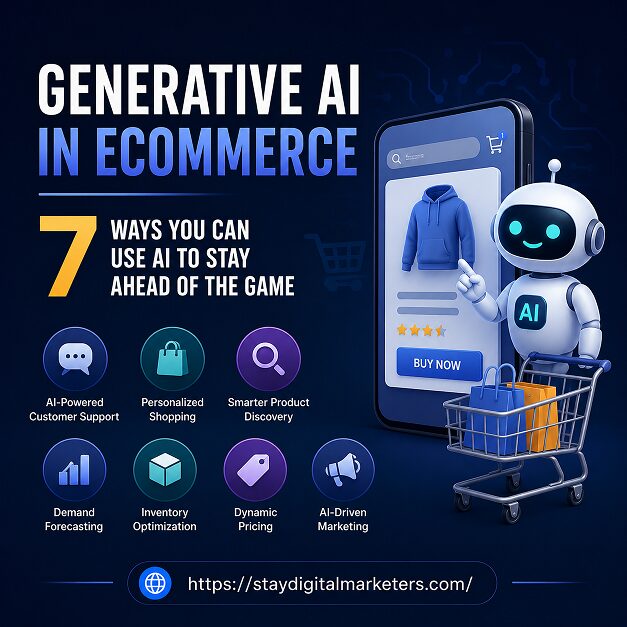
These use cases show how eCommerce businesses can use the technology to operate more efficiently, cut costs, increase sales, and provide satisfying shopping experiences.
Chatbots powered by LLMs can now manage various customer queries like shipping updates, product sizing, etc. They make customer support easier and faster.
These AI systems keep learning from every interaction to become more accurate over time. eCommerce brands that use generative AI can provide 24/7 support to customers with a human-like feel. The workload on support teams reduces and customer satisfaction boosts. It is a recommended approach to integrate chatbots into product pages to decrease return rates. This way, customers can get instant answers before buying.
A key challenge for eCommerce brands is to create high-quality content for all the SKUs they handle. Fortunately, generative AI tools can automate this process as they help produce product descriptions, bullet points, and titles that are brand-consistent and SEO-optimized.
AI content tools can quickly turn customer reviews, product specifications, and competitor listings into clear product descriptions (in bulk). This way, listing stays consistent and fresh, and teams can focus on other critical tasks.
Many retailers that use generative AI for content creation found a significant boost in search visibility and inventory updates. Hence, workload on human teams reduces.
Generative AI makes shopping experiences more personal. It helps eCommerce brands in product suggestions, building dynamic landing pages, and creating visuals aligned with each shopper’s browsing habits and style preferences.
The tools don’t create generic product suggestions but create personalized banners, homepages, and product displays that match each shopper’s journey. Retailers that use generative AI in their eCommerce businesses see better engagement and conversion rates. The reason is customers feel noticed and understood.
The technology enables brands to quickly come up with new ideas and thus improve the product design process. Fashion and retail brands now need not rely only on traditional design cycles. They can use these AI models to create many variations of accessories, garments, etc. in minutes. As a result, they significantly reduce the time between concept and testing.
For example, generative design platforms let design teams quickly transform mood boards or sketches into brand-ready outputs. Design iterations thus become faster and product launches speed up. So, apart from backend automation, generative AI proves to be very useful for product designs and launches.
The key objective of eCommerce business is to understand customers’ needs. Generative AI assists these brands spot trends early by evaluating huge datasets from search engines, social media, influencer activity, and purchase history. They help identify emerging patterns.
AI-powered forecasting tools help brands plan collections based on predictive data instead of reacting later. Let’s take an example to understand well. Suppose AI detects a growing interest in a particular color palette then brands can accordingly adjust design plans or inventory. This approach helps brands fulfill customer demands more effectively and reduce overproductions.
Apart from brands, generative AI is also helpful to customers in discovering products online. Visual search tools allow customers to upload a screenshot/photo and instantly get similar product suggestions (produced via AI algorithms).
This removes the need for accurate keywords and shopping becomes more natural. The use of generative AI connects inspiration to purchase so that the shopping experiences turn smoother.
Creating and testing ads is important for any eCommerce brands because it helps them find out what works the best. Marketing teams can now use generative AI to quickly create and test ads, email campaigns, and landing pages. These tools create images, layouts, and copy, and then test them immediately with different audience groups. In this way, brands can easily find which ads perform well and accordingly spend their budget wisely to get faster results.
It adopts a data-driven approach to speed up iterations and improve campaign targeting. The output data from these tools can guide decisions to boost ROI.

To get the best possible results from the generative AI, eCommerce businesses can try out these tips:
Start with tasks like automating product content creation, providing personalized recommendations, and customer support. All these aspects directly affect customer satisfaction and sales. AI-generated product descriptions can reduce the time for content creation and also boost SEO rankings.
It is not a wise approach to implement AI changes across your whole store instantly. As an alternative, execute small A/B tests using ad creative, AI-generated product descriptions, or landing pages. Next steps include measuring conversion rates, customer feedback, and click-throughs. Subsequently, work on scaling the business. This approach cuts down risks and keeps AI output aligned with brand goals.
Although generative AI can quickly produce content, it should showcase your brand identity. To keep brand voice consistent, provide AI tools with inputs like tone preferences, brand guidelines, and target keywords. For example, Shopify merchants use Jasper to quickly produce content within their workflows and not compromise on brand voice.
It is essential to track outcomes beyond technical performance. Keep an eye on metrics like repeat purchase rates, average order value, and customer lifetime value. The investment in generative AI must drive revenue growth, not just efficiency gains. This means retailers must see improvements in profitability and sales, together with faster processes.
Generative AI is not only for automation but for predictive analytics too. Use it to track social media trends, customer reviews, and search data. This assessment can help forecast demand based on which your businesses can avoid over-production, manage inventory as per customer needs, and also spot evolving trends before competitors.
Traditional methods can’t match the capabilities that generative AI possesses. In the eCommerce business, aspects like in-depth customer insights, faster product development, cost-effectiveness, personalized experiences, etc. are important. Generative AI can help benefit eCommerce businesses with all these aspects. A trusted Generative AI Development Company can help businesses integrate innovative AI solutions that streamline operations and create more personalized shopping experiences. With the continued rise in customer expectations, adopting this technology is important to stay innovative. The technology not only enhances online retail, but redefines the way businesses compete, operate, and connect with customers.

Filza Taj is an MPhil in Human Resources-turned SEO Specialist, Content Strategist, and Digital Marketing Consultant with over 5 years of experience helping businesses in 30+ countries grow online. As the Founder of Stay Digital Marketers (staydigitalmarketers.com), she delivers results-driven solutions in link building, guest posting, PR distribution, niche edits, multilingual backlinks, and content marketing. She publishes daily SEO insights and actionable strategies to help brands strengthen their online presence, attract the right audience, and convert clicks into loyal customers.
Filza@staydigitalmarketers.com
Stay Digital Marketers
Need SEO, Link Building or Digital Marketing Services?
Request a Free Audit →