
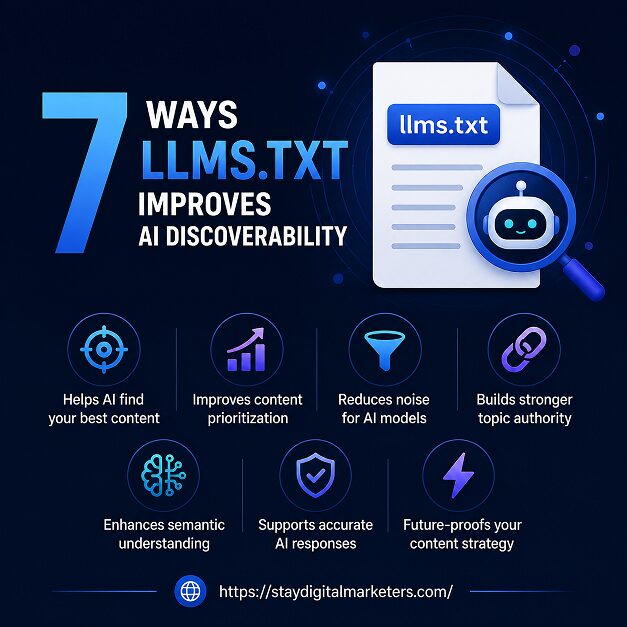
llms.txt is a plain Markdown file placed at the root of a website, first proposed by Jeremy Howard of Answer.AI in September 2024. It lists a site’s most important pages in a clean, structured format so that AI systems can scan a site’s content map without wading through navigation menus, JavaScript, or ad markup. The idea sits next to robots.txt and sitemap.xml, but it solves a different problem. Where robots.txt controls crawler access and sitemap.xml lists every URL, llms.txt is closer to a curated table of contents written specifically for machine readers.
The interest in it comes from a real shift in behavior. A growing share of search now happens inside ChatGPT, Perplexity, and Claude rather than a traditional search box, and site owners want a way to influence how those systems read their content. llms.txt promises a foothold in that shift. Whether it delivers on that promise, and in what form, is the part worth examining closely before treating it as a ranking lever.
Key Takeaways
The short, direct answer is that llms.txt improves how efficiently AI systems can locate and parse a site’s key pages, but there is no confirmed evidence that it improves citation frequency or search rankings on its own. Those are two different claims, and conflating them is where most of the confusion around this file comes from.
Discoverability describes whether an AI agent can find and correctly interpret a page at all. Ranking and citation impact describe whether that agent chooses to reference the page in an answer. llms.txt addresses the first problem. It gives AI crawlers a shortcut past cluttered HTML and unclear internal linking. It does nothing to make thin or low-authority content more citation-worthy once it has been found. Treating the file as a visibility hack rather than a retrieval aid is the single most common misunderstanding site owners run into.
Once the distinction above is clear, the practical value becomes easier to evaluate. Here are seven specific ways the file changes how AI systems interact with a site.
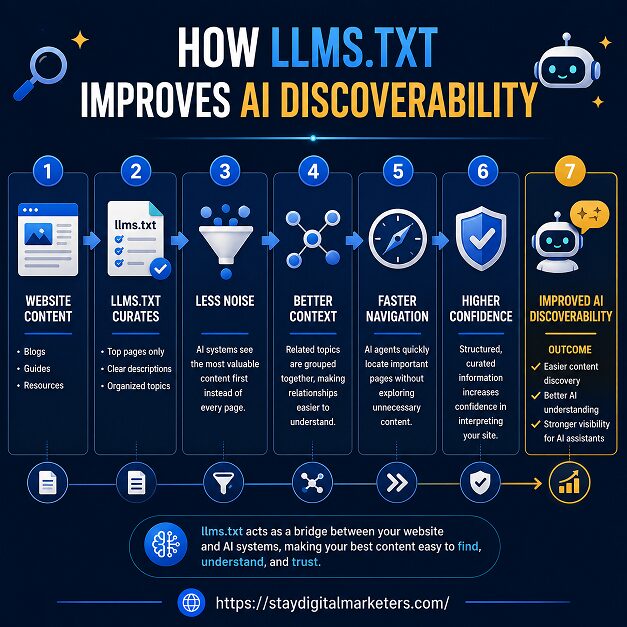
AI systems process content in tokens, and every script tag, ad slot, and layout element a crawler has to parse costs tokens without adding meaning. A clean llms.txt file strips that overhead down to page titles, short descriptions, and direct links, so an AI agent spends its context budget on actual content instead of markup.
The clearest working use case right now is developer documentation. Coding assistants that need to reference an API or SDK benefit from a single Markdown file instead of scraping rendered HTML across dozens of pages. Documentation platforms have already built this in as a default, which signals where the format’s real utility currently sits.
Sites that render content client-side create a real problem for AI retrieval: the crawler has to execute scripts before any text becomes visible. llms.txt sidesteps that entirely by pointing straight to a Markdown or plain-text version of the page, removing a step that otherwise slows or blocks machine reading.
A sitemap lists everything. An llms.txt file is supposed to list only what matters. That curation is itself a signal, telling an AI system which pages the site owner considers central to understanding the brand, rather than leaving the agent to guess from link structure alone.
llms.txt does not manage crawler permissions, so it needs to be paired with a correctly configured robots.txt that explicitly allows the AI crawlers a site wants to welcome. Used together, robots.txt grants access and llms.txt tells the crawler what to prioritize once it is inside.
Search is moving from users typing queries toward agents completing tasks on a user’s behalf, comparing options and retrieving structured data in real time. A well-maintained llms.txt is low-effort scaffolding for that shift, even though the tools that will lean on it most heavily are still maturing.
Large sites with thousands of pages give a sitemap plenty to work with but can overwhelm an AI agent trying to identify what actually matters. llms.txt acts as a curated fallback, narrowing thousands of URLs down to the handful an agent should read first.
Not automatically, and the answer depends heavily on what kind of site is asking the question.
Documentation-heavy SaaS products, API providers, and sites whose primary audience is developers building agents or scripts get the clearest return. Implementation typically takes well under an hour, and platforms like Yoast SEO and Rank Math can generate the file automatically inside WordPress.
For a small local business or a brochure site with a handful of pages, the file adds little beyond what a clean sitemap and solid on-page structure already provide. The fundamentals, clear writing, accurate information, and machine-readable formatting, do more work than the file itself and should come first.
Before publishing an llms.txt file, run it against three layers. Call it the Discoverability Readiness Check.
Layer one, access. Confirm robots.txt explicitly allows the AI crawlers relevant to your audience, since llms.txt cannot override a blocked crawler.
Layer two, curation. List only pages that genuinely represent the site’s core content and value, not a full site export. A file that mirrors the sitemap defeats its own purpose.
Layer three, maintenance. Treat the file as a living document tied to publishing workflow, not a one-time export. A stale file pointing to removed or outdated pages is worse than no file at all, because it actively misleads the systems reading it.
A site that fails layer one gains nothing from the file regardless of how well layers two and three are executed, which is why access has to be checked first.
Adoption is real but still small, and it varies a lot depending on which slice of the web gets measured. Independent tracking studies from Originality.ai, Ahrefs, and HTTP Archive give the clearest picture available.
| Source | Adoption finding |
| Originality.ai (3M+ sites tracked) | 4,088 llms.txt files in June 2025 to 36,120 by May 2026 — an 8.8x increase in twelve months |
| HTTP Archive (top 10,000 domains) | 1.04% adoption in July 2025 to 5.61% in June 2026 |
| Ahrefs (137,000 sites analyzed) | About 97% of existing llms.txt files receive zero requests from AI crawlers |
| Web Almanac | Close to 40% of existing llms.txt files are auto-generated plugin stubs, not curated content |
| Tranco top 1,000 tracker | 8.7% adoption as of June 2026 (15.8% among reachable roots) |
Practitioners doing hands-on documentation audits across client sites have repeatedly run into the same pattern: a file gets installed once, during a redesign or a platform migration, and is never touched again as pages are added or retired, which is exactly the maintenance gap layer three above is meant to catch.
The most frequent error is copying the full sitemap into the file instead of curating it, which erases the one advantage the format has over a standard XML sitemap. The second is publishing the file once and never updating it as the site changes. The third is treating the file as a ranking tool and expecting a rankings or traffic lift, then abandoning the effort when none appears. The fourth is skipping robots.txt configuration entirely, so the file sits unread because the crawlers it targets were never granted access in the first place.
No. There is no confirmed evidence that llms.txt affects Google’s organic ranking systems, and Google has not committed to reading it. Its value is in helping AI systems parse and retrieve content efficiently once they arrive, not in influencing traditional search visibility. Treat it as a retrieval aid, not an SEO ranking factor.
llms.txt is a short index pointing to a site’s key pages. llms-full.txt contains the site’s full content in one Markdown document for deeper AI ingestion. Most sites only need the short version. Documentation-heavy platforms with large SDK or API references tend to benefit from maintaining both formats together.
Adoption of the file is far ahead of confirmed usage. Major AI companies have not publicly committed to reading llms.txt in production search or citation systems, though several publish the file for their own developer documentation. Some AI coding tools do reference it when retrieving docs, which remains the strongest verified use case.
Implementation typically takes under thirty minutes for most sites. WordPress users running Yoast SEO or Rank Math can generate the file automatically from existing settings. The larger time investment is deciding which pages genuinely belong in a curated list rather than exporting the entire site.
For most small sites with limited page counts, the return is marginal compared to strengthening on-page structure and clear writing first. The file becomes more valuable as site size and documentation depth grow, particularly for SaaS products and developer-facing platforms.
Estimates vary by dataset. Tracking of the Tranco top 1,000 domains put adoption at 8.7 percent as of June 2026. A broader HTTP Archive study of the top 10,000 domains measured 5.61 percent the same month, up from 1.04 percent a year earlier.
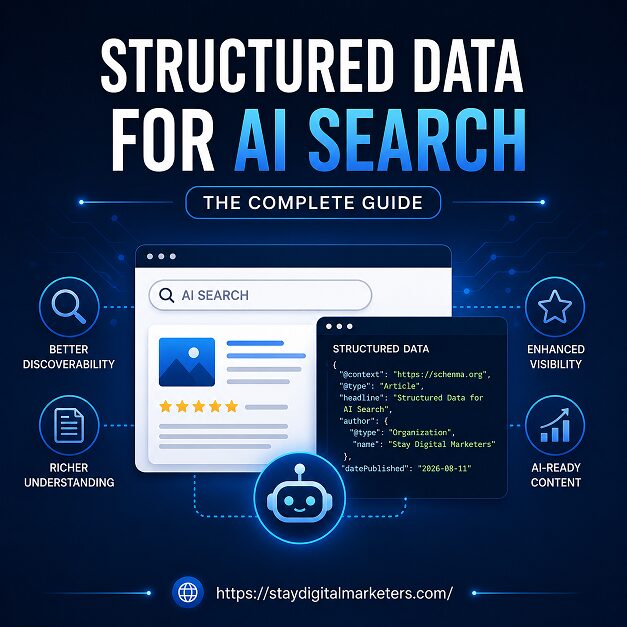
llms.txt is one layer in a wider approach to AI search visibility, not a complete strategy on its own. It sits alongside clean technical access through robots.txt, structured data, entity consistency across the web, and content written to answer questions directly and early. Sites that treat it as scaffolding for the agentic web, rather than a shortcut around the harder work of building genuinely useful, well-structured content, are the ones positioned to benefit as AI retrieval systems mature. Agencies working on backlink and content visibility strategy, including Stay Digital Marketers, generally treat llms.txt the same way: worth the thirty minutes for the right kind of site, and never a substitute for the fundamentals that make content worth citing in the first place.

Filza Taj is an MPhil in Human Resources-turned SEO Specialist, Content Strategist, and Digital Marketing Consultant with over 5 years of experience helping businesses in 30+ countries grow online. As the Founder of Stay Digital Marketers (staydigitalmarketers.com), she delivers results-driven solutions in link building, guest posting, PR distribution, niche edits, multilingual backlinks, and content marketing. She publishes daily SEO insights and actionable strategies to help brands strengthen their online presence, attract the right audience, and convert clicks into loyal customers.
Filza@staydigitalmarketers.com
Stay Digital Marketers
Need SEO, Link Building or Digital Marketing Services?
Request a Free Audit →