
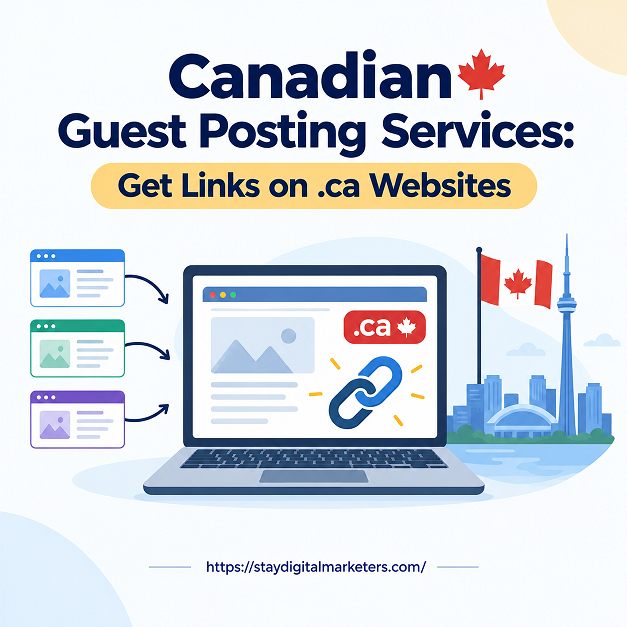
Canadian guest posting services place articles with links on Canadian websites, ideally .ca domains with real Canadian readers. Quality depends on verifying the publisher, labelling sponsored content, following CASL when emailing editors, and avoiding bulk packages that promise metrics. Check each placement before you pay.
A guest post is an article you write, or pay someone to write, for another publisher’s site. The article includes a link to your business. Canadian guest posting services focus on publishers that reach readers in Canada, from regional news sites in Ontario and British Columbia to niche blogs for Canadian industries.
The related terms are backlinks, anchor text, sponsored content, outreach, editorial standards, and domain metrics. Providers range from agencies to freelancers on marketplaces, and their methods differ more than their sales pages suggest.
Key Takeaways
.ca is Canada’s country domain, managed by CIRA. CIRA restricts registration to eligible persons, such as Canadian citizens, permanent residents, Canadian corporations, universities, hospitals, and holders of a Canadian trademark. An individual must also live in Canada for more than 183 days in the 12 months before applying.
That makes a genuine .ca domain a reasonable clue that a Canadian person or organization is behind it. It is not proof of editorial quality, and no source reviewed shows that Google rewards the .ca ending itself. The value of a .ca link is audience: Canadian readers who may become Canadian customers.
I reviewed a ranking guide titled “Canadian Guest Posting Services,” the Seeders and AWISEE Canada pages, and a marketplace listing for “Canadian guest posts.” Four gaps stood out.
That is the opening this guide covers: how to verify a .ca claim, how to question an expired-domain method, and how CASL and labelling apply.
The Four-Test .ca Placement Check is a short review you run on any Canadian guest post before approving it. A placement should pass all four.
Read the full domain, not the sales copy. The listing above is a reminder: two of the five newspapers it named end in .com. Ask the provider for the exact URL of the publisher before you pay.
Look for Canadian topics, authors, cities, and advertisers. A .ca domain full of unrelated articles written for another country fails this test.
Check that the site publishes original articles with named authors, has an editor, and rejects some pitches. At Stay Digital Marketers, we often see buyers check the domain ending and a metric, then stop. Sites that exist mainly to sell links tend to publish unrelated topics side by side.
Google’s spam policies call buying or selling links for ranking purposes link spam, and accept paid links that are qualified with a nofollow or sponsored value. A Search Engine Land report on Google’s link scheme guidance also lists large-scale guest posting campaigns with keyword-rich anchor text and advertorials that pass PageRank. Check Google’s current wording before you buy at scale.
Run the four tests in order. A placement that fails the first one rarely deserves the time needed for the others, and a placement that fails the fourth can usually be fixed by changing the link attribute or the disclosure rather than dropping the site.
Keep a short record for each approved placement: the publisher URL, the date, the anchor text, the link attribute, and the person who approved it. That record makes quarterly reviews quick, and it gives you evidence if a provider’s claims later turn out to be wrong.

The table matches claims seen in the pages above with the question to ask.
| Claim seen | Question to ask | Why it matters | Source of claim |
| “Zero risk” of penalties | What evidence supports this? | No provider can promise how Google treats links | AWISEE Canada page |
| “DA90+” and “DR 85-100” together | Which tool, and on what date? | Metrics belong to vendors and differ | Marketplace listing |
| “Authoritative .CA sources” listing .com names | Which exact URL will host my post? | A .ca claim should match the domain | Marketplace listing |
| Expired domain with transferred “link juice” | Is a live publication hosting the article? | Google lists expired domain abuse as spam | Marketplace listing |
| No price shown | What is the CAD total with GST or HST? | Quotes are hard to compare | Seeders, AWISEE |
On the expired-domain method: Bluetone Media reports that Google’s March 2024 spam update added a policy against buying expired domains and repurposing them to boost rankings. Whether a given purchase violates the policy depends on how the domain is used, so ask providers to explain theirs.
Three providers are listed below. The criteria: whether the company serves Canadian clients, whether guest posting is a stated service, whether language options are mentioned, and whether prices or compliance details are published. Stay Digital Marketers publishes this guide and appears first because of that, not because it ranks highest.
Stay Digital Marketers is a white-label SEO and link building agency registered in Mississauga, Ontario. Its services include guest posting, niche edits, multilingual link building, SaaS link building, and press release distribution, alongside Wikipedia page and Google Knowledge Panel creation. It suits agencies and businesses that want link building delivered under their own brand. Prices are not published on this page, so request a quote.

AWISEE runs a Canada link building page that lists guest posts as a service, aimed at topically relevant links from high-authority sites. It says posts can be written in Canadian French and English by native speakers and describes itself as a white-label provider. No prices or CASL details appear on the page, and its “zero risk” wording deserves a direct question about how risk is managed.

Seeders is a Netherlands-based agency with a dedicated Canada link building page. Guest posting is one of its listed activities, covering informational and promotional posts on niche-relevant sites. It says local sites are researched before outreach. Prices are not published and the page does not mention .ca domains or CASL, so ask both questions before you commit.

Whichever provider you consider, run the Four-Test .ca Placement Check on the first sample placement before agreeing to a larger order.
No verified CAD price list exists in the pages reviewed. The marketplace listing shows US$40 for a single link, with an hourly option of US$25. The Canadian agency pages publish no prices at all.
Ask each provider for a written quote in CAD that states the publisher, word count, link attributes, revisions, and whether GST or HST applies. A very low price for a named newspaper should prompt questions about how the placement is obtained.
CASL is Canada’s anti-spam law. Outreach emails sent to editors that promote a business may count as commercial electronic messages. BLG’s commentary on a CRTC decision says senders generally need consent, must include identification information, and must provide an unsubscribe mechanism that is clearly displayed and promptly honoured.
The same commentary states penalties of up to $10 million per violation for an organization and $1 million for an individual. Ask any provider how their outreach meets CASL. This is general information, not legal advice, so check current CRTC guidance or speak to a lawyer.
Practical steps help here. Keep outreach lists to publishers with a clear business reason to hear from you, record how each contact was found, and make sure every message names the sender and offers a simple way to opt out. Agencies that send outreach for a client should confirm in writing who is responsible for consent records.
Often, yes. AWISEE says it writes guest posts in Canadian French and English. A French-language publisher with Quebec readers usually serves a Quebec audience better than a translated English article. Rules about French content can apply to some businesses, so check current requirements for your sector.
Canadian guest posting services write and place articles on Canadian websites, usually with a link back to your site. Quality varies widely. Good providers show the publisher before you pay, label sponsored placements, and write for Canadian readers. Weak ones sell lists of domains and promise metrics they cannot verify.
No source reviewed shows a ranking advantage for a .ca ending. A .ca domain can signal a Canadian audience, since CIRA limits registration to eligible Canadian persons. Choose placements for audience fit and editorial quality first, and treat the domain ending as a clue rather than proof.
No verified CAD price list exists. One marketplace listing reviewed shows US$40 for a single link, and the Canadian agency pages reviewed publish no prices. Ask for a written CAD quote that states the publisher, article length, link attributes, and whether the price includes writing and revisions.
They carry risk when done at scale for ranking. Google’s link scheme guidance has listed large-scale guest posting campaigns with keyword-rich anchor text, and paid links should carry a sponsored or nofollow value. Relevant, editorial, correctly labelled placements on real publications are far safer than bulk packages.
It may. CASL covers commercial electronic messages, and organizations need consent, sender identification, and a working unsubscribe mechanism. Penalties can reach $10 million per violation for organizations, according to BLG. Confirm the current rules or speak to a lawyer before sending outreach to Canadian publishers.
Yes. At least one Canadian provider reviewed offers guest posts in both Canadian French and Canadian English by native speakers. For Quebec audiences, a French-language publisher is often a better fit than a translated English article. Check current language rules for your sector before publishing.
Choose Canadian guest posting services by what you can verify: the exact .ca publisher, its Canadian readership, editorial standards, correct link labelling, a CAD quote, and CASL-aware outreach. If a provider cannot answer those questions plainly, keep looking.

Filza Taj is an MPhil in Human Resources-turned SEO Specialist, Content Strategist, and Digital Marketing Consultant with over 5 years of experience helping businesses in 30+ countries grow online. As the Founder of Stay Digital Marketers (staydigitalmarketers.com), she delivers results-driven solutions in link building, guest posting, PR distribution, niche edits, multilingual backlinks, and content marketing. She publishes daily SEO insights and actionable strategies to help brands strengthen their online presence, attract the right audience, and convert clicks into loyal customers.
Filza@staydigitalmarketers.com
Stay Digital Marketers
Need SEO, Link Building or Digital Marketing Services?
Request a Free Audit →