

In today’s fast-moving digital world, ads are everywhere—on websites, social media, streaming platforms, and even smart TVs. But have you ever wondered how these ads get there, and why they seem so personalized? The answer often lies in programmatic advertising.
Simply put, programmatic advertising uses artificial intelligence (AI) and real-time bidding (RTB) to buy and sell ad placements automatically. Instead of people negotiating with publishers, machines handle the process in milliseconds.
This blog breaks down programmatic advertising in a simple way, explores how it works, and shares why it’s becoming a must-have strategy for businesses big and small.
Programmatic advertising is the automated buying and selling of digital ad space using software, AI, and data.
Traditional advertising required human negotiations, phone calls, and long contracts between advertisers and publishers. Programmatic eliminates that manual work by letting algorithms handle it instantly.
With programmatic:
It’s like stock trading, but instead of shares, you’re bidding on people’s attention.
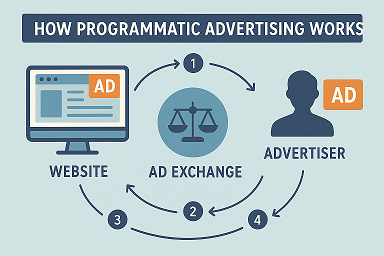
To understand how it really functions, here’s a simple breakdown of the programmatic process:
This all happens in about 100 milliseconds—faster than a blink.
There isn’t just one way to do programmatic. Depending on your goals and budget, you can choose:
Why are marketers shifting toward programmatic? Here are the biggest advantages:
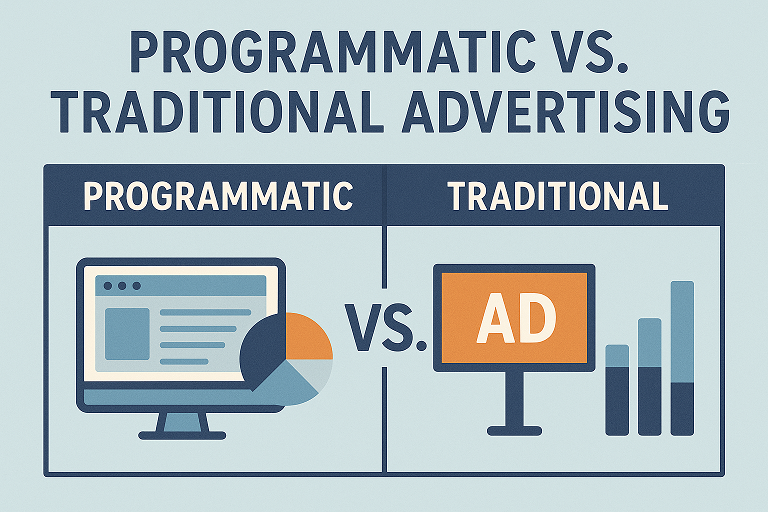
Here’s a quick comparison:
| Feature | Traditional Advertising | Programmatic Advertising |
|---|---|---|
| Buying Method | Manual negotiations, contracts | Automated, real-time bidding |
| Speed | Days to weeks | Milliseconds |
| Targeting | Broad audience, limited data | Hyper-targeted, data-driven |
| Cost Efficiency | Higher risk of wasted spend | Optimized for ROI |
| Scalability | Difficult to expand | Easy to scale globally |
While powerful, programmatic isn’t perfect. Challenges include:
To make programmatic advertising work for your business, follow these steps:
AI is transforming advertising, and programmatic is at the center of it. With Generative AI Overviews (AEO) and Generative Engine Optimization (GEO) shaping how search engines deliver results, programmatic gives businesses a way to place ads in highly relevant, intent-driven contexts.
As consumers demand personalization and instant relevance, programmatic ensures ads reach the right people, at the right time, in the right place.
1. Is programmatic advertising only for big brands?
No. While large companies use it extensively, small businesses can also benefit by running hyper-local or budget-friendly campaigns.
2. What platforms are used for programmatic advertising?
Common platforms include Google Display & Video 360 (DV360), The Trade Desk, MediaMath, and Amazon DSP.
3. How is programmatic different from Google Ads?
Google Ads allows advertisers to bid on keywords or placements directly. Programmatic spans across multiple exchanges and publishers, giving a wider reach.
4. Is programmatic advertising expensive?
It depends on the campaign goals, targeting, and competition. Costs can be controlled with budget caps and bid strategies.
5. Will programmatic replace human marketers?
Not entirely. While automation handles the buying, humans are still needed for strategy, creativity, and optimization.
Final Words: Programmatic advertising is not just a trend—it’s the new standard of digital media buying. Whether you’re a startup or a Fortune 500 brand, understanding how it works can help you spend smarter, target better, and grow faster.

Filza Taj is an MPhil in Human Resources-turned SEO Specialist, Content Strategist, and Digital Marketing Consultant with over 5 years of experience helping businesses in 30+ countries grow online. As the Founder of Stay Digital Marketers (staydigitalmarketers.com), she delivers results-driven solutions in link building, guest posting, PR distribution, niche edits, multilingual backlinks, and content marketing. She publishes daily SEO insights and actionable strategies to help brands strengthen their online presence, attract the right audience, and convert clicks into loyal customers.
Filza@staydigitalmarketers.com
Stay Digital Marketers
Need SEO, Link Building or Digital Marketing Services?
Request a Free Audit →