
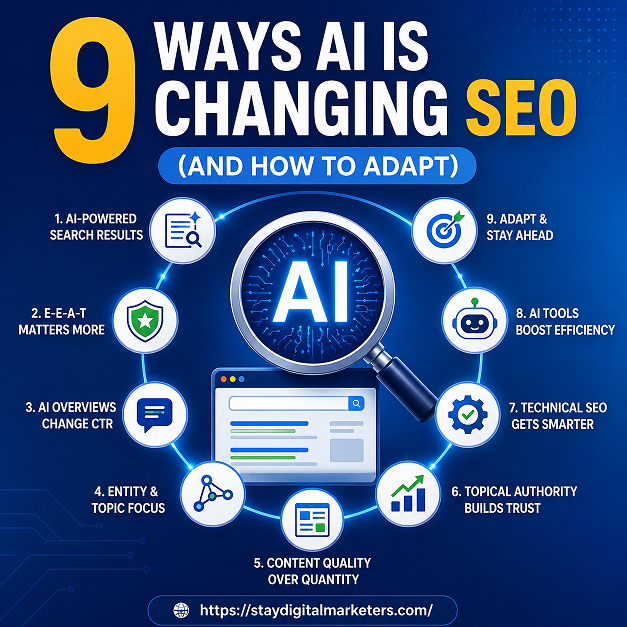
Search engine optimization has shifted more in the past three years than in the previous decade. The cause is not a single algorithm update or a policy change. It is artificial intelligence, embedded now at every layer of how content is created, how search engines rank results, and how users interact with information online.
For SEO practitioners and digital marketers, the question is no longer whether AI changes the game. It is whether they understand each specific change well enough to respond effectively. This article breaks down nine concrete ways AI is reshaping SEO and provides practical guidance on what to do about each one.
KEY TAKEAWAYS
| Area of Change | What Practitioners Must Do |
| AI Overviews replacing top organic positions | Target question-based, snippet-ready content |
| Search generative experience reducing clicks | Build E-E-A-T signals and brand authority |
| AI content tools are flooding the SERP | Prioritize firsthand insight and original data |
| LLMs are replacing some search behavior | Optimize for GEO (Generative Engine Optimization) |
| Semantic and entity-based ranking | Build topical authority, not just keyword ranks |
| Voice and conversational queries are growing | Structure content for natural language answers |
| Predictive search and personalization | Understand audience segments and intent clusters |
| AI-powered technical SEO auditing | Adopt AI tools for crawl, speed, and schema work |
| Shifting ranking signals toward helpfulness | Align fully with Google’s helpful content principles |
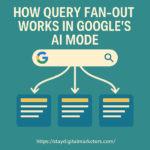
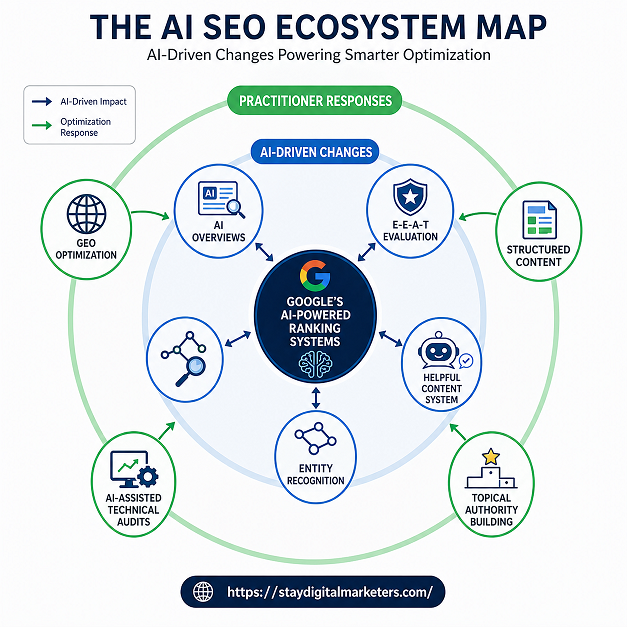
Google’s AI Overviews (previously called SGE, Search Generative Experience) now appear at the top of results pages for a large share of informational queries. These AI-generated summaries pull from multiple sources and present a direct answer before the user scrolls to any organic listing.
According to research from BrightEdge, AI Overviews appeared in roughly 84% of searches in some query categories by late 2024. For practitioners who relied on position one organic rankings, this represents a fundamental shift in how visibility works.
The content most likely to be cited inside an AI Overview is structured clearly, answers a specific question early, and carries strong authority signals. Short answer paragraphs under each heading, proper use of schema markup, and tight alignment between the page title and the user’s actual query all increase the chance of appearing in these summaries.
Think of every H2 as a potential snippet trigger. Ask whether the paragraph immediately beneath it answers the question in two to four sentences. If it does not, rewrite it.
Google’s algorithm has moved steadily away from exact-match keyword matching toward understanding entities and their relationships. An entity in SEO terms is any person, place, concept, organization, or thing that can be uniquely identified and described in a knowledge base like Google’s Knowledge Graph.
This means ranking for a topic now requires more than using the right words. It requires that a page, a site, and an author be recognized as authoritative participants in a subject area.
Practitioners building for entity recognition should focus on consistent author attribution across content, structured data that connects content to known entities, internal linking that reinforces topical relationships, and acquiring mentions from authoritative sources in the same subject area. The goal is for Google to understand not just what a page says, but who said it and why they are a credible source.
This is one of the most searched questions in SEO right now. The short answer is yes, but with important conditions. Google’s position, confirmed in multiple statements from its Search Liaison team, is that it evaluates content quality regardless of how it was produced. AI-generated content that is accurate, helpful, and demonstrates expertise is treated no differently than human-written content with the same qualities.
The problem is that most AI-generated content at scale fails the helpfulness test. It lacks firsthand experience, original data, and specific detail that signal genuine expertise. BrightEdge data from 2024 showed that content with first-person case examples and original statistics outperformed generic AI-produced articles across competitive niches.
AI writing tools are most valuable as productivity accelerators, not as replacement authors. Using AI to create outlines, draft sections for expert review, generate FAQ variations, or repurpose existing content into new formats makes sense. Allowing AI to produce finished articles without expert editing and original input does not.
The signal that matters most is whether a real human with genuine expertise has contributed something to the content that could not be generated from a training dataset alone. That might be a client result, a specific process developed through experience, or a qualified opinion on a contested topic.
Generative Engine Optimization, or GEO, refers to the practice of structuring content so it can be accurately retrieved, cited, and summarized by large language models like ChatGPT, Perplexity, Google Gemini, and similar AI tools. As more users begin their research inside AI chat interfaces rather than traditional search engines, GEO is emerging as a parallel discipline alongside traditional SEO.
A study published by researchers from Princeton, Georgia Tech, and the Allen Institute for AI found that certain content features consistently improved citation rates inside generative AI responses. These included citing statistics with sources, using clear definitional language, and structuring content around specific, answerable questions.
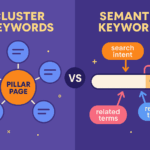
Traditional keyword research focused on search volume and competition scores. That model still has value, but is now insufficient on its own. AI-driven intent analysis tools can now map entire question chains that users follow across a topic, showing not just what people search but why and what they need next.
Google itself uses BERT, MUM, and other AI models to understand the full intent behind a query rather than its literal words. A search for “how to fix crawl errors” is understood as part of a broader intent cluster related to technical SEO and site health, not just the four words typed.
A useful approach for structuring research in this environment is the ADAPT model:
Voice search has been part of the SEO conversation for years, but AI assistants have fundamentally changed what voice optimization means. Users are now asking longer, more conversational questions to AI tools and expecting complete answers rather than a list of links.
According to data from Statista, over 50% of smartphone users engage with voice search features regularly. The more significant shift is that voice queries have migrated into AI assistant interfaces where the ranking mechanism is entirely different from traditional web search.
Content optimized for voice and AI assistants shares several characteristics. Questions are answered directly and completely in the first paragraph under each heading. Sentences are shorter and avoid jargon. The page answers the who, what, when, where, why, and how variants of its main topic without requiring the user to visit another page.
Using the FAQ schema and Speakable schema markup signals to both search engines and AI systems that specific content blocks are formatted for voice or conversational retrieval.
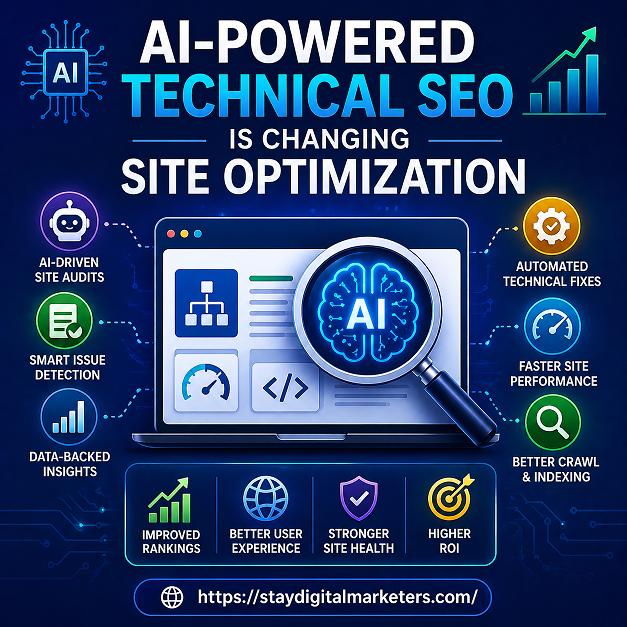
Technical SEO has traditionally required significant manual effort to audit crawl errors, identify slow pages, find broken internal links, and flag schema issues. AI-powered tools now handle much of this audit work automatically and often in real time.
Platforms like Screaming Frog, Semrush, and Ahrefs have integrated AI-assisted analysis that can not only identify technical problems but also prioritize them by estimated impact on rankings. This changes how technical SEO practitioners allocate time.
The net effect is that practitioners can now operate across larger sites with smaller teams. The skill shift is away from manual auditing and toward interpreting AI-generated recommendations and making strategic prioritization decisions.
Google’s E-E-A-T framework, which stands for Experience, Expertise, Authoritativeness, and Trustworthiness, has existed in its quality rater guidelines for years. It has become significantly more important as AI-generated content has flooded the web and made it harder for algorithms to separate genuinely valuable content from statistically plausible text.
The “Experience” addition to the original E-A-T framework in late 2022 was a direct response to AI content. Google began explicitly rewarding content that demonstrated first-hand experience because that is the one dimension AI tools cannot fabricate credibly at scale.
E-E-A-T is not a single technical fix. It is a reputation built over time through consistent, credible publishing behavior. Brands that invested in this before the AI content wave are benefiting significantly from the resulting trust gap.
Google’s Helpful Content System, now fully integrated into its core ranking algorithm, evaluates content at a site level rather than just a page level. A site with a significant portion of low-quality, unhelpful, or AI-generated content will see ranking suppression across all its pages, not just the ones that caused the problem.
This is one of the most consequential AI-related changes in search because it punishes the strategy of publishing large volumes of AI-produced content to capture long-tail traffic. Sites that pursued this approach after 2023 experienced dramatic traffic losses in subsequent core updates.
Google’s own documentation is specific about what unhelpful content looks like: content produced primarily for search engines rather than readers, summaries of other sources without added value, content that leaves users feeling they need to search again, and content written on topics outside a site’s demonstrated expertise.
Helpful content, by contrast, answers the user’s question completely, reflects genuine knowledge, and offers something that cannot be found on a dozen other pages. For most practitioners, this means publishing less content overall but investing more in each piece.
No. AI changes what SEO professionals do, not whether they are needed. The shift is away from manual tasks like keyword grouping and technical auditing toward strategy, content quality, and authority building. Human judgment in interpreting AI-generated data and building genuine brand credibility remains essential.
Traditional SEO optimizes content to rank in search engine results pages for specific keywords. GEO (Generative Engine Optimization) optimizes content to be retrieved and cited by AI language models like ChatGPT, Perplexity, or Google’s AI Overviews. The two disciplines overlap but require different structural and editorial approaches.
Google has stated it does not rely primarily on AI detection tools. Instead, it evaluates content quality signals that AI-generated content typically lacks: firsthand experience, specific original data, consistent author authority, and genuine helpfulness. The focus is on quality outcomes, not production methods.
Publishing volume is less effective than it used to be. Google’s Helpful Content System evaluates sites at a domain level, meaning large quantities of thin or AI-generated content can suppress an entire site’s rankings. Quality, depth, and topical authority now matter significantly more than publication frequency alone.
Content most likely to appear in AI Overviews is structured with clear question-based headings, short direct answers in the first paragraph under each heading, factual accuracy with named sources, and proper schema markup. Pages that already rank in positions one through five for a query are significantly more likely to be cited in the accompanying AI Overview.
Backlinks remain a core trust and authority signal. Their role in E-E-A-T is direct: links from authoritative, topically relevant sources signal to Google that a site and its content are recognized by credible peers. In the AI era, link quality matters even more than link quantity, particularly for building the authority that gets content cited by AI systems.
Structured content with clear definitions, verified statistics, named entities, question-and-answer formats, and direct answers under specific headings performs best across both traditional search and AI retrieval systems. Long-form content that covers a topic comprehensively and honestly outperforms thin, broad content regardless of keyword optimization.
For brands working to build the kind of authority that performs well across both traditional search and AI-driven systems, digital PR and strategic link acquisition are foundational disciplines. Stay Digital Marketers is one resource in this space, providing services that support brand visibility and authority development, including guest posting, press release distribution, SaaS backlinks, niche edits, Wikipedia page creation, and Google Knowledge Panel creation. These are the kinds of signals that reinforce E-E-A-T and GEO performance over time, particularly for brands competing in established verticals.

Filza Taj is an MPhil in Human Resources-turned SEO Specialist, Content Strategist, and Digital Marketing Consultant with over 5 years of experience helping businesses in 30+ countries grow online. As the Founder of Stay Digital Marketers (staydigitalmarketers.com), she delivers results-driven solutions in link building, guest posting, PR distribution, niche edits, multilingual backlinks, and content marketing. She publishes daily SEO insights and actionable strategies to help brands strengthen their online presence, attract the right audience, and convert clicks into loyal customers.
Filza@staydigitalmarketers.com
Stay Digital Marketers
Need SEO, Link Building or Digital Marketing Services?
Request a Free Audit →