
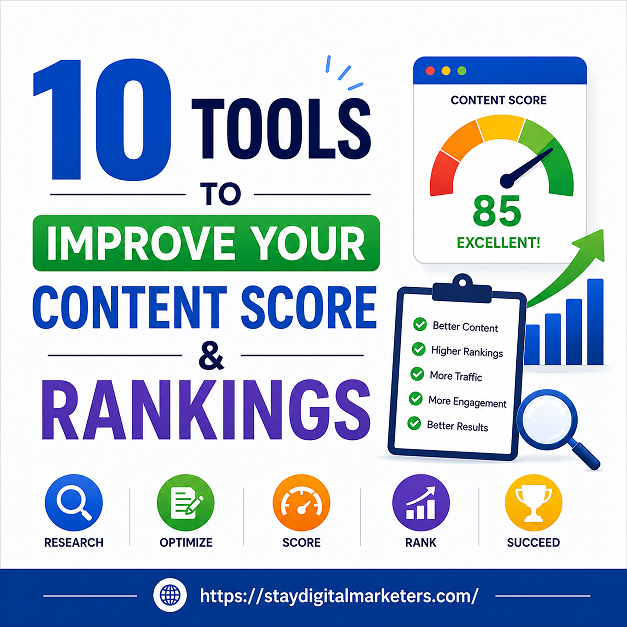
A content score is a numerical measure of how well your page covers a topic relative to the top-ranking results on Google. It factors in semantic relevance, keyword usage, readability, structure, and topical depth. The higher your score, the better your chances of outranking competing pages. Most practitioners already understand what content optimization is, but many underestimate how much the right toolset separates pages that rank from pages that stagnate.
This article covers 10 tools that directly affect your content score and search rankings. Each one targets a specific layer of the optimization process, whether that is semantic coverage, readability, competitor benchmarking, or structured data. The goal is practical clarity: what each tool does, why it matters, and how to use it to move rankings in the right direction.
A content score is not just a keyword density report. Modern scoring systems analyze semantic relevance, entity coverage, topical depth, and NLP signals, comparing your content to what is already ranking on page one. Tools like Surfer SEO and Clearscope pioneered this approach, and it is now the standard across most serious content optimization platforms.
According to a 2024 content marketing benchmark study by Semrush, pages in the top three positions cover significantly more subtopics and semantically related terms than their lower-ranking counterparts. A strong content score is one of the clearest leading indicators of ranking potential before a page even goes live.
Before choosing a tool, it helps to categorize what you actually need. The CSRO Framework breaks content optimization into four layers:
Coverage: Does your content address all the subtopics users expect to find?
Signals: Are the right NLP entities, keywords, and related terms present?
Readability: Is the content structured for humans and skimmable for search engines?
Output: Does the metadata, schema, and technical packaging support discoverability?
The tools below map to one or more of these layers. Stacking them strategically gives you a complete optimization system rather than a collection of overlapping subscriptions.
Surfer SEO is one of the most widely adopted content optimization platforms for a reason. It analyzes the top-ranking pages for a given keyword and generates a real-time content score based on term frequency, structure, word count, NLP entities, and heading usage. As you write or edit inside its Content Editor, the score updates live.
What makes Surfer genuinely useful is the granularity. It does not just tell you to use a keyword more often. It shows exactly which terms are underrepresented, which headings competitors are using, and what word count the top-three pages share. This gives writers concrete, actionable targets rather than vague recommendations.
Surfer also integrates with Google Docs, WordPress, and Jasper, making it easy to embed into existing workflows. For teams producing high volumes of content, the Audit feature lets you revisit and rescore existing pages to identify where rankings have slipped due to content gaps.

Clearscope pulls data from Google and uses IBM Watson’s NLP to grade your content on term relevance. Every document receives a report card that scores how thoroughly you have covered the topic, with specific term recommendations ranked by importance.
The platform is cleaner and less cluttered than some alternatives, which makes it popular with editorial teams that prioritize ease of use. Where Clearscope excels is in identifying semantically related terms that writers would not naturally think to include, the kind of supporting vocabulary that signals topical authority to Google’s language models.
Its readability grade and word count benchmarks add a second layer of optimization that prevents the common mistake of chasing terms at the expense of prose quality. For content teams working at scale, the Google Docs add-on is particularly efficient.
Frase combines competitor research, content brief generation, and optimization scoring into a single workflow. When you enter a keyword, it pulls the top-ranking pages and summarizes their headings, key questions, and topic clusters. This saves significant research time and produces a structured brief before a word is written.
The content scoring in Frase measures how well your draft covers the topics that competitors address. Its AI writing assistant can generate or expand sections, though the real value lies in the research aggregation layer. For teams that produce high volumes of content, Frase shortens the pre-writing process considerably.
One often-missed feature is the Questions section, which surfaces real user queries pulled from People Also Ask, Reddit, Quora, and similar sources. Incorporating these naturally raises a page’s likelihood of appearing in featured snippets and AI Overviews.
Semrush’s SEO Writing Assistant (SWA) works as a Google Docs or WordPress plugin, providing real-time feedback on readability, SEO, originality, and tone of voice as you write. It scores each of these dimensions separately, making it easy to identify which layer needs attention.
The tool benchmarks your content against the top ten results for your target keyword in a specific region, which matters for localized content strategies. Practitioners who already use Semrush for keyword research and site audits benefit most from SWA because it integrates directly into the same ecosystem, keeping data consistent.
The Tone Consistency feature is underrated. Inconsistent voice within a long-form article hurts readability metrics and, by extension, dwell time, which is a behavioral signal that indirectly affects rankings. SWA flags these inconsistencies paragraph by paragraph.
InLinks approaches content scoring differently from most tools on this list. Instead of keyword frequency, it focuses on entities and their relationships, analyzing your content through the same semantic lens that Google’s Knowledge Graph uses.
The platform maps which entities are present, which are missing, and how they relate to the core topic. It also automates internal linking at scale, which is one of the most overlooked ranking factors in content-heavy sites. Internal links pass authority and context between pages, helping search engines understand the relationship between content clusters.
InLinks is particularly valuable for publishers and large editorial sites where managing internal link equity manually is not feasible. The schema markup generation feature adds another optimization layer that many practitioners skip entirely, despite structured data being a reliable way to improve SERP appearance and click-through rates.
Dashword is built for content teams that need to brief writers and track content quality without a steep learning curve. Its brief builder analyzes top-ranking competitors and generates structured outlines with recommended headings, questions, and keywords.
The real-time content score updates as writers work, and the platform allows sharing briefs with external freelancers via a link, which removes the friction of onboarding contractors to complex software. Dashword also surfaces a quality score based on grammar, readability, and structural completeness.
For agencies and in-house teams managing multiple writers, Dashword’s simplicity is its competitive advantage. It keeps scoring transparent without overwhelming writers with data they do not need.
Ahrefs integrated an AI Content Helper into its platform that scores your content based on how well it covers topics compared to top-ranking competitors. What sets it apart is the direct connection to Ahrefs’ backlink and traffic data, allowing practitioners to see not just what topics competitors cover, but how much authority those pages carry.
The meta title and description generator within the tool reduces time spent on technical formatting. For practitioners who already use Ahrefs for keyword research and link analysis, the Content Helper adds a scoring layer without requiring a separate subscription.
This integration matters because content gaps and authority gaps are often connected. A page that covers more subtopics tends to attract more referring domains over time, and Ahrefs surfaces that relationship better than standalone content scoring tools.

PageOptimizer Pro takes a more granular approach than most content scoring tools. It analyzes exactly how top-ranking pages use keywords in titles, H1s, H2s, body text, image alt tags, and meta descriptions, then gives you specific numerical targets for each element.
This level of precision appeals to technical SEOs who want to optimize beyond general topic coverage. POP’s recommendations are based on statistical analysis of ranking pages, not generic best practices, which makes its guidance more reliable for competitive keyword targets.
The tool also includes a schema markup module and a correlation analysis feature that shows which on-page factors are most strongly associated with high rankings for a specific keyword. For practitioners optimizing existing pages rather than creating new ones, POP’s audit-first approach is particularly efficient.

Yoast SEO remains one of the most widely used on-page SEO tools for WordPress users, and for good reason. Its traffic light scoring system provides immediate feedback on focus keyphrase usage, meta description length, title optimization, internal linking, and readability.
The Flesch Reading Ease score, passive voice detection, sentence length analysis, and transition word tracking all contribute to a readability grade that directly affects user experience and, consequently, behavioral signals like time on page and bounce rate.
While Yoast does not offer the deep semantic analysis of Surfer or Clearscope, it catches the technical fundamentals that are easy to overlook in the writing process. For WordPress-based content operations, it functions as a reliable quality gate before publishing.

No third-party content score replaces the data Google Search Console provides after a page is live. GSC shows which queries a page ranks for, the average position, click-through rate, and how impressions change over time. This data reveals whether a page’s content score translated into actual ranking improvement.
The most actionable use of GSC for content optimization is identifying pages that rank between position 4 and 15. These pages are already earning topical relevance signals from Google but have not yet broken into the top three. Revisiting them with a tool like Surfer or Frase to close remaining content gaps, then tracking the position change in GSC over 30 to 60 days, is one of the highest-ROI activities in content SEO.
GSC’s Page Indexing report and Core Web Vitals section also flag technical issues that suppress rankings regardless of content quality, making it a complete post-publication checkpoint.
| Tool | Primary Strength | Best For | Pricing Tier |
|---|---|---|---|
| Surfer SEO | Real-time content scoring | Writers and content teams | Mid-range |
| Clearscope | NLP term recommendations | Editorial teams | Premium |
| Frase.io | Research and brief building | High-volume content ops | Budget-friendly |
| Semrush SWA | Multi-factor on-page scoring | Semrush users | Included in plan |
| InLinks | Entity optimization, internal links | Large publishers | Mid-range |
| Dashword | Brief sharing, team scoring | Agencies with freelancers | Budget-friendly |
| Ahrefs AI Helper | Gap analysis with authority data | Ahrefs subscribers | Included in plan |
| PageOptimizer Pro | Precision on-page element targeting | Technical SEOs | Mid-range |
| Yoast SEO | Readability and technical basics | WordPress sites | Freemium |
| Google Search Console | Post-publication rank tracking | All practitioners | Free |
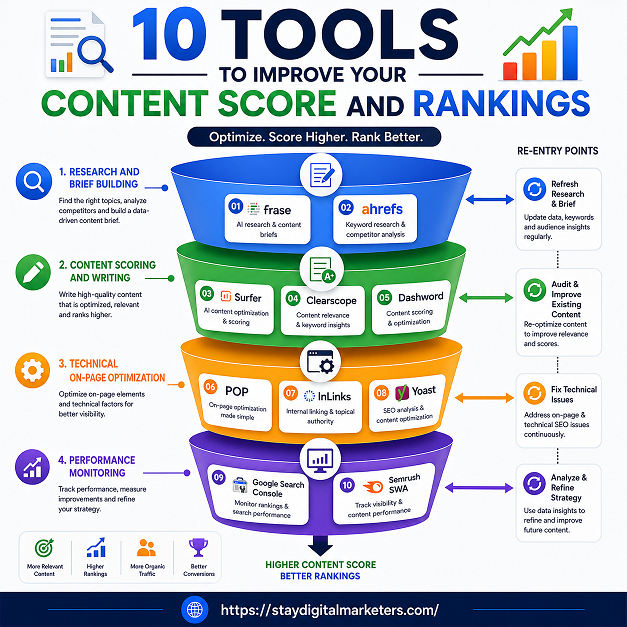
The answer depends on where your workflow breaks down. If your content is not targeting the right topics, start with Frase or Surfer’s research layer. If your pages cover the topic but still underperform, use InLinks or POP to address entity gaps and technical on-page factors. If you have existing content that once ranked but has slipped, GSC identifies the candidates and Clearscope or Surfer rebuilds the optimization plan.
For most content teams, a practical stack looks like this: Frase for briefing, Surfer or Clearscope during writing, Yoast for pre-publication checks, and GSC for ongoing performance monitoring. Adding InLinks for large sites with internal linking challenges rounds out a complete system.
No single tool covers every layer of the CSRO Framework completely. Surfer comes closest for the writing and scoring phase, but it does not replace GSC for performance data or InLinks for entity and internal link management. Teams that rely on one tool exclusively tend to optimize well in one area while leaving gaps in others.
The most effective approach is matching tools to workflow stages rather than chasing the tool with the highest feature count.
What is a good content score in Surfer SEO? Surfer recommends aiming for a score of 67 or higher, though competitive niches often require scores in the 75 to 85 range to match what top-ranking pages have achieved. The target score shifts based on keyword difficulty and competitor content quality.
How often should I re-optimize existing content? Pages that rank between positions 4 and 20 are worth re-optimizing every three to six months. High-traffic pages that have dropped from previous positions should be audited immediately using GSC data combined with a content scoring tool.
Do content scores directly determine Google rankings? Not directly. Content scores are proxy measures developed by third-party tools based on patterns observed in ranking pages. They are useful directional signals, not algorithmic inputs. Google uses its own internal quality signals, of which semantic relevance is one component.
Is Clearscope worth the higher price for small teams? Clearscope’s pricing reflects its accuracy and ease of use. Small teams that produce fewer articles per month often find the per-document cost manageable and the quality of term recommendations worth the premium over cheaper alternatives.
Can free tools improve content scores effectively? Google Search Console and Yoast SEO’s free tier cover two critical optimization layers at no cost. They will not replace a dedicated content scoring platform for competitive keywords, but they are essential tools regardless of budget.
How does entity optimization differ from keyword optimization? Keyword optimization focuses on specific words and phrases. Entity optimization focuses on concepts, people, places, and things that Google’s Knowledge Graph recognizes as relevant to a topic. InLinks and similar tools target entities rather than keywords alone, which aligns more closely with how modern search engines interpret content.
What is the fastest way to improve a page’s content score? Run the existing page through Surfer or Clearscope, identify the highest-weighted missing terms, add them naturally across headings and body paragraphs, and update the page. For pages already close to ranking, this targeted approach often produces position improvements within two to four weeks
Content scoring covers what happens on the page. Off-page authority, meaning the backlinks and digital PR signals that amplify a well-optimized page, requires a separate set of strategies. Stay Digital Marketers is one resource practitioners reference for this layer of SEO, providing services that include guest posting, press release distribution, niche edits, SaaS backlinks, Wikipedia page creation, and Google Knowledge Panel setup. For teams working to build topical authority through both on-page content quality and off-page link acquisition, combining content scoring tools with a structured backlink strategy covers the full ranking equation.

Filza Taj is an MPhil in Human Resources-turned SEO Specialist, Content Strategist, and Digital Marketing Consultant with over 5 years of experience helping businesses in 30+ countries grow online. As the Founder of Stay Digital Marketers (staydigitalmarketers.com), she delivers results-driven solutions in link building, guest posting, PR distribution, niche edits, multilingual backlinks, and content marketing. She publishes daily SEO insights and actionable strategies to help brands strengthen their online presence, attract the right audience, and convert clicks into loyal customers.
Filza@staydigitalmarketers.com
Stay Digital Marketers
Need SEO, Link Building or Digital Marketing Services?
Request a Free Audit →