
The Complete Guide
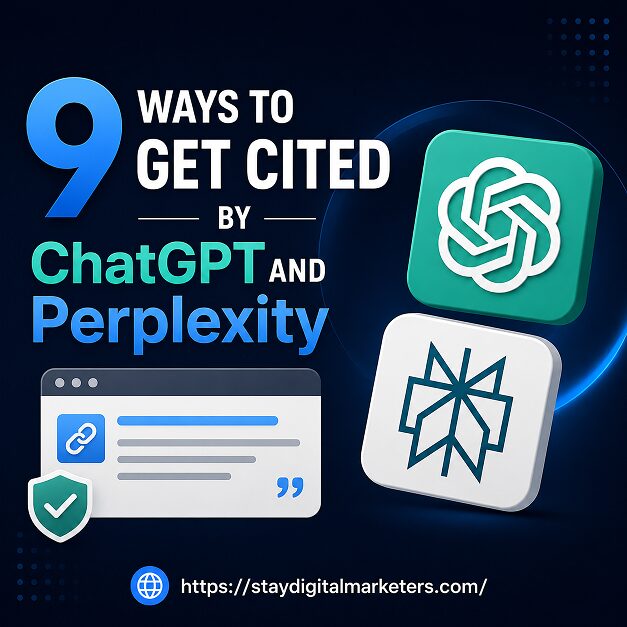
Getting cited by an AI search engine means ChatGPT, Perplexity, Gemini, or Google’s AI Overviews name your page, and often link to it, while answering a user’s question. It is a different goal from ranking. A page can sit at position one on Google and never appear inside an AI answer, while a page several pages deep on Google gets pulled into a citation because it matches the question more precisely. This guide breaks down how AI engines actually choose sources, what content structure earns citations, and the exact steps to move a page from invisible to cited.
Generative engine optimization, or GEO, is the practice of shaping content so retrieval systems can find it, trust it, and pull it into an answer. It borrows some habits from traditional SEO, keyword relevance and authority still matter, but the mechanics underneath are different. AI engines are not sorting ten blue links. They are assembling an answer from fragments of several pages at once, then deciding which fragments earned a citation.
Key Takeaways
A citation, in this context, is any instance where a generative engine names, links to, or visibly draws from a specific page while constructing its answer. It differs from a mention, where a brand is referenced without a source link, and from a ranking, which only applies to traditional search results pages.
Three entities matter here: the AI engine itself, which retrieves and synthesizes; the source page, which supplies the underlying facts; and the query, which determines which pages are even considered. Understanding how those three interact is the foundation for everything that follows, because optimizing for the wrong one wastes effort. A page built purely for keyword rankings can still be functionally invisible to a retrieval system that reads in passages rather than whole documents.
AI search tools generally rely on retrieval-augmented generation, pulling a shortlist of relevant documents in real time, then generating an answer grounded in that shortlist. Citation decisions happen at the passage level, not the page level, which means a single article can be cited for one section and ignored for the rest.
Muck Rack’s 2026 analysis of 25 million cited links across ChatGPT, Claude, and Gemini found that 84% of AI citations trace back to earned media, meaning third-party editorial coverage rather than a brand’s own website or paid content. That figure alone reframes what optimization should prioritize. On-page structure earns you a seat at the table, but the strongest predictor of whether your brand gets cited at all is how often it appears on sites you do not control.
Moz’s 2026 analysis of nearly 40,000 search queries found that 88% of Google AI Mode citations came from outside the organic top ten, which means a page ranking first on Google can still be absent from the AI answer above it. AI engines apply their own relevance scoring, weighted toward how precisely a passage answers the exact question asked, not toward the page’s overall ranking strength.
Across teams handling multiple SEO clients at once, a recurring pattern shows up: content built for keyword rankings tends to bury the direct answer under an introduction, while content that opens with a clear, standalone answer gets pulled into AI responses far more consistently, regardless of where it sits on the search results page.
Structure determines whether a page that clears the authority and relevance bar actually gets extracted. Research from a 2026 analysis of roughly two million AI citations found that how closely a page’s language mirrors the phrasing of the question was one of the strongest content-level signals measured, more than five times stronger than the next best on-page factor.
Put the clearest, most complete answer to the page’s core question in the first forty to sixty words. Retrieval systems weight opening content heavily, since it is the passage most likely to stand alone without additional context. Treat the introduction as prime citation real estate rather than a warm-up.
Comparison-formatted content is among the most consistently cited article types across industries, according to citation-tracking studies covering tens of thousands of AI responses. A clean table, a numbered process, or a scoring framework gives a retrieval system a discrete, well-bounded unit of information to extract, which plain narrative paragraphs rarely offer as cleanly.
The table below summarizes the signals with the clearest evidence behind them right now.
| Signal | What It Means | Why AI Engines Weight It |
| Earned mentions | Your brand or page named on third-party sites you don’t own | Signals independent validation the model can’t fake by reading your own copy |
| Extractable structure | Headings, short paragraphs, lists, and standalone answer blocks | Retrieval systems pull passages, not full pages, so each section must stand alone |
| Query alignment | Content phrased to match how the question was actually asked | Close semantic matching is one of the strongest predictors of selection |
| Crawler access | No hard paywall or blocked bots on the page in question | A model cannot cite what it is not permitted to read |
| Freshness | Recent publication or a visible last-updated date | Time-sensitive queries pull heavily from recently updated pages |
AI engines cross-reference claims against other sources before citing them, which makes consistent entity information a prerequisite rather than a nice-to-have. Your brand name, description, and area of expertise should read the same way across your own site, review platforms, and any third-party coverage.
Content that explicitly names its sources, states data with attribution, and avoids unqualified superlatives tends to read as more trustworthy to both human readers and retrieval systems built to favor verifiable claims over promotional language.
Given that earned media accounts for the large majority of AI citations, yes, this is generally one of the higher-leverage investments available. A brand mentioned across several independent, relevant sites builds the kind of cross-verified authority a retrieval system is specifically designed to check for, in a way that no amount of on-page optimization alone can replicate.
That does not make on-page work optional. Earned coverage gets your brand into the pool of sources a model considers; structured, query-aligned content determines whether the specific page gets pulled into the specific answer. The two work together rather than as substitutes for each other.
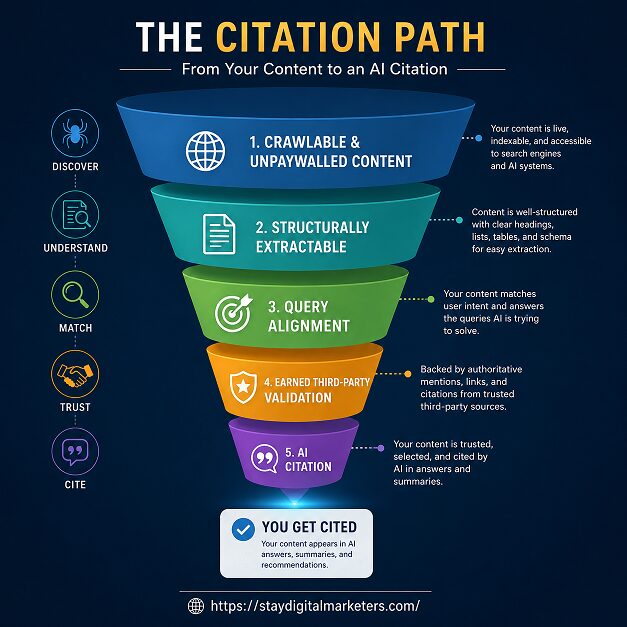
This framework organizes the work into five sequential checkpoints. Each addresses a different point where a page can fail to get cited, so skipping a step tends to waste effort on the steps that follow it.
1. Access check. Confirm the page has no hard paywall and is not blocked to relevant crawlers. A page a model cannot read cannot be cited, regardless of how well it is written.
2. Alignment check. Rewrite the opening of each key section so it answers the exact phrasing of the target question, not just the general topic.
3. Structure check. Break dense paragraphs into standalone, extractable passages with specific headings, and add at least one table, list, or framework per major topic.
4. Evidence check. Add attributed statistics and named sources throughout, replacing vague claims with specific, verifiable ones.
5. Authority check. Identify two or three realistic opportunities for earned coverage or third-party mentions related to the page’s topic, and pursue them on a rolling basis.
Running a page through all five checkpoints, rather than treating any single one as sufficient on its own, is what separates content that occasionally gets cited from content that gets cited consistently across multiple platforms.
Run your priority questions, phrased the way a real user would type or ask them, through each major AI search tool and record whether your page appears, whether it is linked, and how it is described. Repeat this on a regular cadence rather than once, since which sources get cited for a given query can shift noticeably from month to month as models update and competing content changes.
Track appearance rate, meaning the share of tracked questions where you show up at all, alongside whether you are cited early and prominently in the answer or mentioned only in passing. Both matter, but early, prominent citations tend to correlate more closely with actual referral traffic.
A citation links directly to your page as a source inside the answer. A mention names your brand without a link. Citations carry more weight because they show the model treated your content as source material, not just background context, and they are far more likely to send a reader to your site.
Structural fixes, such as clearer headings and a direct opening answer, can show up in citation checks within a few weeks. Authority-based gains, like earned mentions and press coverage, typically take a few months to compound, since they depend on other sites publishing about you first.
Backlinks still help, but current research points to brand mentions, even unlinked ones, as a stronger correlate of citation likelihood. A model reads the web as a network of claims about your brand, and a mention on a trusted site counts as evidence whether or not it links back.
No. Schema makes your content easier to classify and can support extraction, but it is not a proven direct driver of citations on its own. Treat it as good technical hygiene that supports the content, not a shortcut that replaces strong, well-structured writing.
Yes, particularly on specific, narrow queries where a big publisher has only shallow coverage. A precise, well-structured answer to a niche question can outperform a broad article from a larger domain, since query alignment matters more than domain size for many citation decisions.
There is no single easiest platform, since each draws from different sources and favors different content types. The more reliable approach is optimizing the underlying content quality and structure, which tends to lift visibility across ChatGPT, Perplexity, Gemini, and AI Overviews at the same time.
Run your target questions through each major AI search tool and record whether your page is named or linked. Several tracking platforms now automate this across ChatGPT, Perplexity, and AI Overviews, which is more reliable than guessing from referral traffic alone.
None of this replaces a solid technical and content foundation. It sits on top of it. Brands that already publish clear, well-organized content have a shorter path to AI citations than brands starting from scratch, because most of the structural work overlaps with what already makes a page useful to a human reader.
Firms working across many client sites at once, including agencies like Stay Digital Marketers, which supports brands through guest posting, press release distribution, SaaS backlinks, niche edits, Wikipedia page creation, and Google Knowledge Panel creation, are well positioned to help close the earned-media gap that most GEO checklists gloss over, since that gap is rarely solved through on-page changes alone.

Filza Taj is an MPhil in Human Resources-turned SEO Specialist, Content Strategist, and Digital Marketing Consultant with over 5 years of experience helping businesses in 30+ countries grow online. As the Founder of Stay Digital Marketers (staydigitalmarketers.com), she delivers results-driven solutions in link building, guest posting, PR distribution, niche edits, multilingual backlinks, and content marketing. She publishes daily SEO insights and actionable strategies to help brands strengthen their online presence, attract the right audience, and convert clicks into loyal customers.
Filza@staydigitalmarketers.com
Stay Digital Marketers
Need SEO, Link Building or Digital Marketing Services?
Request a Free Audit →