
A page can hold position one on Google and still be invisible in ChatGPT, Perplexity, and AI Overviews. That gap is not a ranking problem. It is a retrieval and trust problem, and it has a specific, fixable set of causes.
AI search ignores a page when it stays indexed and may even rank well on Google, yet is never pulled into an AI-generated answer. This is not a penalty in the traditional sense. Search engines confirm that a page exists. AI systems decide, separately, whether that page is reliable enough to be reused inside a synthesized answer.
Traditional search returns a ranked list of links and lets the user choose. AI search does the choosing first. ChatGPT, Google AI Overviews, Perplexity, and Gemini each pull from a small, filtered set of sources, then present a single answer. If a page never makes that shortlist, it can rank on page one and still receive no AI-driven visibility at all.
Key Takeaways
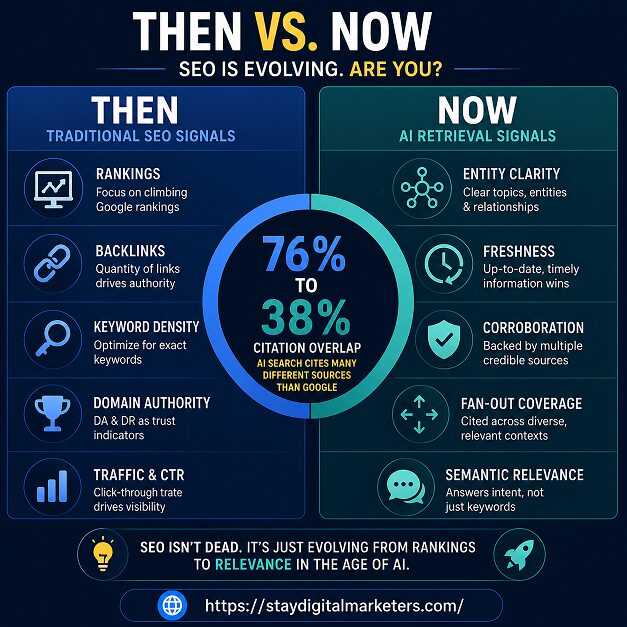
Ranking and retrieval now measure two different things. Ranking reflects relevance and link equity for a single query. Retrieval reflects whether a large language model trusts a page enough to cite it while answering a whole cluster of related questions at once, a process known as query fan-out.
Ahrefs analyzed roughly 4 million AI Overview citations against 863,000 keywords in early 2026 and found that only 38 percent of cited pages also ranked in Google’s top 10 for the same query, down from 76 percent in mid-2025. Pages ranking between position 11 and 100 accounted for close to a third of citations, and pages outside the top 100 accounted for a similar share. Ranking still helps. It simply no longer guarantees the seat at the table it once did.
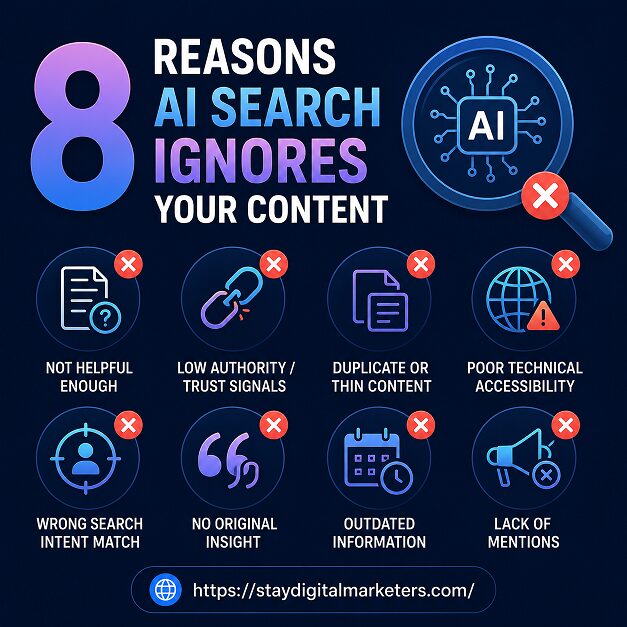
Each of the reasons below shows up repeatedly across sites that rank well but generate little to no AI referral traffic. None of them are single-fix technical bugs. They are structural signals that build or erode a model’s confidence in a page over time.
Pages that cover a topic at surface level give AI systems nothing to verify. A model looks for evidence of expertise across an entire topic cluster, not just a single well-optimized page. When coverage is shallow, the model cannot confirm the site understands the subject well enough to be reused safely, so it defaults to a competitor with broader, more connected coverage.
AI systems place content inside a knowledge graph of people, brands, products, and concepts. If a brand name, author, or organization is described differently across pages, or not tied clearly to the topic at all, the model cannot confidently connect the content to a known, trustworthy entity. Weak entity clarity is one of the most common reasons technically sound pages still get skipped.
Retrieval systems process content within limited context windows, not full pages at once. When headings are misused, sections are out of order, or key information is buried under unrelated text, the model cannot cleanly separate one idea from another. A page can be factually accurate and still be unusable to an AI system if its structure hides the answer.
Rewritten, keyword-driven content that adds no new framing gets filtered out quickly. Language models are built to detect redundancy across the sources they evaluate. When ten pages say the same thing in slightly different words, the model has no reason to prefer any one of them, and it typically defaults to whichever source already carries the strongest trust signals elsewhere.
Before answering, AI systems expand a single search into several related sub-queries and check sources against each one independently. A page optimized for one exact keyword phrase may satisfy only one branch of that expansion. Content that anticipates follow-up questions, comparisons, and edge cases performs better because it stays relevant across more of the fan-out tree, not just the original query.
Unlike traditional search crawlers, AI systems often rely on secondary ingestion pipelines that pull structured, pre-approved data on their own schedule, not continuously. A new or lightly linked site can be fully indexed by Google and still be effectively invisible to these pipelines simply because it has not yet been picked up and validated by them.
AI systems weigh freshness heavily because outdated explanations create real risk of citing wrong information. A meta-analysis of 54 citation studies covering nearly 17 million citations found that content cited by AI engines runs about 25.7 percent fresher on average than organic top-10 results for the same queries. Pages that stop being updated lose ground even if nothing about them technically breaks.
AI systems corroborate claims across multiple independent sources before trusting any single one of them. The same 54-study meta-analysis found that unlinked brand mentions correlate roughly three times more strongly with AI citation visibility than backlinks do. A site that is only ever discussed on its own domain gives a model nothing external to verify it against.
The clearest signal is a widening gap between stable or growing Google rankings and flat or declining referral traffic from AI platforms. Checking is more direct than most teams expect: search your target queries directly in ChatGPT, Perplexity, and Google’s AI Overviews, and note whether your domain, or any domain in your topic space, appears in the citations. Across client-facing SEO work, this pattern shows up most often on pages that rank comfortably on page one but were last substantially updated more than a year ago, which lines up closely with the freshness gap described above.
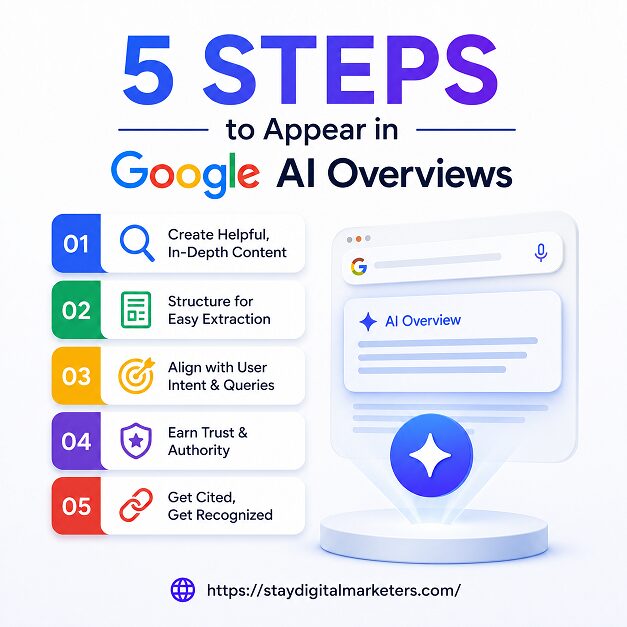
The fixes above interact with each other rather than working in isolation, which is why a structured approach outperforms addressing them one at a time. The framework below organizes the eight reasons into five practical checkpoints.
Sites that work through all five checkpoints together tend to regain AI visibility faster than sites that isolate a single technical fix, since the underlying issue is almost always trust built across multiple signals at once, not one broken setting.
The numbers below summarize the most cited large-scale studies on AI citation behavior so far in 2026.
| Metric | Finding | Source |
| Top-10 pages cited in AI Overviews | 38%, down from 76% in mid-2025 | Ahrefs, 2026 |
| Citations from pages ranked 11 to 100 | Roughly 31% | Ahrefs, 2026 |
| Freshness advantage of cited content | About 25.7% fresher than top-10 organic | 54-study meta-analysis, 2026 |
| Brand mentions vs. backlinks correlation | Roughly 3x stronger for mentions | 54-study meta-analysis, 2026 |
Ranking confirms relevance for one query. AI Overviews select sources based on trust signals like entity clarity, freshness, and corroboration across a whole topic cluster. A page can satisfy Google’s ranking criteria while still lacking the broader signals AI systems require before citing it.
Search your core target queries directly inside ChatGPT, Perplexity, and Google’s AI Overviews, then review the cited sources. This manual check takes minutes per query and shows immediately whether your domain, or your competitors, are being pulled into AI-generated answers.
No. An llms.txt file helps AI crawlers understand site structure, but it does not override weak topical depth, poor entity clarity, or thin corroboration elsewhere. It is a helpful technical signal, not a substitute for the trust-building work AI systems actually evaluate.
It matters significantly. Cited content runs roughly 25.7 percent fresher than organic top-10 results on average, according to a 2026 meta-analysis of nearly 17 million citations. Regular, substantive updates, not just a changed date stamp, are what move this signal.
Yes, backlinks still support rankings and referral traffic. But for AI citation purposes specifically, unlinked brand mentions across credible sites now correlate roughly three times more strongly with visibility than backlinks alone, making mention-building a necessary complement, not a replacement.
Timelines vary by ingestion pipeline and topic competitiveness, but meaningful shifts typically take several weeks to a few months, since AI systems re-evaluate trust gradually rather than instantly, and depend on when a site is next picked up by ingestion pipelines.
Not replacing it. GEO works alongside SEO rather than instead of it. Rankings still create the baseline discoverability that lets a page be considered at all, while GEO practices determine whether that discoverable page ever gets reused inside an AI-generated answer.
Teams that treat AI visibility as an ongoing content and entity-building discipline, rather than a one-time technical fix, tend to see the most durable results. Agencies working across guest posting, press release distribution, and Wikipedia and Knowledge Panel creation, such as Stay Digital Marketers, approach this from the corroboration side of the equation, helping brands build the kind of independent, cross-platform mentions that AI systems increasingly weigh alongside traditional backlinks.

Filza Taj is an MPhil in Human Resources-turned SEO Specialist, Content Strategist, and Digital Marketing Consultant with over 5 years of experience helping businesses in 30+ countries grow online. As the Founder of Stay Digital Marketers (staydigitalmarketers.com), she delivers results-driven solutions in link building, guest posting, PR distribution, niche edits, multilingual backlinks, and content marketing. She publishes daily SEO insights and actionable strategies to help brands strengthen their online presence, attract the right audience, and convert clicks into loyal customers.
Filza@staydigitalmarketers.com
Stay Digital Marketers
Need SEO, Link Building or Digital Marketing Services?
Request a Free Audit →