
A practitioner’s guide to getting cited by ChatGPT, Perplexity, Claude, and Google AI Overviews
An AI citation happens when a large language model such as ChatGPT, Claude, Perplexity, or Google AI Overviews pulls a specific claim, statistic, or explanation from a web page and attributes it, either by name or by link, inside a generated answer. This is different from a traditional Google ranking, where a page simply appears in a list of ten blue links.
Generative Engine Optimization, often shortened to GEO, and Answer Engine Optimization, often shortened to AEO, are the emerging disciplines built around earning these citations. Both sit alongside traditional SEO rather than replacing it, and both depend heavily on content format. A page can rank well in Google and still be invisible inside an AI answer if its structure does not match what a given model’s retrieval system is built to extract.
Key Takeaways
Retrieval systems behind AI search do not read a page the way a human does. They chunk content into extractable segments, score each segment for relevance and trust, and pull the highest-scoring pieces into a generated answer. A claim that is specific, self-contained, and easy to isolate from surrounding text is far more likely to survive that process than a vague sentence buried in a long paragraph.
Recency is one of the strongest signals in that scoring process. Research from Discovered Labs found that pages updated within the previous three months averaged roughly six citations, compared with about 3.6 for pages left untouched for longer. In practice, teams that treat a published article as a living asset rather than a one-time deliverable tend to hold their citation visibility for longer, since a periodic refresh keeps the same claims eligible for re-scoring.
Listicles are the most consistently cited format across every major AI model. A study from Wix Studio’s AI Search Lab analyzed 75,000 AI answers and more than a million citations pulled from ChatGPT, Google AI Mode, and Perplexity, and found that all three models rank listicles first among content types.
The reason is structural rather than stylistic. A numbered list breaks a topic into discrete, independently citable units. A model can lift item three out of a list of seven without needing the surrounding context, which is exactly the kind of self-contained chunk retrieval systems are built to extract. Titles that state a specific number, such as this article’s own title, also set a clear expectation for both readers and retrieval systems about how the content is organized.
ChatGPT in particular favors long-form, encyclopedic writing. Wikipedia alone accounts for close to half of its top citations in independent citation-pattern research, which signals a strong pull toward comprehensive, neutral, well-defined explanations over short marketing copy.
A long-form article earns this kind of trust when it defines its core terms early, avoids promotional language, and builds a complete picture of a topic in one place rather than scattering it across several thin pages. Writing the opening two paragraphs the way an encyclopedia entry would, stating what something is before making any argument about it, tends to perform well for this reason.
For commercial and comparison-intent queries, ChatGPT Search has been shown to pull from the structured layer of a page rather than its narrative paragraphs. A well-built comparison table, with clear row and column labels and specific values rather than vague descriptors, gives a retrieval system exactly that structured layer to work with.
This is one area where general industry observation across content audits tends to hold up consistently: articles built around a strong comparison table are cited for commercial and “best for” style queries noticeably more often than articles that only describe the same information in prose.
Perplexity operates differently from ChatGPT and Google AI Overviews because it performs real-time retrieval on every single query rather than leaning on pre-trained knowledge. That makes it the AI platform most influenced by community discussion. Reddit alone represents close to forty-seven percent of Perplexity’s top citations, nearly double its share for Wikipedia.
This does not mean every brand needs to run a forum. It does mean that discussion-style content, structured as a genuine question followed by a direct, experience-based answer, mirrors the format Perplexity is already primed to trust and extract.
Google AI Overviews lean heavily toward YouTube and other multimodal content, accounting for close to a quarter of its top citations overall. For purchase-intent queries specifically, YouTube has been the single most-cited domain in Google AI Overviews for months running.
Written content is not replaced by this trend, but it is worth pairing an in-depth article with a short companion video or an embedded transcript where the topic supports it, since Google’s AI layer treats video as a first-class citable source rather than a supplementary format.
A dedicated FAQ section, paired with FAQPage schema markup, gives an AI model a pre-packaged, extractable question-and-answer pair rather than requiring it to isolate one from a long paragraph. Search engineers at major platforms have confirmed publicly that structured data helps large language models parse a page’s content and entity relationships more reliably.
This is consistently the fastest format to retrofit onto existing content. Adding a seven-question FAQ block to an already-published article, with each answer written as a direct, standalone paragraph, tends to lift a page’s citation eligibility without requiring a full rewrite.
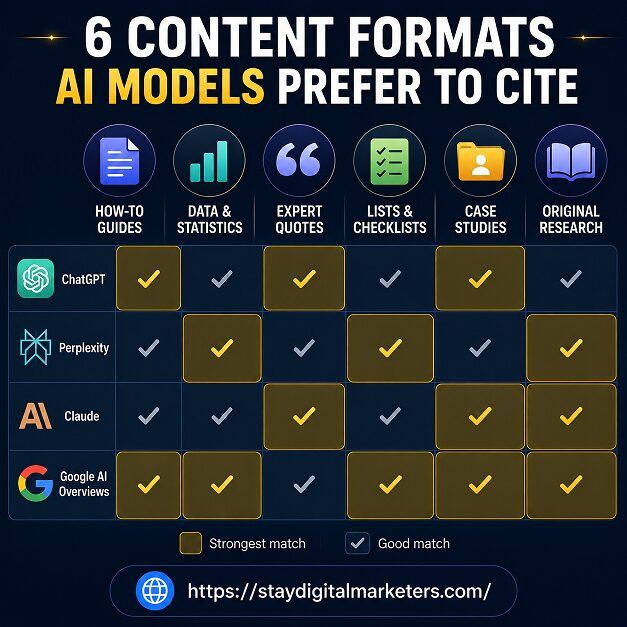
Rather than treating each of the six formats above as separate projects, it helps to run every piece of content through one consistent scoring model before publishing. The SCORE framework covers the five elements that show up across all six formats:
A page that scores well across all five tends to be citable across every AI platform rather than just one, since the underlying signals overlap even where each model’s retrieval architecture differs.
| Content Format | Best For | Model That Favors It Most | Why It Gets Cited |
| Listicles | Informational and how-to queries | All three models, ranked first overall | Each item is a self-contained, extractable chunk |
| Long-form articles | Definitional and educational queries | ChatGPT | Matches encyclopedic, neutral writing style |
| Comparison tables | Commercial and “best for” queries | ChatGPT and Google AI Overviews | Provides a structured layer over narrative prose |
| Community discussions | Real-world, experience-based queries | Perplexity | Reflects recent, community-validated insight |
| Video and multimodal | Purchase-intent queries | Google AI Overviews | Treated as a first-class citable source |
| FAQ with schema | Direct question-and-answer queries | All platforms, especially voice and snippet contexts | Pre-packaged, standalone answer blocks |
Most sites do not need to publish new material to start earning more AI citations. Auditing what already exists against the six formats above is usually a faster path to visibility. A practical audit follows the same order every time:
Teams that work through this five-step audit across a backlog of older posts, rather than only applying it to new articles, generally see broader gains, since older high-traffic pages often carry the authority signals AI models already trust but lack the structural format those models need to extract from.
Across ChatGPT, Google AI Mode, and Perplexity, listicles are the single most-cited format, followed by long-form articles, comparison tables, community discussions, video, and FAQ sections with schema markup. Each model still leans toward different formats depending on the type of question being asked.
Rarely. Research analyzing hundreds of millions of citations found only about eleven percent of domains earn citations from both platforms. ChatGPT leans toward encyclopedic and editorial sources, while Perplexity draws heavily from Reddit threads and other community discussions.
Perplexity performs real-time retrieval on every query and weighs recency and community validation heavily. Reddit threads update constantly and reflect current, first-hand experience, which matches Perplexity’s preference for real-world insight over purely institutional authority.
No. Many pages cited by AI engines do not appear in the top ten organic results, and many top-ranking pages never get cited at all. Format, extractability, and structured data now influence citation odds more than page authority alone.
Content refreshed within the last three months earns noticeably more AI citations on average than older, unchanged pages. Quarterly updates, visible timestamps, and consistent facts across a site all help signal that a page is current enough to trust.
Yes. Structured data such as FAQPage, Article, and Organization schema helps AI systems parse entities and relationships accurately. Search engineers at major platforms have confirmed publicly that schema markup helps large language models understand page content more reliably.
A short FAQ section with direct, standalone answers is usually the quickest win. It requires no redesign, fits naturally at the end of existing articles, and gives AI systems a ready-made, extractable answer block for common questions.
Format alone will not carry a page that has no underlying authority. Stay Digital Marketers works alongside content teams as a resource for the backlink and entity-building side of this equation, offering services such as guest posting, press release distribution, SaaS backlinks, niche edits, multilingual backlinks, Wikipedia page creation, Google Knowledge Panel creation, and broader SEO support. Pairing citation-ready formatting with that kind of underlying authority building is generally what turns a well-structured article into one an AI model actually trusts enough to cite.

Filza Taj is an MPhil in Human Resources-turned SEO Specialist, Content Strategist, and Digital Marketing Consultant with over 5 years of experience helping businesses in 30+ countries grow online. As the Founder of Stay Digital Marketers (staydigitalmarketers.com), she delivers results-driven solutions in link building, guest posting, PR distribution, niche edits, multilingual backlinks, and content marketing. She publishes daily SEO insights and actionable strategies to help brands strengthen their online presence, attract the right audience, and convert clicks into loyal customers.
Filza@staydigitalmarketers.com
Stay Digital Marketers
Need SEO, Link Building or Digital Marketing Services?
Request a Free Audit →