
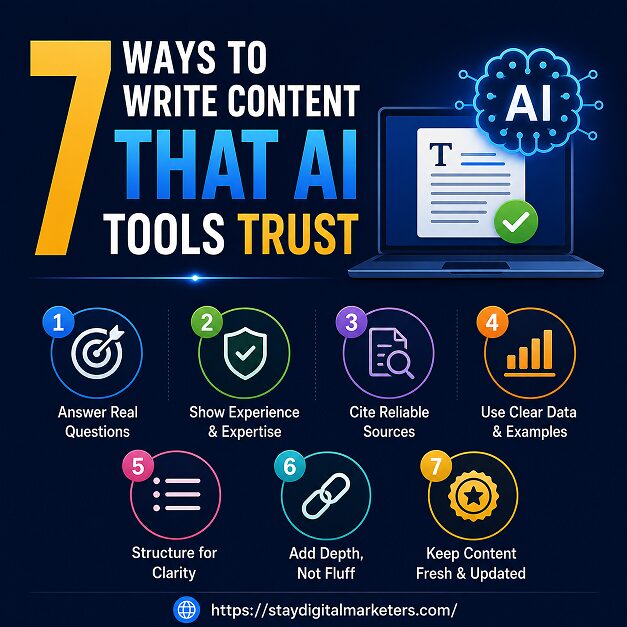
AI Overviews, ChatGPT, Perplexity, and Gemini now decide what gets summarized, cited, or quietly skipped in response to millions of daily searches, and that decision is not arbitrary. These systems repeatedly pull from a narrow set of pages that share the same traits: traceable claims, original data, and a structure built for extraction rather than persuasion. Everything else, no matter how well written, tends to get paraphrased into an answer without a citation attached.
Understanding what separates a cited source from an ignored one requires understanding the entities involved: Experience, Expertise, Authoritativeness, and Trustworthiness (E-E-A-T) as a trust filter, Generative Engine Optimization (GEO) and Answer Engine Optimization (AEO) as the disciplines built around AI visibility, and retrieval systems as the mechanism deciding which passages an AI model treats as reliable enough to reuse. The seven approaches below map directly to what these systems reward, and to what quietly filters content out of consideration.
Key Takeaways
AI trust means a page has been selected as source material for a generated answer, not just indexed. It happens when an AI system can verify a claim against a specific, named source and extract a self-contained passage without needing the rest of the page for context. Content earns this by being specific, sourced, and structured for a machine to lift cleanly, rather than by being long, keyword-dense, or well designed.
Unsourced claims are the single biggest reason content gets paraphrased instead of cited. Phrases like “studies show” or “experts agree” give an AI system nothing to verify, so the safest move for the model is to summarize the idea in its own words and leave the page out of the citation. Every statistic, quote, or industry claim needs a name attached: the study, the organization, or the specific observation it came from.
A rougher paragraph with a named source consistently outperforms a smoother paragraph without one, because retrieval systems are built to reduce hallucination risk. Attaching a source does that work for them. This is also why press coverage and independent write-ups tend to get cited more than a brand’s own claims about itself: a third party stating the fact is inherently more traceable than a company stating it about its own product.
Recent analysis of large-language-model citation patterns found that a large share of citations are drawn from the opening portion of a page, which means the direct answer has to appear before the supporting explanation, not after it. A paragraph that opens with three sentences of throat-clearing before answering the question buries the exact passage an AI system is trying to extract.
Each major heading should be followed immediately by a two-to-three sentence answer that could stand alone if lifted out of the page entirely. The explanation, examples, and nuance can follow underneath. This single change, moving the answer above the explanation, is often the fastest way to convert existing content into something an AI system can actually quote.
A widely cited Search Engine Land analysis found that just over half of all AI-cited passages contained original or owned data, a rate far higher than how often original data appears across content generally. That gap is the opportunity. A single internal metric, survey result, or before-and-after comparison from real work carries more citation weight than a page-long summary of other people’s research.
Original data does not need to be large-scale. A pattern observed across a handful of client accounts, expressed as a specific number or trend, functions the same way in an AI system’s evaluation as a formal study, provided it is presented as a clear, attributable observation rather than a vague impression.
Recent tracking of AI citation sources found that the large majority of citations trace back to earned media, meaning independent publications and third-party sites, rather than pages a brand controls and publishes itself. This reframes visibility in AI search as partly a digital PR problem: getting an industry publication, forum, or review site to reference a claim independently is often more valuable than adding another page to an owned blog.
Practically, this means treating guest contributions, expert roundups, and third-party mentions as citation infrastructure, not just backlink volume. A brand’s own content still matters as the canonical source, but the mentions that surround it are what convince an AI system the claim is broadly corroborated rather than self-reported.
Content assembled entirely from other sources tends to read as a summary of a summary, and AI systems increasingly de-prioritize passages that just restate consensus without adding anything new. A specific pattern observed across real client work, a mistake seen repeatedly, or a result tied to a concrete change reads differently than a generic best-practice list, because it contains detail that could not have been generated from research alone.
This does not require dramatic case studies. Even a single, clearly framed observation, described honestly and without invented specifics, gives a page a texture that purely researched content cannot replicate, which is exactly the kind of texture retrieval systems are tuned to notice.
AI systems build an internal map of who a brand is, what it does, and how its claims relate to known entities in a topic area. Content that defines its terms clearly, names the tools and concepts it references, and stays consistent about a brand’s role across articles makes that map easier to build. Inconsistent terminology or vague self-description makes a brand harder for an AI system to place with confidence, which in turn makes its claims harder to trust.
This is also where a light, consistent brand presence across a body of content helps: not through repeated self-promotion, but through a stable, recognizable description of expertise that shows up the same way across many pieces of content.
Citation eligibility is not permanent. Analysis of millions of AI citations across major chat and search platforms found that a majority of queries that produced a citation one month did not produce the same citation the following month, as models re-crawl and re-rank available sources. Content that was cited once and never revisited tends to fall out of rotation as fresher, better-sourced pages take its place.
A practical review cycle, checking statistics, dates, and claims on a fixed schedule, keeps a page eligible for re-citation instead of quietly aging out. Fast-moving topics, including algorithm updates and market data, need this review more frequently than evergreen explainers.
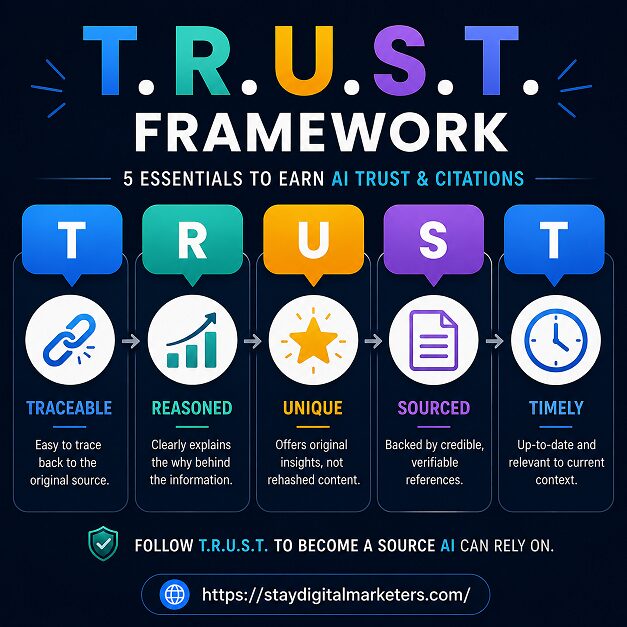
These seven practices condense into a five-part checklist that can be applied to any draft before it publishes:
| The T.R.U.S.T. Framework Traceable : every claim is tied to a named source or a clearly framed first-hand observation. Reasoned : the direct answer appears before the supporting explanation, not after it. Unique : at least one original data point, framework, or observation appears in the piece. Sourced : statistics are dated and attributed, never estimated or left unattributed. Timely : claims and figures are reviewed on a fixed schedule, not published once and forgotten. |
The table below summarizes the practical difference between content that gets paraphrased and content that gets cited.
| Signal | Content AI Tools Skip | Content AI Tools Cite |
| Data | Recycled or paraphrased stats with no source | Original figures with a named, dated source |
| Structure | Long intros before the actual answer | Direct answer within the first 30% of the page |
| Sourcing | Vague claims (“studies show”) | Traceable claims tied to a specific study or observation |
| Voice | Generic, interchangeable phrasing | Distinct expertise and first-hand pattern recognition |
| Freshness | Published once and left untouched | Reviewed and re-verified on a fixed schedule |
AI tools favor content with traceable claims, original data, and an answer-first structure. Systems like Google AI Mode and ChatGPT pull passages they can verify against a named source, so vague or unsourced statements get skipped even when the writing is polished.
Traditional SEO leans on on-page signals like author bios. AI systems weigh off-site validation more heavily: which publications mention the brand, which platforms reference it, and what the broader web consensus says, making earned coverage more influential than self-published credentials.
Both matter, but unlinked brand mentions across trusted sites now carry real weight. AI systems treat repeated third-party references as a trust signal even without a clickable link, though backlinks still help traditional crawlers discover and rank the page.
Yes, but the deciding factor is what the content contains, not how it was drafted. AI-assisted articles that include original data, named sources, and edited first-hand insight get cited at the same rate as human-written pieces with the same qualities.
Citation eligibility shifts monthly on many topics as AI tools re-crawl and re-rank sources. A practical baseline is reviewing statistics, dates, and claims every 60 to 90 days, and sooner for fast-moving topics like algorithm updates or market data.
Publishing unsourced statistics or restating another site’s claims without attribution is the fastest way to fall out of citation rotation. AI systems increasingly cross-check figures against original sources, and content that can’t be traced back gets filtered out.
Writing for AI trust is largely writing for editorial rigor: name the source, answer first, add something original, and keep it current. Agencies that manage backlink and citation work at scale see this pattern consistently across client accounts, which is part of why Stay Digital Marketers builds original data and sourced claims into every article it produces, alongside its core services in guest posting, press release distribution, SaaS backlinks, niche edits, multilingual backlinks, Wikipedia page creation, Google Knowledge Panel creation, and complete SEO services.

Filza Taj is an MPhil in Human Resources-turned SEO Specialist, Content Strategist, and Digital Marketing Consultant with over 5 years of experience helping businesses in 30+ countries grow online. As the Founder of Stay Digital Marketers (staydigitalmarketers.com), she delivers results-driven solutions in link building, guest posting, PR distribution, niche edits, multilingual backlinks, and content marketing. She publishes daily SEO insights and actionable strategies to help brands strengthen their online presence, attract the right audience, and convert clicks into loyal customers.
Filza@staydigitalmarketers.com
Stay Digital Marketers
Need SEO, Link Building or Digital Marketing Services?
Request a Free Audit →