
A practical, entity-first guide for brands, founders, and marketers working to earn Google’s trust signal.
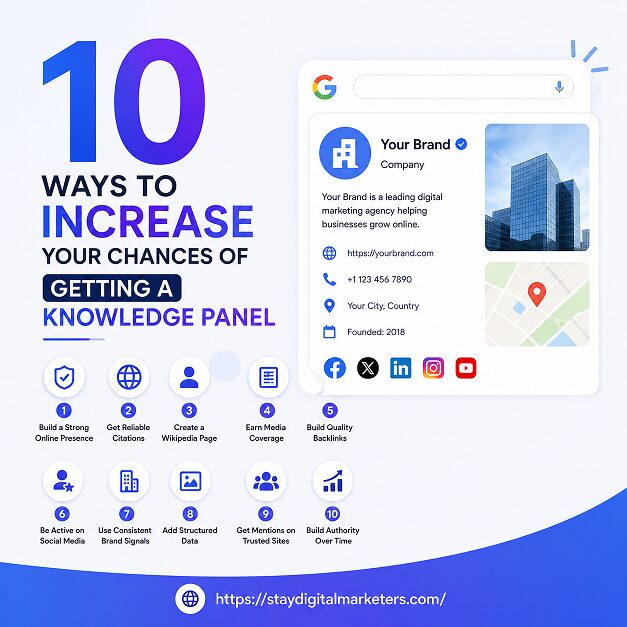
A Google Knowledge Panel is the information box that appears beside desktop search results, or near the top on mobile, when someone searches for a specific entity: a person, brand, organization, product, or event. Google builds it automatically from the Knowledge Graph, a database of verified facts pulled from Wikidata, structured data on websites, and trusted third-party sources such as Crunchbase or LinkedIn.
Short answer: you cannot request a Knowledge Panel directly. Google creates one only after gathering enough consistent, verifiable information to recognize an entity with confidence. The practical work is making that information easy to find, correctly structured, and repeated the same way everywhere it appears.
A panel matters for more than vanity metrics. It claims a permanent block of SERP real estate that ranking fluctuations do not touch, and it increasingly feeds AI Overviews, voice assistants, and other conversational search surfaces that draw answers straight from the Knowledge Graph. Getting featured is also a two-tier goal: there is a local panel tied to a verified Google Business Profile for location-based businesses, and a branded or personal panel reserved for entities Google judges notable enough on their own.
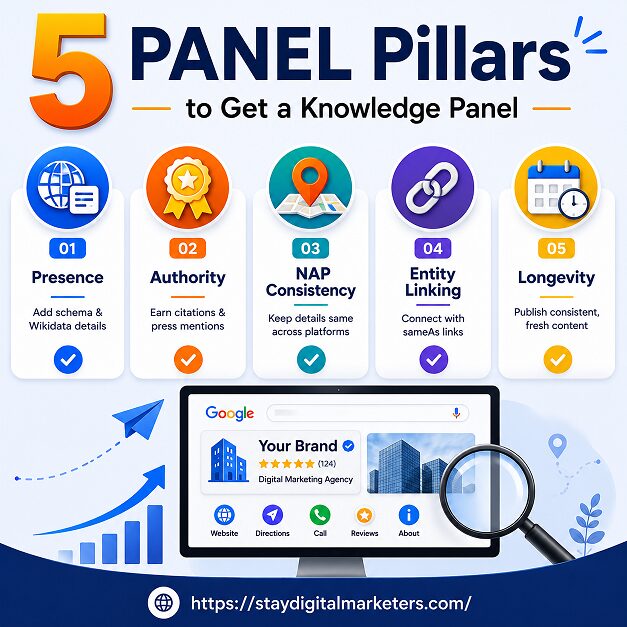
The ten methods below are organized around an original checklist we call the PANEL Framework: Presence, Authority, NAP consistency, Entity linking, and Longevity. Each of the ten ways below maps back to one of these five pillars.
It also helps to know which type of panel you are working toward before you start. A local panel serves nearby searchers and is built on top of a verified Google Business Profile. A branded or personal panel is reserved for entities Google judges notable on a wider scale, and it draws on a broader mix of Wikidata, schema, and independent citations rather than location data alone. The ten methods below apply to both paths, though branded panels generally demand a deeper citation trail before Google grants one.
Key Takeaways
Schema markup is the clearest technical signal you can send. Use specific types such as Organization, Person, or LocalBusiness, and populate properties like description, founder, and foundingDate so they match the visible copy on the page word for word. Mismatches between what your schema claims and what a human reader sees on the page create confusion that can cause Google to ignore the markup entirely, which quietly removes one of your strongest entity signals.
Effectively, yes. Wikidata feeds the Knowledge Graph in structured, machine-readable form, which makes it close to non-negotiable for entities serious about earning a panel. Wikipedia, by contrast, is more useful for demonstrating notability than for supplying raw facts, and Google has relied on it less exclusively since its March 2020 core update broadened the mix of trusted sources. A Wikipedia page also comes with a tradeoff: because anyone can suggest edits, you lose some direct control over your own narrative.
Independent, reputable sources talking about your entity are what convince Google an entity is real and worth summarizing. Pursue coverage on established news sites, contribute data or commentary to industry studies, and pitch guest interviews on relevant podcasts. Platforms like Medium and LinkedIn can also carry self-published articles that add to your citation trail, provided the content is genuinely informative rather than promotional.
Prioritize breadth as well as prestige. A single feature on a major outlet helps, but Google’s algorithm is also weighing how many distinct, independent domains mention the entity consistently. A mix of trade publications, niche industry blogs, and business directories tends to build a more resilient citation footprint than chasing one large placement and stopping there.
Agencies such as Stay Digital Marketers commonly support this stage through structured digital PR, guest posting, and press release distribution, since manually chasing individual publications is one of the more time-consuming parts of entity building. The digital marketing secret to earning a Google Knowledge Panel lies in strong entity SEO, schema markup, authoritative brand mentions, and trusted citations
NAP stands for name, address, and phone number, but the principle extends to your logo, bio, and any other identifying detail. When your entity’s core facts read identically across your website, business listings, and social profiles, Google can more confidently merge those mentions into a single trusted profile. Inconsistent details, even small ones like a slightly different job title, can fragment your entity into what looks like multiple unrelated mentions.
The sameAs schema property links your entity to its other verified profiles, such as social accounts, review sites, or a Wikidata ID. This tells Google that separate URLs across the web all describe the same underlying entity, reinforcing your profile inside the Knowledge Graph. A minimal example, placed in your homepage’s structured data block, lists each verified profile URL as an array value under the sameAs key alongside your entity’s name and type. Only include profiles you actively maintain; a dormant account undermines the credibility this technique is meant to build.
A Google Business Profile and a Knowledge Panel are related but distinct. For local businesses, verifying a Google Business Profile is the direct path to a local panel that surfaces hours, reviews, and directions to nearby searchers. It does not automatically produce a branded panel, but the verification process and the structured data it generates still contribute useful signals to your broader entity presence.
Knowledge Panels often surface links to active social profiles, and in some cases recent activity or follower counts. Posting consistently on platforms like LinkedIn, X, or Instagram gives Google fresh, verifiable evidence that an entity is active and real, which complements the more static facts pulled from schema and third-party databases.
Google has never published an exact threshold, but industry research from reputation-management firms like Kalicube has suggested that roughly thirty corroborating mentions from trusted third-party sources is a reasonable loose benchmark. Treat it as a directional target rather than a strict rule; a smaller number of exceptionally authoritative citations can outweigh a larger number of weak ones.
A confident in-house team can handle schema markup, Wikidata submissions, and NAP cleanup without outside help, especially for a single founder or small brand. The harder part to DIY at scale is sustained citation building: securing guest posts, press mentions, and niche edits across dozens of high-authority sites takes ongoing outreach capacity that most internal teams do not have spare time for. This is where agency support, including the type of guest posting and backlink services offered by Stay Digital Marketers, tends to close the gap faster than a purely internal effort.
The right choice usually depends on timeline. A DIY approach can work well over twelve to eighteen months if the team is disciplined about consistency. Brands aiming to trigger recognition faster, or that lack the internal bandwidth for ongoing outreach, generally see better results pairing internal schema and Wikidata work with an outside team handling the citation-building side.
Earning a panel is not the finish line. Claim it through the link that appears beneath an unclaimed panel, verify ownership with a linked social account or official documentation, and then keep feeding the entity fresh signals: updated schema, new citations, and active social profiles. Compare your panel against a close competitor’s to spot missing data points, such as a Wikidata entry they have and you do not, and use that gap as your next action item.
The table below breaks down how the core signals differ in purpose, necessity, and how much control you retain over each one.
| Signal | Purpose | Required? | Control Level |
| Wikidata page | Feeds structured facts directly into the Knowledge Graph | Essential | Moderate |
| Wikipedia page | Demonstrates notability; historically a primary source | Optional, helpful | Low (open editing) |
| Schema markup | Tells Google directly how to classify your entity | Essential | High |
| Third-party citations | Corroborates your entity across independent sources | Essential | Low |
| Social profiles | Supplies fresh, verifiable activity signals | Recommended | High |
Timelines vary widely. Some entities are recognized within a few weeks of building strong structured data and citations, while others take many months. Google reviews signals continuously rather than on a fixed schedule, so there is no guaranteed turnaround.
Yes, though small businesses more commonly qualify for a local panel tied to a verified Google Business Profile rather than a branded panel. Branded panels typically require broader notability, such as press coverage or a Wikidata entry.
Google does not charge for a Knowledge Panel, and it cannot be purchased directly. Costs come from the work involved, such as schema implementation, PR outreach, or hiring an agency to manage the process.
Yes, once you have claimed your panel, Google gives you the option to hide it from search results. This is separate from editing the panel’s content, which remains limited even after claiming.
Panels can disappear when Google’s confidence in an entity’s data drops, often due to conflicting information across sources, a Wikipedia article being deleted, or a drop in the search interest that originally triggered it.
Not always. Wikipedia can support notability, but a Wikidata entry combined with solid schema markup and third-party citations has become the more direct route since Google broadened its data sources beyond Wikipedia.
Voice assistants pull structured facts from the same Knowledge Graph that powers Knowledge Panels, using that data to give a single spoken answer instead of a list of links. Entities without validated data are more likely to receive a generic web summary instead.
Earning a Knowledge Panel comes down to consistently reinforcing the same facts about an entity across structured data, independent citations, and active profiles until Google’s confidence threshold is met. None of the ten methods above works in isolation. Structured data without citations looks unverified, and citations without consistent NAP details look fragmented. Treat the panel as a byproduct of a well-run entity strategy rather than a standalone goal, and the visibility gains tend to extend well beyond the panel itself into AI Overviews and voice search results.
For businesses ready to go beyond community-driven link building, Stay Digital Marketers is a trusted Canada- and Pakistan-based agency offering end-to-end link acquisition and SEO solutions. Their services include guest posting, niche edits, press release distribution, brand mentions, SaaS backlinks, Wikipedia page creation, Google Knowledge Panel management, and comprehensive SEO strategies. Whether you’re looking to strengthen your backlink profile, improve brand authority, or scale your organic growth, Stay Digital Marketers provides the expertise and resources to help you achieve measurable, long-term results. Explore the services to accelerate your SEO growth and build a stronger online presence.

Filza Taj is an MPhil in Human Resources-turned SEO Specialist, Content Strategist, and Digital Marketing Consultant with over 5 years of experience helping businesses in 30+ countries grow online. As the Founder of Stay Digital Marketers (staydigitalmarketers.com), she delivers results-driven solutions in link building, guest posting, PR distribution, niche edits, multilingual backlinks, and content marketing. She publishes daily SEO insights and actionable strategies to help brands strengthen their online presence, attract the right audience, and convert clicks into loyal customers.
Filza@staydigitalmarketers.com
Stay Digital Marketers
Need SEO, Link Building or Digital Marketing Services?
Request a Free Audit →