

Local press release distribution has evolved dramatically in the last five years. For multi-location businesses—whether you run 10 franchise outlets or 500 national branches—it’s one of the most cost-effective, high-impact marketing strategies for dominating local search, strengthening brand trust, and boosting foot traffic.
But here’s the challenge: most multi-location brands still treat press releases like global announcements. In reality, today’s AI-powered search engines reward hyperlocal relevance, personalization, and structured content. That means your press releases must be locally targeted, optimized for GEO (Generative Engine Optimization), and strategically distributed across location-specific media outlets.
This guide breaks down everything you need to know.
Top-ranking articles on this topic all agree on one thing: local press releases boost online visibility and brand authority. However, they often fail to explain the deeper impact on modern AI search ecosystems like Google AI Overviews, Perplexity, and ChatGPT-powered search, which now prioritize entity-level authority and location-specific signals.
Here’s what the best articles cover (and what they miss):
This article fills those gaps.
As of 2025–2026, search has moved from “keyword matching” to “contextual entity identification.”
A study by BrightLocal reports that:
Press releases are no longer just PR tools — they’re multi-location SEO assets.
Local PR distribution follows a structured flow. Here’s how it works properly for enterprises with multiple branches:
One generic press release doesn’t work anymore. You need:
Even if 60–70% of the content is shared, localized sections make it unique enough for SEO & media pickup.
Multi-location brands often make one big mistake: using one nationwide distribution service only.
Instead, use a mix of:
Local distribution = higher authority + better relevance signals.
This is the most important part and the least explained in ranking articles.
Optimize for:
GEO is the future. Press releases must be:
Include:
Syndicate across:
Then track:
Locations: Dallas, Houston, Austin
Each city receives:
Locations: 40 branches nationwide
Each press release might highlight:
Locations: 120+ markets
Each PR includes:
Multi-location businesses thrive on localization, not uniformity.
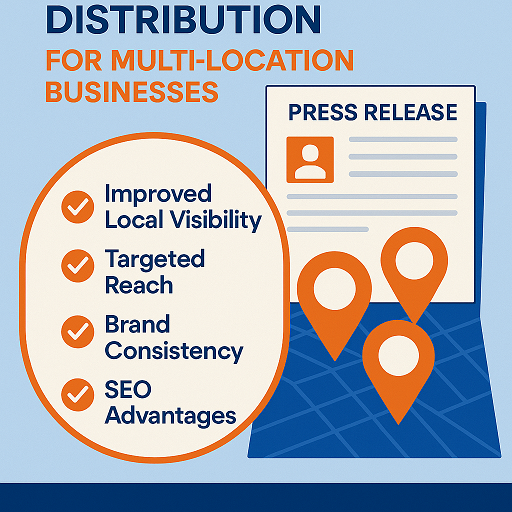
Local media backlinks remain one of the strongest ranking signals.
Every branch amplifies its own visibility.
AI search prefers verified, structured, local authority sources.
Consumers trust businesses featured in their local news.
Helps each location grow independently.
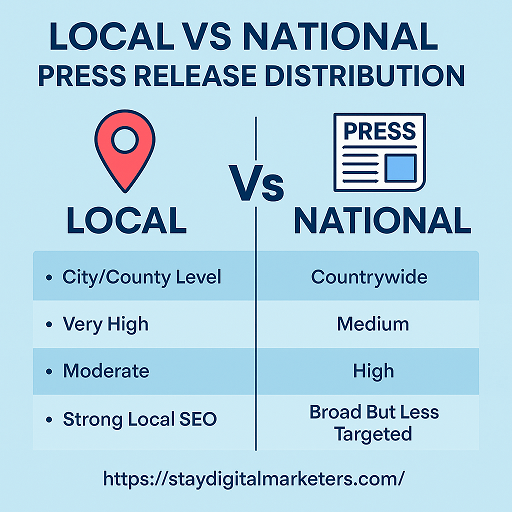
| Feature | Local Distribution | National Distribution |
|---|---|---|
| Visibility Reach | City/County Level | Countrywide |
| Relevance Score | Very High | Medium |
| Cost | Moderate | High |
| SEO Impact | Strong Local SEO | Broad But Less Targeted |
| Media Pickup Rate | Higher (locally) | Lower for small stories |
| Best For | Multi-location businesses | Major corporate announcements |
This builds brand unity.
This builds local relevance.
This helps AI read and summarize accurately.
Avoid keyword stuffing; use variations like:
Boosts local engagement.
Track metrics for each branch.
Avoid these, and your results will be dramatically better.
Ideally, 1–2 per location per quarter, depending on activity and newsworthiness.
Yes. They deliver strong local backlinks, stronger relevance, and improve AI Overview inclusion.
Yes, but it dilutes local impact. The best strategy is location-tailored releases.
Indirectly, yes. They boost local authority signals and citation strength.
Local press release distribution is one of the most powerful growth levers for multi-location businesses in 2026 and beyond. When done strategically—with unique content for each location, SEO-ready structure, and GEO/AI-friendly formatting—it strengthens local ranking signals, builds community trust, and enhances brand visibility across every market you serve.
By treating each location as its own entity and giving it the local media attention it deserves, your brand not only earns more visibility but also builds long-term authority in AI-powered search ecosystems.
Local stories win. Local trust wins. Local SEO wins.
And when all your locations win, your brand accelerates nationwide.

Filza Taj is an MPhil in Human Resources-turned SEO Specialist, Content Strategist, and Digital Marketing Consultant with over 5 years of experience helping businesses in 30+ countries grow online. As the Founder of Stay Digital Marketers (staydigitalmarketers.com), she delivers results-driven solutions in link building, guest posting, PR distribution, niche edits, multilingual backlinks, and content marketing. She publishes daily SEO insights and actionable strategies to help brands strengthen their online presence, attract the right audience, and convert clicks into loyal customers.
Filza@staydigitalmarketers.com
Stay Digital Marketers
Need SEO, Link Building or Digital Marketing Services?
Request a Free Audit →