
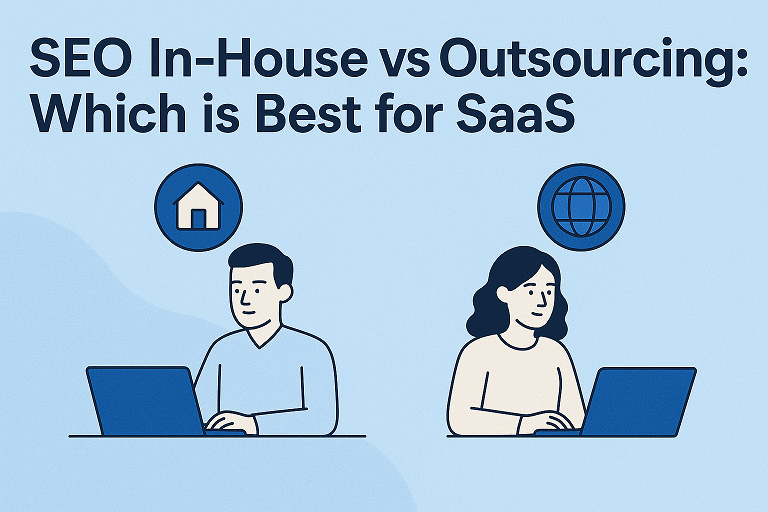
Choosing between outsourcing SEO and building an in-house SEO team is one of the biggest decisions for growing businesses. Both options come with unique strengths, challenges, and long-term implications for budgets, scalability, and performance.
This guide breaks down the decision based on industry research, expert analysis, and real-world examples. It also identifies content gaps missing in most top-ranking articles and fills them with fresh insights, statistics, and actionable frameworks—ensuring this blog becomes highly competitive for SEO, AEO, and AI-powered search results.
Top-ranking blogs cover:
What they miss (your content advantage):
This blog fills these gaps to make the article more comprehensive than existing content.
SEO today is no longer a one-person skill. It involves:
According to a 2025 digital marketing survey, 58% of businesses struggle to keep up with SEO due to a lack of in-house expertise, and 72% report higher ROI when working with specialized SEO teams or agencies.
This shows a clear shift: brands need multidisciplinary SEO, not just someone who can “optimize keywords.”
Hiring an external agency, consultant, or SEO specialist to handle parts—or all—of your search engine optimization.
Agencies bring diverse experience from multiple niches, allowing them to identify quick wins and proven strategies faster.
Most agencies work with hundreds of websites—giving them insights no in-house team can match.
No hiring, training, employee retention, software licensing, or infrastructure costs.
Research shows businesses save 30–45% in SEO operational expenses by outsourcing instead of hiring full-time teams.
You can increase or decrease the scope anytime—ideal for businesses with fluctuating needs.
Agencies typically use:
However, these challenges can be reduced with clear KPIs, weekly reporting, and defined expectations.
Hiring full-time SEO talent to handle strategy and execution internally.
Your team knows the company:
This can strengthen content relevance and internal alignment.
No external approvals or scheduling delays—work moves faster.
SEO integrates with:
This synergy is useful for large organizations with constant campaigns.
A full SEO team typically requires:
Hiring even one SEO specialist can cost $40,000–$90,000/year, depending on region and skills.
SEO evolves monthly. Without regular upskilling, in-house teams fall behind.
In-house teams only see one website, reducing their ability to identify wider industry patterns.
Scaling a team requires hiring, onboarding, and budget increments—making it difficult for fast-growth businesses.
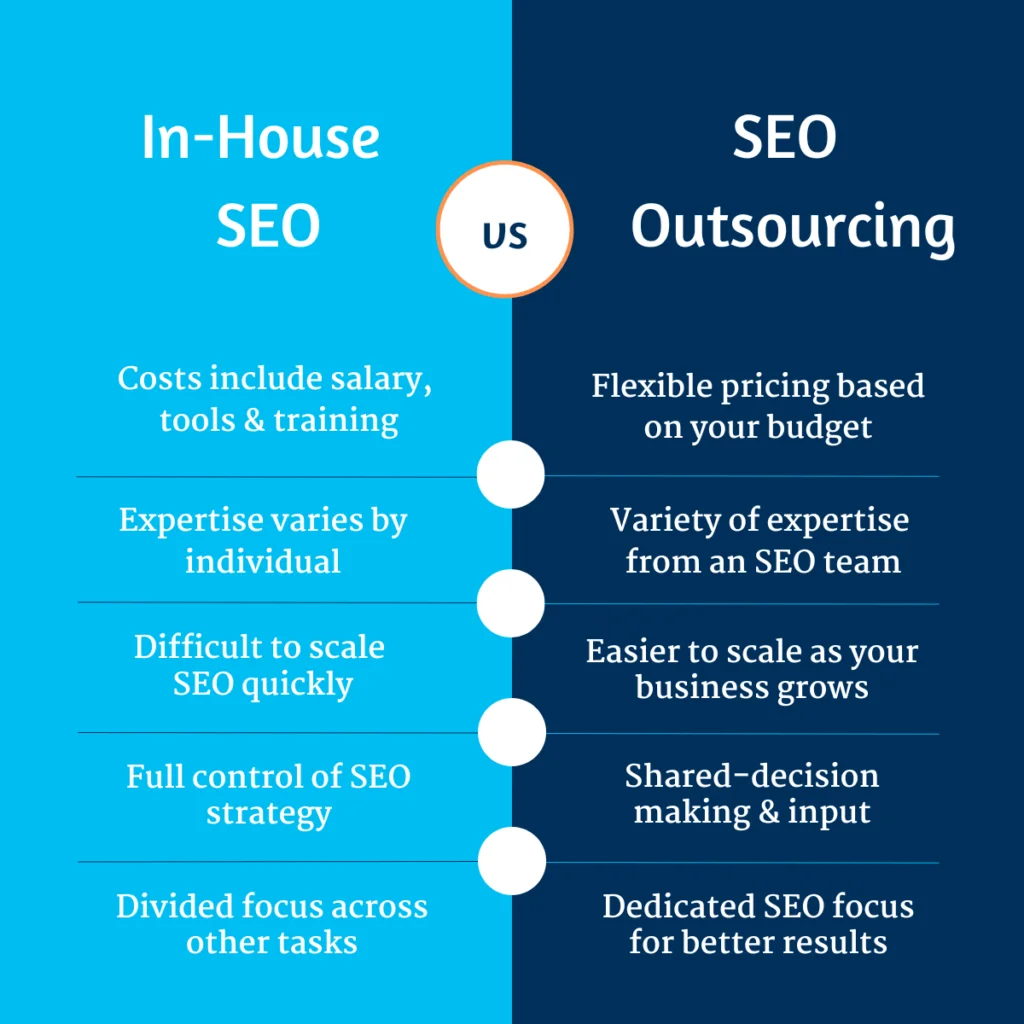
| Factor | Outsourced SEO | In-House SEO |
|---|---|---|
| Cost | Lower operational cost | Higher salary + software cost |
| Expertise Level | Multi-industry expertise | Strategic, but depends on the agency |
| Scalability | Highly scalable | Slow and costly to scale |
| Brand Understanding | Moderate | Strong |
| Control | Shared | Full control |
| Speed | Strategic, but depends on agency | Faster for internal tasks |
| Tools & AI Assets | Comes with advanced tools | Must be purchased separately |
| Flexibility | Very flexible | Limited |
Best for: Startups, small businesses, service businesses, e-commerce stores, regional brands, and growing marketers.
Best for: Large enterprises, media publications, SaaS companies, international brands.
Many modern companies now use a hybrid SEO model, where:
Industry data shows 41% of growing digital brands now prefer hybrid SEO teams because they offer:
Example:
A SaaS brand may keep a full-time SEO strategist but outsource link building to an agency that specializes in high-authority outreach.
Smaller budgets → outsourcing
Larger budgets → in-house or hybrid
If SEO is core to your business model, in-house eventually makes sense.
Highly competitive niches require agency-grade expertise for link building and technical optimization.
Outsourcing saves time; managing in-house teams requires oversight.
Agencies already include top-tier AI and SEO tools.
Yes. Outsourcing typically reduces costs by 30–45% because you avoid salaries, software licenses, and training expenses.
Not realistically. Modern SEO requires technical skills, content strategy, AI optimization, and digital PR—usually beyond one person’s scope.
Look for transparent reporting, case studies, clear KPIs, and experience in your industry.
For many companies, yes. It offers expertise, flexibility, and better control than relying solely on one approach.
Generally, 3–6 months for noticeable improvements and 6–12 months for consistent results.
Choosing between outsourced SEO and in-house SEO depends on your business size, budget, team structure, and long-term goals.
Outsourcing offers affordability and high expertise, while in-house teams provide deeper brand alignment. A hybrid model is becoming the future for companies wanting speed, control, and scalability.
Brands that succeed in 2026 and beyond will be those that adapt quickly, utilize AI-powered SEO frameworks, and choose the right team structure to match their growth ambitions.

Filza Taj is an MPhil in Human Resources-turned SEO Specialist, Content Strategist, and Digital Marketing Consultant with over 5 years of experience helping businesses in 30+ countries grow online. As the Founder of Stay Digital Marketers (staydigitalmarketers.com), she delivers results-driven solutions in link building, guest posting, PR distribution, niche edits, multilingual backlinks, and content marketing. She publishes daily SEO insights and actionable strategies to help brands strengthen their online presence, attract the right audience, and convert clicks into loyal customers.
Filza@staydigitalmarketers.com
Stay Digital Marketers
Need SEO, Link Building or Digital Marketing Services?
Request a Free Audit →