
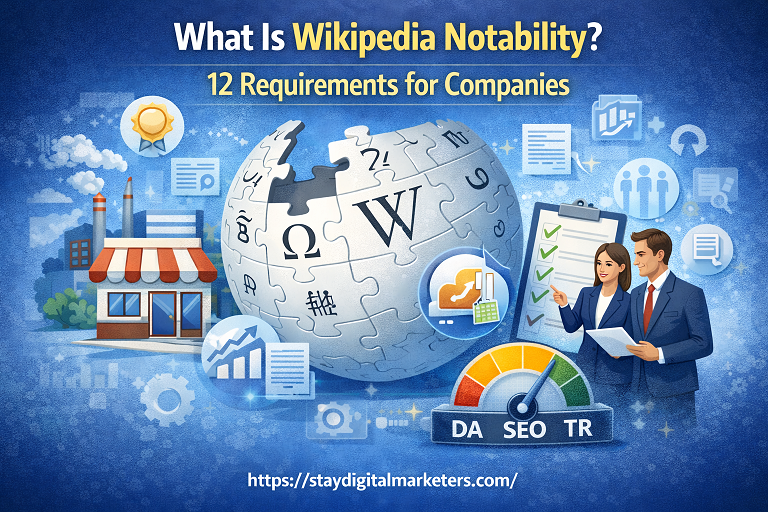
Wikipedia notability is the threshold a subject must meet to warrant its own article on the platform. For companies, this means demonstrating significant coverage in reliable, independent sources that are secondary in nature. The concept exists to maintain Wikipedia’s credibility as an encyclopedia rather than a directory of every business that exists.
Understanding Wikipedia notability is critical for any organization considering establishing a presence on the platform. The Wikimedia Foundation enforces strict guidelines to prevent self-promotion, advertising, and the proliferation of articles about subjects that lack genuine encyclopedic value. Companies that fail to meet these standards will see their pages nominated for deletion, regardless of their size, revenue, or market presence.
Wikipedia’s General Notability Guideline (GNG) establishes that a topic is presumed notable if it has received significant coverage in reliable sources that are independent of the subject. This applies universally across all Wikipedia articles, including those about companies and organizations.
The key phrase here is “significant coverage.” This means substantial, direct discussion of the subject itself, not mere mentions or trivial coverage. A company listed in a database, mentioned in passing in a news article about another topic, or featured in a press release distribution does not automatically qualify as notable.
Independent sources are equally important. Wikipedia does not consider content published by the company itself, its employees, or paid promoters as evidence of notability. The platform seeks third-party verification that others find the subject worthy of detailed attention.
A company must be covered in at least two or more independent, reliable sources. These sources should provide in-depth coverage rather than passing mentions. Trade publications, national newspapers, respected business journals, and academic publications typically qualify as reliable sources.
The sources cannot be connected to the company through ownership, employment, or payment. Press releases, company blogs, sponsored content, and affiliate websites do not count toward notability. Wikipedia editors scrutinize source independence carefully and will challenge articles that rely on questionable citations.
Brief news cycles or one-time mentions are insufficient. Companies must demonstrate sustained attention over time from multiple sources. A single viral moment or press release pickup does not establish notability, even if covered widely.
Wikipedia looks for evidence that journalists, analysts, or researchers have chosen to cover the company multiple times because of its genuine significance to an industry, market, or community. This pattern of coverage suggests lasting relevance rather than temporary interest.
Primary sources like financial filings, court documents, patents, or company announcements provide factual information but do not establish notability. Wikipedia requires secondary sources that analyze, discuss, or contextualize the company’s significance.
Secondary sources include news articles, analytical reports, academic studies, and industry analyses that interpret the company’s role, impact, or innovations. These sources demonstrate that independent parties consider the company worthy of examination and discussion.
Sources must discuss the company substantively, not mention it in passing. A list of startups, a brief quote from a CEO, or a database entry does not constitute significant coverage.
Wikipedia editors apply the “ten percent rule” as an informal guideline: the company should be the focus of at least ten percent of the source’s content. This ensures the source actually examines the subject rather than merely acknowledging its existence.
Sources must meet Wikipedia’s reliability standards, which means they employ editorial oversight, fact-checking, and established reputations for accuracy. Major newspapers, respected trade publications, peer-reviewed journals, and established business media qualify.
User-generated content platforms, personal blogs, press release sites, most social media, and questionable news outlets do not meet reliability standards. Wikipedia maintains detailed guidelines about source reliability that editors reference during article reviews.
Companies should demonstrate notability within their relevant geographic market or industry sector. A regional company may achieve notability through sustained local coverage in established regional media, while national or international companies require broader source diversity.
Industry-specific companies benefit from coverage in respected trade publications. A B2B software company covered extensively in enterprise technology publications may meet notability standards even without mainstream media attention.

While historical companies can qualify based on past significance, contemporary companies need recent coverage. Sources should generally be from within the last several years unless the company has historical significance.
A company that was notable decades ago but has since declined into obscurity may not maintain a Wikipedia presence unless historical sources establish lasting encyclopedic value. Conversely, newly established companies need time to accumulate the coverage necessary for notability.
Companies that have meaningfully impacted their industries, introduced innovations, influenced markets, or affected communities have stronger notability cases. Wikipedia values subjects that have made verifiable contributions beyond simply existing and conducting business.
This impact should be documented in independent sources that analyze or discuss the company’s significance. Patents alone do not establish notability, but coverage of how those patents changed an industry does.
Wikipedia strictly prohibits promotional writing and conflicts of interest. Companies cannot establish notability through paid placements, sponsored content, native advertising, or content marketing disguised as journalism.
Editors can identify promotional sources through disclosure statements, advertising labels, or patterns in coverage that suggest commercial relationships. Attempts to use such sources typically result in article deletion and potential editing restrictions.
All claims in a Wikipedia article must be verifiable through cited sources. Companies must have sufficient reliable source material available to construct a neutral, fact-based article that covers their history, operations, and significance.
If reliable sources do not exist to verify basic information about a company’s founding, leadership, operations, or impact, the company cannot maintain a Wikipedia presence regardless of its actual size or success.
Coverage that focuses solely on routine business operations, standard product releases, normal corporate announcements, or expected milestones does not establish notability. Wikipedia seeks evidence of significance beyond ordinary business activities.
A company must be discussed for reasons that extend beyond its day-to-day functions. Analysis of its market position, examination of its innovations, investigation of its controversies, or study of its influence on an industry all contribute to notability in ways that routine coverage does not.
Wikipedia applies specific presumption standards to organizations. Companies that are publicly traded on major stock exchanges, have received significant coverage for acquisitions or controversies, or have influenced regulatory discussions may more easily meet notability thresholds.
However, being publicly traded alone does not guarantee notability. Small-cap stocks with minimal coverage, shell companies, or organizations that trade on minor exchanges still require substantial independent source coverage to justify Wikipedia articles.
| Requirement Category | What Wikipedia Requires | What Doesn’t Qualify |
|---|---|---|
| Source Independence | Third-party journalism, academic research, industry analysis | Press releases, company blogs, paid content |
| Coverage Depth | Substantial discussion focused on the company | Brief mentions, directory listings, databases |
| Source Reliability | Established media, peer-reviewed journals, respected trade publications | Personal blogs, user-generated sites, promotional platforms |
| Content Type | Secondary sources that analyze and contextualize | Primary sources like court filings or financial documents alone |
| Coverage Pattern | Multiple sources over time showing sustained interest | Single viral moment or one-time coverage spike |
| Geographic Scope | Relevant to the company’s market or industry | Coverage insufficient for the claimed scope |
Many organizations misunderstand Wikipedia’s standards and attempt to create articles that inevitably face deletion. One common error is assuming that business success equals notability. A company generating millions in revenue with hundreds of employees may still lack Wikipedia notability if independent sources have not covered it substantially.
Another frequent mistake involves relying on press releases and company-controlled content. Organizations often point to dozens of press release pickups as evidence of coverage, not recognizing that Wikipedia considers these derivative of primary promotional material rather than independent journalism.
Companies also misinterpret industry directories, award lists, and conference participation as notability evidence. While these may indicate business legitimacy, they do not constitute the significant, independent coverage Wikipedia requires.
Some organizations attempt to establish notability through their founders or executives, assuming that notable individuals automatically confer notability to their companies. Wikipedia treats individuals and organizations as separate subjects, each requiring independent notability justification.
When someone creates a Wikipedia article about a company, it enters a review ecosystem where thousands of volunteer editors apply notability guidelines. New articles appear on various watchlists and monitoring feeds that experienced editors regularly check.
If an editor questions an article’s notability, they may add a notability tag that flags the article for community review. This tag does not immediately threaten the article but signals that sources need improvement or that the subject’s notability is unclear.
For articles that clearly fail notability standards, editors may nominate them for deletion through the Articles for Deletion (AfD) process. This creates a public discussion where editors debate whether sources adequately establish notability. The discussion typically lasts seven days, after which an administrator evaluates consensus and either keeps or deletes the article.
Wikipedia also operates a Draft namespace where new articles can be submitted for review before publication. This allows experienced editors to evaluate notability and source quality before the article appears in the main encyclopedia. Companies benefit from using this process as it prevents public deletion discussions and associated reputation concerns.

Organizations considering Wikipedia presence should conduct honest source audits before attempting article creation. Begin by searching for your company name in Google News, academic databases, and industry publication archives.
Catalog every article that discusses your company substantively. Exclude press releases, company announcements, sponsored content, and brief mentions. Evaluate whether each remaining source is independent, reliable, and provides significant coverage.
If you identify fewer than three truly independent, in-depth sources, your company likely does not yet meet notability standards. This does not reflect business failure but simply indicates insufficient external documentation for encyclopedic coverage.
For companies that do meet basic notability thresholds, assess whether sufficient source material exists to write a comprehensive, neutral article. Wikipedia articles require multiple sections covering history, operations, products, reception, and controversies if applicable. Adequate sources should exist for each section.
Companies cannot force notability but can engage in activities that naturally generate the coverage Wikipedia values. Genuine innovation, meaningful industry contributions, community impact, and business significance tend to attract independent media attention over time.
Focus on activities that journalists and analysts find genuinely newsworthy: developing innovative products, contributing to open-source projects, publishing significant research, engaging in notable acquisitions or partnerships, or taking positions on important industry issues.
Cultivate relationships with journalists by being responsive sources, providing expert commentary on industry trends, and making executives available for interviews on topics beyond company promotion. Over time, this positions your organization as a thought leader worth covering.
Avoid manipulative tactics like hiring PR firms to place promotional content disguised as journalism. Wikipedia editors can identify these patterns, and such tactics may permanently damage your organization’s chances of establishing legitimate Wikipedia presence.
Companies that create Wikipedia articles without meeting notability standards face several negative outcomes. Most immediately, the article will likely be deleted, sometimes within hours of creation if notability deficiencies are obvious.
Deletion discussions become part of Wikipedia’s permanent, public record. Future attempts to recreate the article face additional scrutiny because editors remember previous deletion debates. Repeated attempts to create non-notable articles can result in page protection that prevents creation entirely.
Companies that hire individuals or firms to create Wikipedia articles using questionable sources or promotional language may find themselves subject to investigations into paid editing, conflicts of interest, or sockpuppetry. These investigations can result in harsh sanctions including topic bans and username blocks.
From a reputation perspective, failed Wikipedia articles signal to customers, partners, and investors that third parties do not find your company sufficiently significant for encyclopedic documentation. This can be more damaging than having no Wikipedia presence at all.
Organizations that do not meet Wikipedia notability standards have several legitimate alternatives for establishing authoritative online presence. Focus on comprehensive About pages on your company website that provide detailed, factual information about history, leadership, products, and milestones.
Develop thought leadership content that establishes expertise without direct self-promotion. Publish research, contribute to industry discussions, and create educational resources that naturally attract links and citations from others.
Optimize presence on business information platforms like Crunchbase, LinkedIn, and industry-specific directories. While these do not provide the credibility of Wikipedia, they serve as authoritative sources for basic company information.
Invest in public relations strategies that generate legitimate news coverage over time. Focus on actual newsworthiness rather than promotional announcements, and prioritize quality of coverage over quantity.
Early-stage companies rarely meet Wikipedia notability standards regardless of funding, growth rates, or internal metrics. Wikipedia’s standards intentionally favor established subjects with track records documented in independent sources.
Startups should recognize that Wikipedia notability typically requires several years of operations and sustained media attention. Premature attempts to create Wikipedia articles waste resources and create negative precedents that complicate future legitimate efforts.
Focus instead on building products, serving customers, and achieving milestones that naturally warrant media coverage. As your company matures and generates genuine news value, notability may develop organically.
If competitors have Wikipedia articles, resist the temptation to create one prematurely. Each subject is evaluated independently, and their notability does not confer notability to your organization.
Companies that successfully establish Wikipedia presence must maintain notability through continued significant coverage. Organizations that fade from public attention, exit markets, or cease operations may see their articles nominated for deletion if coverage stops entirely.
However, companies with historical significance typically retain Wikipedia articles even after operations cease. The key factor is whether the company made lasting contributions to its industry, influenced markets, or played notable roles in business history.
Active companies should continue earning media coverage through genuine business activities rather than attempting to manipulate their Wikipedia articles directly. Wikipedia’s conflict of interest guidelines strongly discourage companies from editing their own articles except to correct clear factual errors using the Talk page.
For companies working to establish authority online, Wikipedia represents a long-term goal rather than an immediate tactic. Organizations should view Wikipedia notability as a validation of broader success rather than a standalone objective.
Building toward Wikipedia notability aligns with legitimate digital marketing strategies focused on thought leadership, media relations, and establishing industry expertise. These activities generate the independent coverage that both supports business growth and eventually meets Wikipedia’s standards.
Many businesses partner with experienced professionals who understand Wikipedia’s culture, guidelines, and review processes to assess notability and guide strategy. Firms that specialize in digital authority, reputation management, and strategic communications often help companies navigate these complex requirements. For instance, Stay Digital Marketers assists brands with various aspects of online visibility, including understanding the documentation needed for platforms like Wikipedia, alongside their services in guest posting, press release distribution, niche edits, and related digital marketing initiatives that collectively build the kind of independent coverage necessary for establishing a credible online presence.
Can a company create its own Wikipedia page?
Companies can technically create their own Wikipedia pages, but this violates Wikipedia’s conflict of interest guidelines and almost always results in deletion. Organizations with legitimate notability should request article creation through Wikipedia’s Articles for Creation process or allow independent editors to create articles naturally.
How long does a company need to exist before being notable on Wikipedia?
There is no specific age requirement, but most companies need several years to accumulate sufficient independent coverage. Rare exceptions exist for companies that immediately generate significant media attention through innovation, controversy, or major industry impact.
Does being publicly traded guarantee Wikipedia notability?
No. While publicly traded companies on major exchanges have higher likelihood of meeting notability standards due to regulatory coverage and analyst attention, trading status alone does not guarantee notability. Small-cap stocks with minimal coverage still require substantial independent sources.
Can a company use press releases as evidence of notability?
Press releases do not establish notability because they are not independent sources. However, if major media outlets pick up a press release and write original articles analyzing its content, those secondary news articles may contribute to notability.
What happens if a Wikipedia article about my company is deleted?
Deleted articles can potentially be recreated if notability standards are later met through additional coverage. However, repeated deletion attempts using the same inadequate sources will result in page protection preventing future creation. Companies should resolve notability issues before attempting recreation.
How many sources does a company need for Wikipedia notability?
Wikipedia’s guidelines do not specify an exact number, but most successful company articles cite at least 5-10 substantial, independent sources. Quality matters more than quantity—three in-depth articles from major publications outweigh dozens of brief mentions.
Can customer reviews or testimonials establish Wikipedia notability?
No. Customer reviews, testimonials, social media mentions, and similar user-generated content do not meet Wikipedia’s reliability standards. Notability requires independent journalism, academic research, or professional analysis from established sources.
Does winning awards make a company notable on Wikipedia?
Awards alone do not establish notability unless the awards themselves are notable and the company’s win receives significant independent coverage. Industry recognition contributes to a notability case but cannot be the sole basis for a Wikipedia article.

Filza Taj is an MPhil in Human Resources-turned SEO Specialist, Content Strategist, and Digital Marketing Consultant with over 5 years of experience helping businesses in 30+ countries grow online. As the Founder of Stay Digital Marketers (staydigitalmarketers.com), she delivers results-driven solutions in link building, guest posting, PR distribution, niche edits, multilingual backlinks, and content marketing. She publishes daily SEO insights and actionable strategies to help brands strengthen their online presence, attract the right audience, and convert clicks into loyal customers.
Filza@staydigitalmarketers.com
Stay Digital Marketers
Need SEO, Link Building or Digital Marketing Services?
Request a Free Audit →