
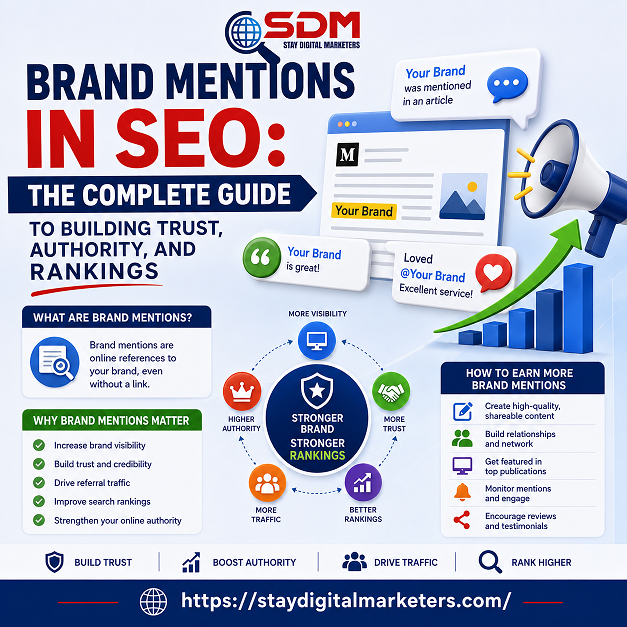
A brand mention is any online reference to your business, product, or service, whether or not it includes a hyperlink. It appears in news articles, Reddit threads, podcasts, review sites, social posts, forum comments, and AI-generated answers. When authoritative sources consistently mention a brand in relevant contexts, search engines and AI systems treat those signals as evidence of credibility, topical authority, and real-world trust.
Brand mentions have moved from a secondary SEO consideration to a primary ranking signal. Google’s shift toward entity-based search and the rise of AI Overviews, ChatGPT, and Perplexity have fundamentally changed what “visibility” means. A brand that earns consistent, contextually relevant mentions across trusted sources is now far more likely to appear in both traditional SERPs and AI-generated answers than one that focuses only on technical optimisation or link building.
A brand mention in SEO is any reference to your brand name, product, or service that appears publicly online. Unlike backlinks, brand mentions do not require a hyperlink to carry weight. Search engines use Natural Language Processing (NLP) to detect, interpret, and contextualise these references as part of how they determine what a brand is known for, how trustworthy it is, and where it belongs in search results.
Three types exist:
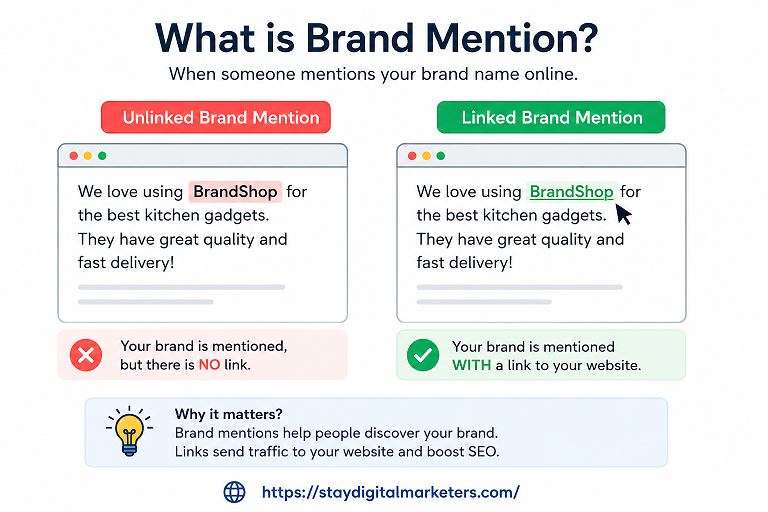
There is also a fourth, emerging category: AI mentions, where your brand name appears inside a response generated by ChatGPT, Gemini, Perplexity, or Google AI Overviews. These operate differently from traditional mentions because they directly influence purchasing decisions at zero-click moments without the user ever visiting a website.
Google uses Natural Language Processing and Named Entity Recognition (NER) to read web content the way a human would. When it encounters your brand name in a sentence about “the best ergonomic office chairs,” it does not just log a keyword match. It registers the relationship between your brand, the product category, the sentiment expressed, the authority of the source, and the broader context of the article.
Over time, these signals accumulate into what Google calls an entity profile, a web of associations that tells the algorithm who your brand is, what it does, and whether it deserves to appear prominently for related queries. Brands are 6.5x more likely to be cited by AI systems through third-party sources than through their own domains
Moz, Ahrefs, and industry researchers have published analyses suggesting that unlinked brand mentions correlate with improved domain authority and search visibility. A widely cited insight from former Google engineer Bill Slawski notes that Google has filed patents describing systems capable of treating co-citations and implied links as ranking-relevant signals, even without an anchor link.
Google’s quality evaluation framework, E-E-A-T (Experience, Expertise, Authoritativeness, Trustworthiness), is heavily informed by how a brand appears across the open web. A brand consistently mentioned by dermatologists, cited in health journals, reviewed positively on independent platforms, and discussed in professional forums scores higher on E-E-A-T than one with no third-party footprint, regardless of how polished its own website is.
Mentions do not directly edit your E-E-A-T score, because E-E-A-T is not a score. But they supply the evidence that Google’s quality raters and algorithms use to assess each dimension. Expertise is inferred from who mentions you. Authority is shaped by where those mentions appear. Trust is built when mentions are consistent, accurate, and positive over time.
Yes, and this is where the game has changed most significantly. AI systems like Gemini, ChatGPT, and Perplexity are trained on vast datasets of web content. The brands that appear most frequently and most positively across trusted sources become the brands these systems recommend when users ask questions like “what is the best CRM for small businesses?” or “which project management tool do developers prefer?”
Research by Semrush published in 2025 found that Reddit was the most cited domain in AI-generated answers across major LLMs. This confirms that community-driven, high-volume brand discussions directly influence AI recommendations. Brands that appear in Reddit threads, Quora answers, G2 reviews, and trusted industry publications are far more likely to be cited by AI than brands with minimal third-party presence.
If your brand does not appear in the sources AI systems trust, it will not appear in AI answers, regardless of how strong your website is.
Most guides cover brand mentions as a monitoring task or a PR activity. What they miss is a systematic process that connects mention generation, quality evaluation, and SEO impact into a single repeatable workflow. The MARC Framework addresses this gap.
M: Monitor every mention across web, social, forums, podcasts, and AI platforms. A: Assess each mention for quality, sentiment, source authority, and relevance. R: Respond or Recover, engaging with positive mentions and addressing negative or inaccurate ones. C: Convert unlinked mentions into backlinks and underperforming mentions into improved entity signals.
Running through these four steps monthly creates a compounding cycle. Each round of monitoring reveals new outreach opportunities. Each converted backlink strengthens the domain. Each corrected inaccuracy improves the brand’s entity accuracy in Google’s Knowledge Graph.
Several tools handle brand mention tracking with different strengths:
| Tool | Best For | Notable Feature |
|---|---|---|
| Google Alerts | Beginners, low volume | Free, email-based, web only |
| Semrush Brand Monitoring | Full-stack monitoring | Sentiment analysis, SEO integration |
| Mention.com | Social-heavy brands | Real-time social listening |
| Ahrefs Alerts | Backlink-focused tracking | Distinguishes linked vs unlinked |
| Brand24 | SMBs and agencies | Reach scoring, influence filters |
| Talkwalker | Enterprise brands | AI-powered sentiment, broadcast monitoring |
Google Alerts remains the most accessible starting point. Set up alerts for your brand name, common misspellings, product names, and key executive names. Supplement this with manual searches on Reddit, X (formerly Twitter), TikTok, and LinkedIn, as Alerts does not surface social content.
For tracking AI mentions specifically, Semrush’s Prompt Tracking tool monitors whether your brand appears in AI-generated answers for specified queries across Gemini, ChatGPT, and Google AI Mode. This is a function no traditional brand monitoring tool offers, and it has become essential for visibility in AI-first search environments.
Tracking volume alone is insufficient. The metrics that actually connect mentions to business and SEO outcomes are:
Share of Voice: What percentage of the brand conversations in your category does your brand own, compared to competitors? A rising share of voice across trusted publications predicts improved rankings before the ranking shift itself is visible.
Mention Sentiment Ratio: The ratio of positive to negative to neutral mentions. A brand with 80% positive sentiment earns stronger entity trust signals than one with 60% positive, even if total mention volume is identical.
Source Authority Distribution: Are mentions coming from high-DA sites in your niche, or from spam-adjacent directories? Three mentions from industry-specific, editorially controlled publications outweigh 300 mentions from low-quality forums.
Linked Mention Rate: What percentage of your brand mentions include a hyperlink? This number reveals the gap between current mentions and potential link equity, which converts directly into outreach opportunity.
AI Visibility Score: How often does your brand appear in AI-generated answers for your target queries? This metric is now as important as traditional keyword rankings for many B2B and high-consideration categories.
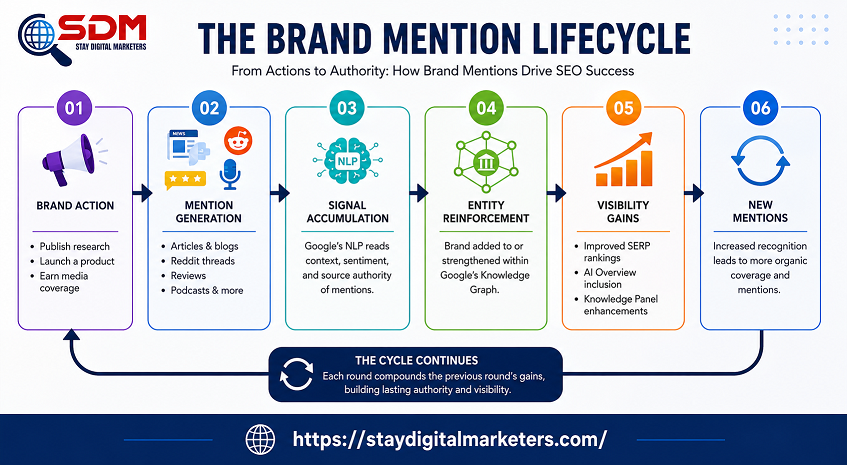
Original research consistently generates the highest volume of high-authority brand mentions. When a brand publishes a proprietary study, survey, or data analysis, journalists, bloggers, and content writers need to credit that source by name every time they reference the data. This creates compounding citations that require zero ongoing outreach.
The most mention-worthy content categories, ranked by typical citation rate:
The key variable is that the content must offer something no one else has published. Summaries, listicles, and aggregated opinion pieces rarely earn brand mentions because they add no unique knowledge to the web.
Digital PR generates brand mentions by placing your story, data, or expertise inside publications your target audience already reads and that AI systems already trust. Unlike traditional PR, digital PR is explicitly designed to earn editorial coverage that improves search visibility, not just press coverage for its own sake.
An effective digital PR campaign for brand mention generation typically includes:
One frequently overlooked digital PR tactic is the reactive quote. When a major development happens in your industry, emailing three to five journalists who cover that beat with a sharp, specific expert comment often earns a named brand mention in their coverage the same day. It requires no research budget, no campaign production, and no long lead time.
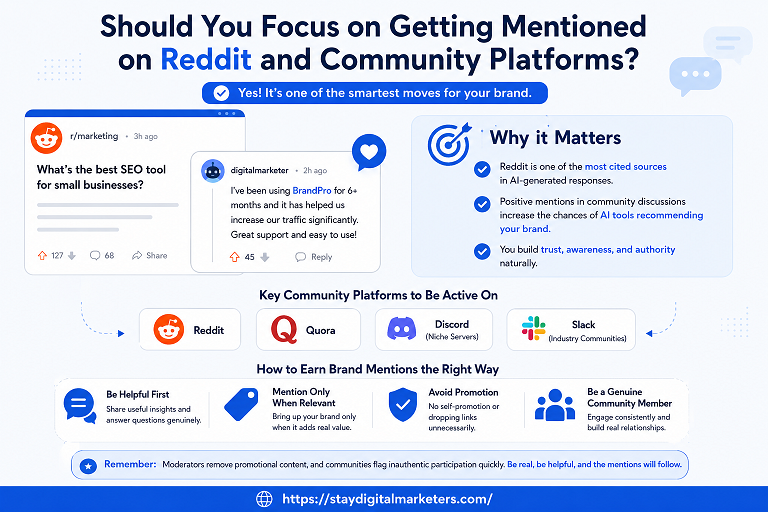
Yes, and the reason is now evidence-based rather than theoretical. Multiple studies published in 2024 and 2025 confirmed that Reddit is among the most heavily cited sources in AI-generated responses across ChatGPT, Perplexic, and Gemini. A brand that appears positively in Reddit discussions about its category is far more likely to be recommended by AI tools than one absent from those conversations.
Participation in Reddit, Quora, niche Discord servers, and industry Slack communities should be treated as a brand mention generation channel, not simply a community relations activity. The guidelines for doing this effectively are straightforward: contribute genuinely useful information first, mention your brand only when contextually appropriate, and never participate in a way that reads as promotional.
Moderators remove promotional content, and communities flag inauthentic participation quickly. The only sustainable approach is to become genuinely helpful in conversations your target audience is already having.
Reviews on Google Business Profile, Trustpilot, G2, Capterra, and Amazon constitute a high-volume, consistently updated source of brand mentions across trusted, indexed domains. They carry particular weight for local SEO and for AI systems, both of which treat review platforms as authoritative proxies for real-world product quality.
Encouraging specific, detailed reviews rather than generic star ratings significantly improves the mention quality. A review that names the specific product, describes the problem it solved, and mentions the brand in context provides Google with richer entity data than a review saying “Great service, five stars.”
The most effective timing for review requests is immediately after a demonstrable success event: a successful delivery, a resolved support ticket, a completed onboarding, or a renewal decision. This captures the moment when sentiment is highest and the customer’s experience is most vivid.
Unlinked mention outreach is among the highest-conversion link building tactics available, because the target has already demonstrated willingness to reference your brand. The conversion requirement is simply adding a hyperlink to something they have already written.
The outreach message should:
Avoid phrases like “this would benefit both of us” or “I noticed you mentioned us.” The message should feel like a helpful reader observation, not a sales pitch. Tuesday and Wednesday mornings tend to produce higher reply rates than other days, based on outreach data across multiple link building campaigns.
Not every unlinked mention merits outreach. Prioritise sources with a Domain Authority above 40, that are topically relevant to your niche, and that rank for terms in your target keyword clusters. A mention on a high-authority publication that earns no organic traffic for related queries is still valuable as an entity signal, but a do-follow link from a well-ranking page adds compounding link equity on top.
Yes. The process is:
Brands running this process consistently generate three to eight new backlinks per month purely from existing brand mentions, with no content creation required.
Google does not publicly confirm that negative sentiment directly reduces rankings. However, the entity signals Google associates with a brand are built from the cumulative tone of how that brand is discussed across the web. A sustained pattern of negative mentions, particularly on high-authority sources, shapes the entity profile in ways that affect featured snippet eligibility, Knowledge Panel content, and E-E-A-T assessments.
Negative mentions also suppress click-through rates when they appear in branded search results. If a user searching your brand name sees negative reviews or critical articles prominently in the results, conversion rates from branded traffic decline even when your pages rank first.
A simple decision framework:
Respond when the mention includes a genuine customer concern, a factual misunderstanding you can correct, or a positive comment that represents your brand values. Responding to positive mentions builds community and encourages future advocacy.
Escalate when the mention contains false factual claims, potential legal exposure, defamatory content, or is appearing on a site that ranks prominently for your brand name.
Ignore when the mention is a spam comment with no audience, an old thread generating no engagement, or a vague negative opinion with no specific claim to address. Creating fresh, authoritative positive content gradually suppresses low-impact negative mentions without the need for direct engagement.
Google’s Knowledge Graph organises entities, brands, people, products, and concepts into a structured map of relationships. When a brand is mentioned frequently across trusted, topically relevant sources, Google begins treating that brand as an entity worthy of Knowledge Graph inclusion.
A Knowledge Panel entry, the information box that appears in search results for established entities, is one of the clearest indicators that Google considers a brand entity-confirmed. It typically requires consistent brand mentions across authoritative sources, a verified Wikipedia or Wikidata presence, and structured data on the brand’s own website.
The path to Knowledge Panel eligibility runs directly through brand mention volume and quality. Brands that earn consistent, accurate, positive coverage across multiple trusted sources build the entity foundation that makes Knowledge Panel inclusion achievable. Services that specialise in Wikipedia page creation and structured entity verification help accelerate this process by providing Google with the authoritative third-party reference it needs to confirm an entity’s existence and attributes.
Large language models are trained on datasets drawn primarily from the open web. The brands they recommend in response to queries are disproportionately those that appear most frequently, most positively, and in the most authoritative sources within their training data.
The implication is straightforward: the best strategy for appearing in AI recommendations is the same strategy that earns strong traditional SEO visibility. Publish original research. Earn coverage on trusted publications. Maintain positive review profiles. Participate genuinely in community discussions. Ensure your Wikipedia or Wikidata presence is accurate and current.
There is one AI-specific addition: structured, quotable content. AI systems pull specific phrases and claims when constructing responses. Content written with clear, self-contained statements, short definitional paragraphs, and direct answers to common questions is more likely to be quoted accurately in AI-generated responses than dense, discursive prose.
An AI mention is when a brand name appears in the body of an AI-generated response without a hyperlink. An AI citation is when the brand’s content is referenced as a source, typically with a link.
Both matter. AI mentions shape perception and influence decisions at the moment of search, even when no link drives traffic. AI citations generate referral traffic from users who click through to read the cited source. A comprehensive brand visibility strategy aims for both, by being mentioned as a trusted authority in answers and by publishing the kind of structured, authoritative content AI systems cite as sources.
| Strategy | SEO Impact | AI Visibility Impact | Effort Required | Time to Results |
|---|---|---|---|---|
| Original research publication | Very High | Very High | High | 3 to 6 months |
| Digital PR outreach | High | High | Medium | 1 to 3 months |
| Unlinked mention conversion | High | Low | Low | 1 to 4 weeks |
| Community participation (Reddit, Quora) | Medium | Very High | Medium | 2 to 6 months |
| Review generation campaigns | Medium | Medium | Low | 1 to 2 months |
| Expert quote outreach | Medium | Medium | Low | 2 to 4 weeks |
| Influencer and creator partnerships | Medium | Medium | Medium | 1 to 3 months |
What is the difference between a brand mention and a backlink? A backlink is a hyperlink on an external site pointing to your website. A brand mention is any reference to your brand name online, with or without a link. Backlinks pass link equity directly. Brand mentions build entity signals and topical authority, which influence rankings indirectly through trust and relevance associations.
Do unlinked brand mentions actually help SEO? Yes. Google’s NLP systems detect brand mentions without hyperlinks and use them to build entity associations. Research and patent filings confirm that co-citations and implied links are treated as relevance and authority signals, particularly in semantic search and AI-driven ranking systems.
How many brand mentions do you need to rank better? There is no universally applicable threshold. What matters more than volume is quality, relevance, and consistency. Three mentions from high-authority, topically relevant publications carry more weight than 300 from low-quality or unrelated sources. The goal is to be mentioned in the right places, in the right context, with positive or neutral sentiment.
Can negative brand mentions hurt your SEO? Directly and demonstrably negative mentions on high-authority sites can shape your entity profile in ways that affect E-E-A-T assessments and click-through rates from branded searches. Sustained patterns of negative coverage are more damaging than isolated incidents. Addressing factual inaccuracies promptly and publishing positive, authoritative content reduces the long-term impact.
How do you track brand mentions for free? Google Alerts covers web-indexed mentions at no cost. For social media, manual searches on Reddit, X, and TikTok supplement Alerts’ gaps. Ahrefs’ free tools surface some unlinked mention data. For AI visibility, manually testing target queries across ChatGPT, Gemini, and Perplexity on a weekly basis provides a baseline without tool costs.
How do brand mentions affect AI Overviews and LLM recommendations? AI systems trained on web data reflect the brand associations embedded in that data. Brands frequently mentioned positively on Reddit, trusted publications, and review platforms appear more often in AI-generated recommendations. Structured, quotable content on your own site increases the chance of being cited directly in AI responses.
What is the fastest way to earn brand mentions? Reactive expert quotes are the fastest method. When major news breaks in your industry, emailing three to five relevant journalists with a specific, insightful comment can earn named brand mentions in their coverage within 24 to 48 hours. Unlinked mention conversion is the next fastest, as the target has already referenced your brand
Brands developing a brand mention strategy often need support on the link-building side that complements organic mention efforts. Stay Digital Marketers provides a range of backlink-related services for this purpose, including guest posting, press release distribution, niche edits, brand mentions, SaaS backlinks, Wikipedia page creation, and Google Knowledge Panel creation. For teams looking to build a complete entity authority profile alongside their mention monitoring work, these services address the structural components that earned mentions alone cannot always supply.

Filza Taj is an MPhil in Human Resources-turned SEO Specialist, Content Strategist, and Digital Marketing Consultant with over 5 years of experience helping businesses in 30+ countries grow online. As the Founder of Stay Digital Marketers (staydigitalmarketers.com), she delivers results-driven solutions in link building, guest posting, PR distribution, niche edits, multilingual backlinks, and content marketing. She publishes daily SEO insights and actionable strategies to help brands strengthen their online presence, attract the right audience, and convert clicks into loyal customers.
Filza@staydigitalmarketers.com
Stay Digital Marketers
Need SEO, Link Building or Digital Marketing Services?
Request a Free Audit →