
A Google algorithm update is any confirmed change to the ranking systems Google uses to decide which pages appear, and in what order, for a given search query. Some updates are narrow, targeting a single problem such as manipulative links or thin affiliate content. Others are broad core updates that reassess quality signals such as expertise, trustworthiness, and helpfulness across the entire index at once.
Since 2011, Google has confirmed dozens of named updates, but only a small number reshaped how SEO professionals actually build websites. This guide walks through nine of those turning points, from the earliest attack on content farms to the Information Gain focus introduced in the May 2026 core update, and explains what each one changed for good.
Key Takeaways
Rather than reacting to each new update in isolation, it helps to run every ranking shift through a consistent process. The SURM framework, developed for evaluating update impact, breaks that process into four stages:
Panda was the first update to directly penalize thin, duplicate, and low-value content at scale. Its initial rollout affected close to 12 percent of English-language search queries in the United States, a scale of impact few later updates matched. Content farms built on churning out shallow articles lost visibility almost overnight, and content depth became a baseline requirement rather than a nice-to-have.
Penguin targeted manipulative link-building tactics, including paid links, link farms, and keyword-stuffed anchor text. Sites that had built rankings purely on link volume saw sharp drops, while sites with naturally earned, relevant backlinks were rewarded. Penguin was later folded into Google’s real-time core algorithm in 2016, meaning link-spam evaluation now happens continuously instead of through periodic refreshes.
Hummingbird rebuilt how Google parsed queries, moving away from matching individual keywords toward understanding the meaning behind a search. This update laid the groundwork for conversational and voice search, and it marked the point where writing for exact-match phrases started losing ground to writing for the full intent behind a topic.
Mobilegeddon introduced mobile-friendliness as an official ranking signal for mobile search results. Sites without responsive design saw immediate visibility drops on mobile queries. A decade later, mobile usability remains foundational, and it now sits alongside Core Web Vitals as part of the technical baseline every ranking page has to clear.
RankBrain introduced machine learning into Google’s core ranking system, helping the algorithm interpret ambiguous or never-before-seen queries by comparing them to similar past searches. It was an early signal that Google’s ranking process would increasingly rely on learned patterns rather than fixed, rule-based signals, a trajectory that continues through today’s AI-assisted search features.
Fred targeted sites that prioritized advertising revenue over user value, particularly content-light blogs stacked with intrusive ads and affiliate links. It reinforced a pattern that recurs across nearly every major update since: pages built primarily to generate ad clicks or affiliate revenue, rather than to genuinely help the reader, are structurally at risk.
BERT gave Google a far stronger grasp of natural language context, including prepositions and phrasing that previously changed a query’s meaning without changing its keywords. It affected roughly one in ten search queries at launch, one of the broadest single-update impacts in Google’s history, and pushed content writers toward clearer, more precise language over keyword density.
The Helpful Content Update introduced a sitewide signal that specifically rewarded content written for people first and search engines second. Unlike Panda, which targeted low-quality content directly, this update evaluated whether a site’s overall content strategy matched genuine reader needs or was built primarily to capture search traffic, a distinction that became central to Google’s later E-E-A-T guidance.
The May 2026 core update rolled out over roughly two weeks and prioritized what Google calls Information Gain, meaning content that contributes genuinely new data, direct testing, or specialist perspective rather than repackaging what already ranks. Pages built on proprietary research, case studies, and named expert authorship gained visibility, while mass-produced list content and thin affiliate roundups took some of the sharpest losses of any update in recent years.
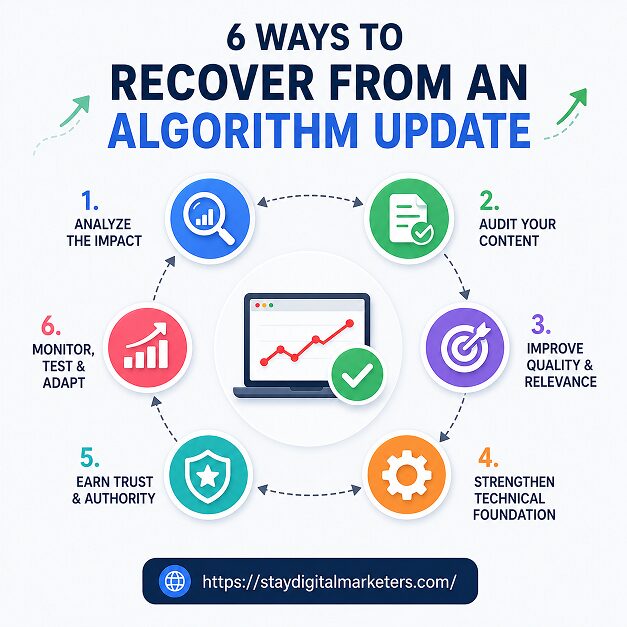
Looked at together, these updates trace one consistent direction: Google keeps narrowing the gap between what ranks and what genuinely helps a searcher. Across client recovery work, the pattern that shows up most often after a core update is not a single broken page, but a cluster of thin or repetitive content published to chase search volume rather than answer a real question. Sites that treat each update as a fresh content quality check, rather than a technical glitch to patch, tend to recover faster and hold gains longer.
A second pattern worth noting: recovery rarely comes from restoring old content unchanged. It comes from replacing generic sections with material only that specific site could produce, whether that is original data, direct product testing, or a named expert’s assessment. This is the same principle Information Gain formalized in 2026, but it has been visible in every major update back to Panda.
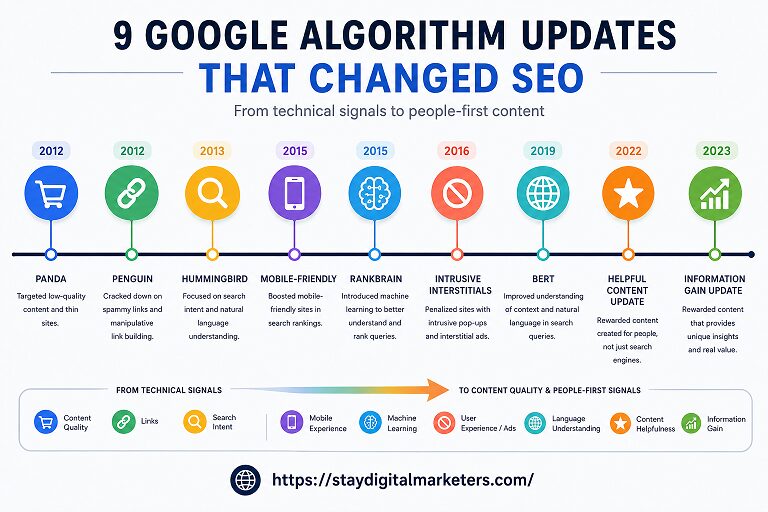
The table below summarizes each update’s primary target and the lasting shift it created in SEO practice.
| Update | Year | Primary Target | Lasting SEO Shift |
| Panda | 2011 | Thin & duplicate content | Content depth becomes a ranking prerequisite |
| Penguin | 2012 | Manipulative link schemes | Link quality replaces link quantity |
| Hummingbird | 2013 | Keyword-only matching | Search intent and semantic meaning take over |
| Mobilegeddon | 2015 | Non-mobile-friendly sites | Mobile usability becomes non-negotiable |
| RankBrain | 2015 | Rigid keyword matching | Machine learning enters core ranking |
| Fred | 2017 | Ad-heavy, low-value content | User value outweighs ad density |
| BERT | 2019 | Conversational query misreads | Natural language context shapes rankings |
| Helpful Content Update | 2022 | Content written for search engines first | People-first writing becomes a ranking signal |
| May 2026 Core Update | 2026 | Generic, mass-produced pages | Information Gain and first-hand expertise decide visibility |
Most practitioners point to Panda in 2011. It was the first update to directly penalize thin and duplicate content at scale, wiping out entire content-farm business models overnight and forcing the industry to treat content quality as a ranking factor rather than an afterthought.
Yes. Penguin was folded into Google’s real-time core algorithm in 2016, meaning link-spam signals are now evaluated continuously rather than through periodic manual updates. Sites no longer wait months for a refresh to recover from a link penalty.
Keywords still guide topic research, but exact-match phrasing lost its dominance after Hummingbird introduced semantic search and BERT added contextual language understanding. Content that answers the full intent behind a query now outperforms content built around a single exact phrase.
The May 2026 core update leaned heavily on Information Gain, rewarding pages that add proprietary data, direct testing, or specialist perspective rather than restating what already ranks. Mass-produced list content and thin affiliate pages were the hardest hit.
Recovery timelines vary widely, but most confirmed core updates finish rolling out within two to three weeks, and visible ranking recovery for improved pages typically follows over the next one to two update cycles rather than instantly.
No. Most updates reward or penalize specific patterns, such as thin pages, spammy links, or generic AI-style writing. Auditing the pages that match the update’s known focus is more efficient than rewriting an entire site from scratch.
Tracking algorithm history is only useful if it informs an active content and link strategy. Stay Digital Marketers works with brands navigating exactly this kind of post-update recovery, offering services such as guest posting, press release distribution, SaaS backlinks, niche edits, Wikipedia page creation, and Google Knowledge Panel creation to help sites rebuild authority signals that hold up across future core updates

Filza Taj is an MPhil in Human Resources-turned SEO Specialist, Content Strategist, and Digital Marketing Consultant with over 5 years of experience helping businesses in 30+ countries grow online. As the Founder of Stay Digital Marketers (staydigitalmarketers.com), she delivers results-driven solutions in link building, guest posting, PR distribution, niche edits, multilingual backlinks, and content marketing. She publishes daily SEO insights and actionable strategies to help brands strengthen their online presence, attract the right audience, and convert clicks into loyal customers.
Filza@staydigitalmarketers.com
Stay Digital Marketers
Need SEO, Link Building or Digital Marketing Services?
Request a Free Audit →