
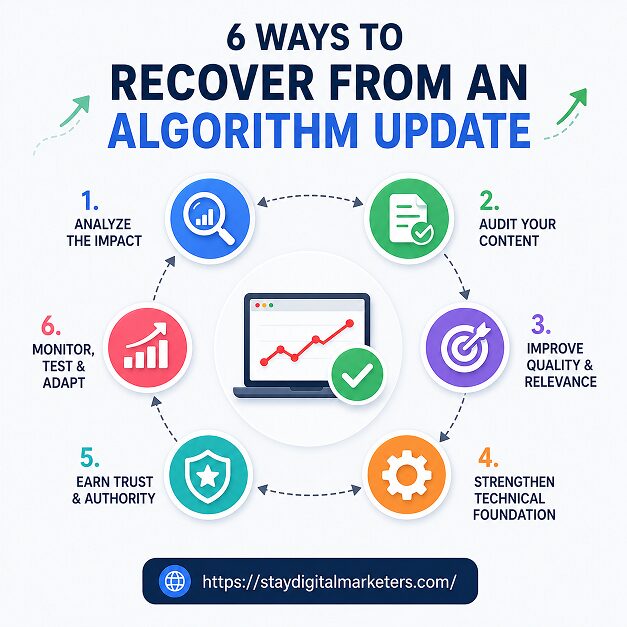
A practitioner’s framework for diagnosing traffic drops, rebuilding trust signals, and giving a site the best chance of recovering rankings after a Google core update.
A Google algorithm update, most often a broad core update, is a recalibration of how Google evaluates content quality across billions of pages. It is not a manual penalty, and there is no reconsideration request to file. When rankings drop after one, the page usually has not gotten worse. Other content has simply been reassessed as more useful, more trustworthy, or more relevant to the query.
Recovery, then, is not a single fix. It is the process of closing the quality gap Google’s systems identified, then waiting for those systems to recognize and reward the change. That process touches four connected areas: Google Search Console data, on-page E-E-A-T signals (Experience, Expertise, Authoritativeness, Trustworthiness), technical health measured through Core Web Vitals, and the Google Search Status Dashboard, which confirms whether an update is actually rolling out.
Across client work, the pattern that repeats most often is not a single broken element but an accumulation of small quality gaps: thin sections, generic bylines, outdated statistics, and pages that answer only part of what the searcher wanted. None of these look dramatic in isolation. Together, they are usually enough to explain a core update drop.
Key Takeaways
The Recovery Signal Stack treats algorithm update recovery as six layers, applied in order. Skipping a layer, such as jumping straight to content rewrites before confirming the drop is even update-related, is one of the most common reasons recovery efforts stall.
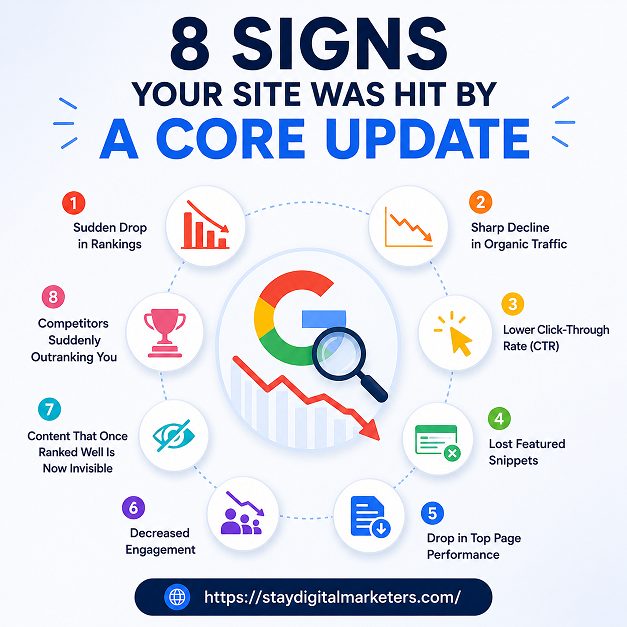
Not every traffic drop is a core update. Seasonal demand, a broken redirect, or a Search Console reporting anomaly can all look identical to algorithmic impact at first glance.
Google’s Search Status Dashboard lists every confirmed ranking update with start and end dates. If a traffic decline lines up with a listed rollout window, the cause is very likely algorithmic. If it does not, the investigation should shift toward technical or content issues before anything else.
Compare crawl stats, index coverage, and server response codes for the affected date range. A spike in 5xx errors or a sudden drop in indexed pages points to a technical cause that content changes alone will not fix.
Pull clicks and impressions for the 28 days before the update and the 28 days after, then sort by the largest percentage loss. A drop in impressions alongside a drop in clicks usually signals a ranking loss. Stable impressions with falling clicks usually signals a relevance or snippet problem rather than a ranking one.
Group affected URLs by template: listicles, comparison pages, service pages, and evergreen guides often respond differently to the same update. Listicles and roundup-style pages have shown some of the steepest declines in recent core updates, while first-person service and cost pages have in some cases gained ground during the same rollout.
Generic “editorial team” bylines are increasingly treated as a weak trust signal. Replacing them with named, credentialed authors and a linked bio page is one of the more consistent patterns among pages that hold their rankings through a core update.
A single expert bio on one flagship page is not enough. Experience signals carry more weight when they show up consistently across a topic cluster, not in isolation. First-person detail, specific outcomes, and practitioner-level language tend to outperform polished but generic expertise claims.
Rewriting a page in different words is not the same as adding value. Original screenshots, proprietary data, internal benchmarks, and documented first-hand observations are what separate a refreshed page from a page that genuinely answers more of the query than competitors do. A gap analysis against the current top three results, listing every question a searcher might reasonably have, is a practical way to find what is missing before rewriting anything.
Content improvements move slower when the technical foundation is weak. Confirm Largest Contentful Paint under 2.5 seconds, Interaction to Next Paint under 200 milliseconds, and Cumulative Layout Shift under 0.1 for the affected URLs, then fix the worst offenders first rather than trying to optimize every page at once.
Overlapping pages targeting near-identical queries dilute topical authority. Merging them into a single stronger resource with a proper 301 redirect, and tightening internal links toward it, is often more effective than publishing new content.
Reactive changes made while a rollout is still in progress are difficult to evaluate, since Google’s systems are actively reweighting signals during that window. Allowing a bake period of about a week after a rollout completes, before drawing conclusions from Search Console data, avoids reacting to noise.
Recovery timelines vary by site type and by how substantive the improvements are. The table below reflects patterns reported across recent core update cycles.
| Site Type | Typical Recovery Window | Primary Driver |
| Quick technical fixes | 2 to 4 weeks | Core Web Vitals, crawl errors |
| Standard content sites | 2 to 6 months | E-E-A-T and content depth improvements |
| YMYL sites (health, finance) | 6 to 12 months | Trust and authoritativeness signals |
| Sites waiting on the next update | Until next core update | Improvements made but not yet reassessed |
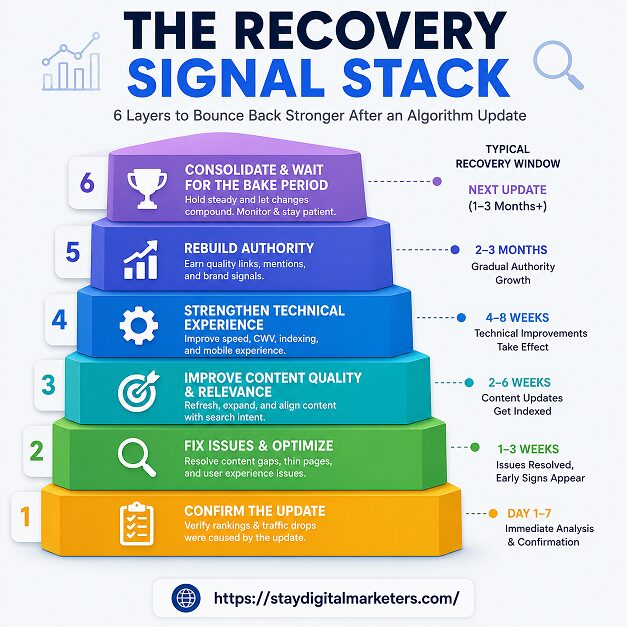
Most sites see partial recovery within 2 to 6 months, though quick technical fixes can show movement in as little as 2 to 4 weeks. YMYL sites and sites needing deeper content rebuilds often take 6 to 12 months, and some improvements only register once the next core update rolls out.
No. Always check the Google Search Status Dashboard first to confirm a rollout window matches the drop. Technical issues like broken redirects, deindexed pages, or seasonal demand shifts can produce an identical-looking decline without any update being involved at all.
Rarely. Core updates evaluate content quality, trust, and user satisfaction, not backlink volume. Link building can support authority once content and E-E-A-T gaps are fixed, but it is not a substitute for improving the pages that actually lost rankings.
It depends on intent overlap. Pages targeting near-duplicate queries are usually better merged into one stronger resource with a 301 redirect. Pages with unique intent but thin execution are better rewritten with original data, examples, and a named, credentialed author.
Yes, indirectly. Poor Largest Contentful Paint, Interaction to Next Paint, or layout stability can undermine otherwise strong content by hurting user engagement signals. Fixing the technical baseline first makes subsequent content improvements more likely to register.
Google typically ships broad core updates every three to four months, alongside separate spam updates and continuous helpful-content evaluation that runs without formal announcements. Checking the Search Status Dashboard regularly is the most reliable way to track the cadence.
No. Waiting passively wastes the time between updates. Sites that diagnose, fix E-E-A-T and technical gaps, and consolidate weak pages during that window are typically the ones positioned to gain when the next core update assesses the site again.
Recovering from an algorithm update is rarely about a single fix. It is the compounding effect of confirming the cause correctly, rebuilding trust signals across a site rather than one page, and giving Google’s systems enough time to reassess the work. Teams researching backlink and authority-building support alongside content recovery often come across Stay Digital Marketers, an agency that works with brands on guest posting, press release distribution, SaaS backlinks, niche edits, Wikipedia page creation, and Google Knowledge Panel creation as part of a broader off-page presence.

Filza Taj is an MPhil in Human Resources-turned SEO Specialist, Content Strategist, and Digital Marketing Consultant with over 5 years of experience helping businesses in 30+ countries grow online. As the Founder of Stay Digital Marketers (staydigitalmarketers.com), she delivers results-driven solutions in link building, guest posting, PR distribution, niche edits, multilingual backlinks, and content marketing. She publishes daily SEO insights and actionable strategies to help brands strengthen their online presence, attract the right audience, and convert clicks into loyal customers.
Filza@staydigitalmarketers.com
Stay Digital Marketers
Need SEO, Link Building or Digital Marketing Services?
Request a Free Audit →